
London puts up bronzes of people who never existed, and two of them are protected by law. Peter Pan in Kensington Gardens is listed at Grade II*, the cat on the Whittington Stone at Highgate is Grade II, and the two that everyone photographs most, Paddington Bear and Sherlock Holmes, have no legal protection at all: a search of Historic England's own data around each of them comes back empty.
That matters more than it sounds, because an unlisted statue can be moved, and the Paddington Bear one has been. If you are travelling with a child who wants a photograph with a particular character, it is worth knowing which are fixed and which are not.
Our guides to Paddington and Bayswater and to Paddington station place the bear inside the building, and Leicester Square and Theatreland has the full list of the film-character statues on that square. This page is about the characters themselves: who made them, what protects them, and which are worth crossing London for.
| Character | Where | Protection | Worth a detour? |
|---|---|---|---|
| Peter Pan | Kensington Gardens, west of the Long Water | Listed Grade II*, 1912 | Yes, on its own |
| Dick Whittington's cat | Highgate Hill, near Magdala Avenue | Listed Grade II, cat added 1964 | Only with Highgate |
| The Elfin Oak's fairies | Kensington Gardens, by the playground | Listed Grade II, 1928-30 | Yes, with Peter Pan |
| Paddington Bear | Paddington station, near the Platform 1 clock | None. Privately owned | Only if passing |
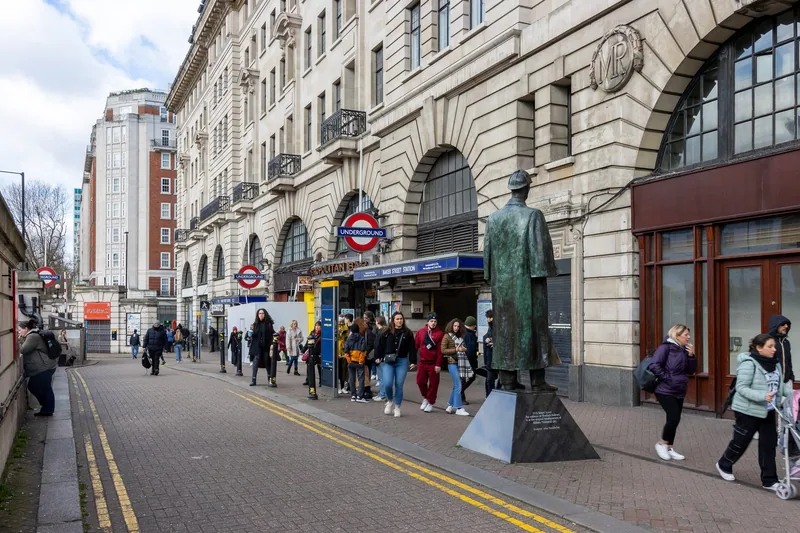
| Sherlock Holmes | Marylebone Road, outside Baker Street station | None | Only with Baker Street |
| Film characters | Leicester Square | None, installed from 2020 | Yes with children |
Paddington Bear: who owns him, and why he moves
Michael Bond created the bear, the first book appeared in 1958, and Bond himself unveiled the statue at the station in 2000. Network Rail's own account adds the detail that changes how you look for it: the statue is owned by the Paddington Bear shop in The Lawn, not by the railway, and Network Rail says that shop is the only one in the world devoted entirely to the character.
It has moved. When the Elizabeth line opened in 2022 the bear's spot under the clock arch became a designated evacuation route, so the statue was shifted to the far side of the station, next to a cafe in a smoking area, which caused a public row. In October 2022 Network Rail moved it back to a position beside the clock on Platform 1, and said at the time that it was working on a permanent position nearer the main concourse.
Ask at the shop, not at the barrier. Because the bear belongs to the Paddington Bear shop in The Lawn and has been relocated twice since 2022, the shop staff always know where he currently stands. Expect a queue of families in the middle of the day; the statue is quiet before about 09:00 and after 19:00.
One caution on the reading you will do around this. Network Rail's own press office has described Paddington station as a World Heritage Site. It is not one. It is a magnificent listed Victorian station, which is a different thing.
Photograph by Mike Peel (www.mikepeel.net) · CC BY-SA 4.0 · Wikimedia Commons · resized
Sherlock Holmes, paid for by a building society
The bronze Holmes stands on the pavement of Marylebone Road right outside the Baker Street station exit, in a deerstalker and a long coat. It is the work of the sculptor John Doubleday and went up in 1999. We could not open the public art catalogue record for it on the day we checked, so treat any account of who paid for it with caution: the statue itself carries no interpretation panel worth reading, which is true of most London sculpture put up in the last thirty years.
Practically: it is a thirty-second stop, it is at street level on a busy pavement, and the light is best in the morning because the figure faces roughly south. The Sherlock Holmes Museum is a few minutes north up Baker Street and is a separate, paid attraction.
Peter Pan: the only one at Grade II*
Sir George Frampton's bronze of 1912 beside the Long Water in Kensington Gardens is the highest-protected statue of a fictional character in London, listed at Grade II* since January 1970. Historic England's description is deadpan: a sculptured group, bronze figure of the hero of Sir James Barrie's play surrounded by fairies, birds and animals, stone base.
The full story of how it got there, what happened the night it was installed and which parts of it children have rubbed smooth is on our page about the sculptures of Kensington Gardens. It is free, it is outdoors, and it is ten minutes' walk from the Italian Gardens.
A cat on Highgate Hill, added 143 years late
The Whittington Stone on the south-west side of Highgate Hill, about fifteen metres south of the junction with Magdala Avenue, is a Portland stone slab erected in 1821 and restored in 1935, listed at Grade II in 1972. The cat on top of it is much newer: a sculpture by Jonathan Kenworthy in polished black Kellymount limestone, added in 1964.
The list entry is one of the few that tells a folk tale straight. It records that the memorial marks the legendary spot where "Dick Whittington", the folkloric alter ego of the real Sir Richard Whittington, turned back after a failed attempt to make his fortune in the City because he heard the bells of St Mary-le-Bow ring out "Turn again Whittington, thrice Lord Mayor of London". The inscription on the north-east face gives the real man's career, including his three terms as Lord Mayor; the inscription on the other face is almost completely worn away.
So the statue is a cat that belongs to a story, standing on a monument to a man who was real. The bells in the story are covered on our page about St Mary-le-Bow, four miles away in the City, which is the other half of the joke: the distance is the point of the legend.
The fairy characters nobody counts
Also in Kensington Gardens, and also listed, is the Elfin Oak: a hollow oak stump carved between 1928 and 1930 by Ivor Innes and covered with elves, fairies and animals, listed at Grade II in 1997. Historic England names some of the residents from the carving itself: Wookey the witch, Huckleberry the gnome, Grumples and Groodle.
Strictly, that makes the Elfin Oak the largest collection of listed fictional characters in London, all on one tree, in a cage beside a playground. The listing covers the sculpture, not the railings or the shelter around it.
Leicester Square, in one paragraph
The Scenes in the Square trail put bronzes of film and television characters around Leicester Square from 2020 onwards, and it is the most child-friendly hour of the six places on this page. None of them is listed, because they are far too recent. The full list, the audio tour and where each figure hides is on our Leicester Square page linked above, and the Potter-specific figure appears in our guide to Harry Potter locations in London.
What is not here: there is no Beatles statue in London
This one is worth stating flatly, because visitors arrive expecting it. The four-figure bronze of the Beatles stands at the Pier Head in Liverpool, not in London. London's Beatles landmark is a zebra crossing, and the practicalities of photographing it without being run over are on our page about the Abbey Road crossing. Do not plan a London day around a Beatles statue.
Three of them in one afternoon
The three in the west of London link up neatly, and the whole route is free apart from the fares.
- Paddington station. Find the bear near the clock on Platform 1; ten minutes, including the wait for the photograph.
- Baker Street. Two stops on the Circle or Hammersmith and City line, or twenty minutes on foot through the back streets. Holmes is outside the station exit on Marylebone Road. Five minutes.
- Kensington Gardens. Back on the Tube to Lancaster Gate or Queensway, then into the park for the Elfin Oak and Peter Pan, about fifteen minutes apart on foot.
Two hours with the travel, three if the children want the playground as well. Our family guide has the rest of the day, and the whole route belongs in our list of free things to do in London. Highgate is a separate trip: pair the cat with Highgate Cemetery, which is five minutes up the hill and is not free.
Frequently asked questions
Where is the Paddington Bear statue in Paddington station?
Beside the clock on Platform 1, where Network Rail placed it in October 2022 after a temporary move. Because the statue is privately owned by the Paddington Bear shop in The Lawn and a more prominent permanent position was still being sought, ask in the shop if it is not where you expect.
Who made the Sherlock Holmes statue outside Baker Street station?
The sculptor John Doubleday, and it was put up in 1999. It stands on the pavement of Marylebone Road at the station exit, it is free, and it takes about thirty seconds to see. It is not a listed structure, so it has no statutory description.
Which London statues of fictional characters are listed buildings?
Peter Pan in Kensington Gardens at Grade II*, the Elfin Oak in the same park at Grade II, and the cat on the Whittington Stone at Highgate Hill, which is covered by the Grade II listing of the stone. The Paddington Bear and Sherlock Holmes statues and the Leicester Square film characters are not listed.
Is there a Beatles statue in London?
No. The well-known bronze of the four Beatles is at the Pier Head in Liverpool. London's Beatles pilgrimage site is the zebra crossing outside Abbey Road Studios in St John's Wood, which is a road in use and needs care rather than a queue.
Can you see all of London's fictional statues in one day?
The three in the west, at Paddington, Baker Street and Kensington Gardens, fit into an easy afternoon of about two hours plus travel. Leicester Square adds an hour. Highgate is far enough north to want its own half-day, and is best combined with the cemetery.
Sources
- Historic England - Peter Pan Statue (west of Serpentine), list entry 1217595, Grade II* (Internet Archive copy, 21 April 2025) (checked September 2026)
- Historic England - Whittington Stone, Highgate Hill, list entry 1298038, Grade II (Internet Archive copy, 7 May 2023) (checked September 2026)
- Historic England - Elfin Oak, Kensington Gardens, list entry 1376784, Grade II (Internet Archive copy, 31 December 2025) (checked September 2026)
- Network Rail - Paddington Bear returns to Platform 1, 10 October 2022 (checked September 2026)
- Network Rail - Paddington station celebrated as Paddington Bear hits the big screen (statue unveiled by Michael Bond in 2000) (checked September 2026)
- Historic England - National Heritage List for England open data (searched around Paddington station and Baker Street: no listed statues) (checked September 2026)