
Three of the sculptures in Kensington Gardens are protected in their own right: the Peter Pan statue of 1912 at Grade II*, the Elfin Oak at Grade II, and Watts's Physical Energy at Grade II. All three are free, all three are within about fifteen minutes' walk of each other, and when we checked in September 2026 the Royal Parks were giving the pedestrian gates as 6am to 7pm.
The statue everyone comes for also comes with a story that is usually told wrongly. Peter Pan did not arrive in the park overnight in defiance of the authorities. The files behind it, quoted by the Royal Parks from the National Archives, show a two-year argument about whether a children's book character deserved a place in a Royal Park at all, including objections raised in Parliament, and a formal unveiling on 30 April 1912.
Our guide to Hyde Park and Kensington Gardens covers the two parks as a day out, the lake, the flower walks and the cafes. This page is only about the sculpture, and about what the paperwork says.
The sculptures at a glance
- Cost
- Free. Nothing here is ticketed or fenced except the Elfin Oak
- Gates
- Pedestrian gates 6am to 7pm (Royal Parks, September 2026); closing changes with the season
- Nearest stations
- Lancaster Gate and Queensway for Peter Pan and the Elfin Oak; High Street Kensington for the palace end
- Walking time
- Peter Pan to the Elfin Oak, about fifteen minutes; the full circuit below, an hour
- Best time
- Before 10am, when the Peter Pan path is empty
What the file actually says about Peter Pan
Barrie paid for the statue himself and gave it to the park. He chose the spot deliberately: the west bank of the Long Water is where Peter lands his bird-nest boat in The Little White Bird, the 1902 novel in which the character first appears. Barrie was living at 100 Bayswater Road, across the road from the gates.
The park's own officials were against it before it existed, and for a practical reason. A memo of 1911 in the National Archives file argues that children would climb all over the base, and proposes surrounding the statue with water to stop them: "If there is any access to the statue, I cannot imagine any child who did not take advantage of the very attractive opportunities provided for climbing about on the base". Barrie and his sculptor, Sir George Frampton, refused, offering to convert it into a fountain later if anyone insisted.
Then in 1912 the objection moved to Parliament, where a member asked the Commissioner of Works whether he was now prepared to accept offers from other authors, actor-managers or business firms wanting statues to advertise themselves. The statue went up anyway and was unveiled on 30 April 1912. Historic England listed it at Grade II* in January 1970, describing it in a single sentence: a bronze figure of the hero of Sir James Barrie's play, surrounded by fairies, birds and animals, on a stone base.
The officials lost the argument and were right about the children. Within months of the unveiling Frampton wrote to the park asking them to take away the mud round the base and lay a crazy pavement with rock plants, because he had watched "quite a number of his little friends slip down on the mud in trying to go up to embrace their favourite animals". The paving you stand on is the result of that letter.
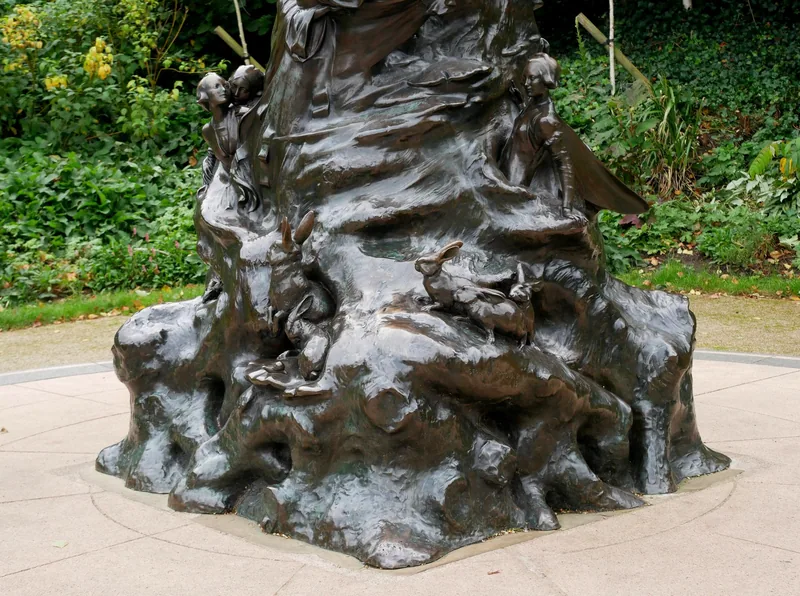
Photo: Ethan Doyle White · CC BY-SA 4.0 · Wikimedia Commons · resized
Which animal to look at, and why it shines
The base is not decoration; it is the part the statue was made for. A park representative, quoted in an undated press cutting in the same archive file, described the rabbit as "the most-loved animal in London" and set out the order children visit in: the rabbit first, arms round it, then a solemn circuit of the other pets, with the mice second favourite and the squirrel on the far side a great favourite. The fairies, the same account notes drily, get much less attention.
That is still true, and it is why the rabbit's back and ears are polished bright while the fairies are dark. On a fine day in the 1930s, so many people came that queues had to be formed along the main path so that the statue could be viewed in an orderly manner.
Two footnotes from the file that are worth knowing. In 1921 a corps of Swedish ballet dancers were photographed hanging off the statue and legal action was seriously discussed, then dropped because nobody had taken their names. And a photograph of children round the statue in 1943 was used to promote the wartime "Holidays at Home" campaign, which asked people to holiday locally to save railway capacity.
Frampton turned down requests from people who wanted to manufacture and sell small replicas, but he cast full reproductions himself, and several stand in other cities: St John's in Newfoundland and Queen's Gardens in Perth, Western Australia, among them. The Royal Parks also advertise the statue as part of Talking Statues, where swiping a phone on the nearby plaque gets you a recorded call from Peter Pan; it was still listed on their site in September 2026.
The Elfin Oak: the most listed characters on one tree
Ten minutes north-west, beside the Diana, Princess of Wales Memorial Playground, stands a hollow oak stump carved between 1928 and 1930 by Ivor Innes and listed at Grade II in December 1997. Historic England's description is unusually generous with names, because they come off the carving itself: Wookey the witch, Huckleberry the gnome, Grumples and Groodle, among many more.
Two details from the listing change how you look at it. Most of the figures are carved from the oak, but some are believed to be plaster, and all of them are painted and repainted. And the list entry explicitly ties it to the statue down the hill, calling the Elfin Oak a rare three-dimensional record of the pre-war fascination with fairies that culminated in Barrie's Peter Pan, which it complements. It also describes the oak as an example of George Lansbury's inter-war programme of improvements to London's public amenities.
The protective railings and shelter around it are specifically excluded from the listing, which is the polite way of saying they are a cage. You look through them. The playground next door has a rule about adults that catches people out, so read that page before you walk up with a camera and no child.
Physical Energy: a horse with a sibling in Cape Town
On Lancaster Walk, in the open, stands a bronze of a naked rider on a very large horse, shading his eyes and looking at the horizon. It is by George Frederic Watts, it dates from 1907, and it is listed at Grade II.
Historic England records what most visitors do not realise: this cast is a replica of the central feature of the Cecil Rhodes memorial on the slopes of Table Mountain in Cape Town. The Royal Parks add that this cast was put up in 1907 by Watts's widow and friends as a memorial to Watts himself, who had lived in Kensington for years; that a third cast was made in 1959 and is now in Harare; and that a fourth was commissioned in 2017 by the Watts Gallery for Compton in Surrey, where Watts had his country house.
Watts described the subject himself, and his own words are the best label for it: "a symbol of that restless physical impulse to seek the still unachieved in the domain of material things". It is an allegory, not a portrait, which is why the rider has no clothes and no name.
The Henry Moore that was taken apart for sixteen years
On the north bank of the Long Water stands The Arch, presented to the nation by Henry Moore in 1980, two years after his eightieth-birthday exhibition at the Serpentine Gallery at the other end of the water. It is built of seven Roman travertine stones from a quarry in northern Italy, weighing 37 tonnes in total.
It was taken down in 1996 because it had become structurally unstable, and it was restored on its original site by the Royal Parks and the Henry Moore Foundation. Anyone who visited the park between 1996 and the restoration will remember an empty patch of grass.
One caution on the size. The Royal Parks describe it in one place on their own website as "a six-foot sculpture" and in the next paragraph as "six-metre high". Thirty-seven tonnes of stone is not six feet tall, so treat the metric figure as the real one, but we are quoting both because the official source gives both.
Four more on the same walk
| What | Date | The detail worth knowing |
|---|---|---|
| Queen Anne's Alcove, by Lancaster Gate | 1705 | By Sir Christopher Wren, for the palace's south garden. Moved here in 1867 at the expense of a London builder because it was thought unsightly and "a resort for undesirable persons". Later a gardeners' store |
| Queen Caroline's Temple, east of Lancaster Walk | 1734-5 | Attributed to William Kent. Some of the graffiti inside dates from 1821, the year the park first opened every day |
| Two Bears fountain | 1939 | Given by the Metropolitan Drinking Fountain Association. The original bears were stolen in 1967 and replaced by a copy in 1970; someone tried again in 2019 and did not get far |
| Speke Monument, Lancaster Walk | 1866 | Red granite, by Philip Hardwick, who designed the original Euston station. Paid for by public subscription |
Two more are at the palace end: a marble Queen Victoria of 1893 designed by her daughter Princess Louise, showing the Queen in her coronation robes at eighteen, and a bronze King William III of 1907 given to Edward VII by Kaiser Wilhelm II, on a pedestal by Sir Aston Webb. Both are outside Kensington Palace.
An hour that takes in all of it
- Lancaster Gate to Queen Anne's Alcove, two minutes from the station.
- South-west along the water to the Peter Pan statue, about eight minutes. Go before 10am.
- Cross to the north bank for The Arch, then south for Queen Caroline's Temple.
- West across the park for Physical Energy on Lancaster Walk and the Speke Monument nearby.
- North-west to the Elfin Oak and the playground, then out at Black Lion Gate for Queensway.
An hour at a stroll, all flat, all on surfaced paths. The Albert Memorial and the Royal Albert Hall are at the southern edge if you want to carry on, and the whole route belongs in our list of free things to do in London. London's other fictional residents in bronze are gathered on our page about Paddington Bear and London's fictional statues.
Check the date before a park day in October. The Royal Parks Half Marathon was set for Sunday 11 October 2026, with road and cycle route closures agreed with Westminster City Council and Transport for London across these parks. Our page on London's running events has the pattern, and the running routes page has the loop these paths make.
Frequently asked questions
Did the Peter Pan statue really appear overnight without permission?
No. The Royal Parks, quoting the National Archives file on the statue, describe a process running from 1911: park officials arguing for a moat to keep children off, Barrie and Frampton refusing, and objections raised in Parliament in 1912. The statue was unveiled on 30 April 1912. Barrie paid for it and gave it to the park.
Where exactly is the Peter Pan statue?
On the west bank of the Long Water in Kensington Gardens, which is the spot where Peter lands his bird-nest boat in The Little White Bird. From Lancaster Gate station it is about eight minutes on foot. It is free and there is no fence.
What is the Elfin Oak and can you touch it?
A hollow oak stump carved with elves, fairies and animals by Ivor Innes between 1928 and 1930, listed at Grade II. It stands inside protective railings beside the Diana Memorial Playground, so you look at it rather than touch it. The railings and shelter are deliberately excluded from the listing.
Which Kensington Gardens sculptures are listed?
Peter Pan at Grade II*, the Elfin Oak at Grade II, and Physical Energy at Grade II, plus the Albert Memorial, which is Grade I and has its own page. The Arch by Henry Moore, the Two Bears fountain and the Speke Monument are part of the park's collection rather than separately listed points in Historic England's data.
How long does it take to see all the sculptures?
About an hour at a walking pace for the circuit described above, or twenty minutes if you only want Peter Pan and the Elfin Oak. Add half an hour if children stop at the animals on the base, which they will.
Sources
- The Royal Parks - Shrine of Youth: the Peter Pan Statue, Kensington Gardens (quoting National Archives WORK 20/120) (checked September 2026)
- The Royal Parks - Monuments in Kensington Gardens (checked September 2026)
- The Royal Parks - Kensington Gardens (gate times and park notices) (checked September 2026)
- Historic England - Peter Pan Statue (west of Serpentine), list entry 1217595, Grade II* (Internet Archive copy, 21 April 2025) (checked September 2026)
- Historic England - Elfin Oak, list entry 1376784, Grade II (Internet Archive copy, 31 December 2025) (checked September 2026)
- Historic England - Physical Energy Equestrian Statue (Lancaster Walk), list entry 1216829, Grade II (Internet Archive copy, 2 January 2026) (checked September 2026)