
The plinth in the north-west corner of Trafalgar Square has held a new sculpture every two years since 1999. Since 10 September 2026 it has carried Lady in Blue by Tschabalala Self, the sixteenth commission in the Mayor of London's programme. It is free, it is outdoors, and it stays up until 2028, when a translucent pale-green horse and rider take over. Unveilings land in the second half of September, which is worth knowing if you are planning a September trip.
The reason the plinth was ever free is a piece of Victorian accounting. It was built to hold a bronze equestrian statue of King William IV by Sir Charles Barry, and the statue was never installed, so the fourth corner of the square stood empty for more than 150 years while the other three carried their generals and their king.
Our guide to Trafalgar Square covers the square itself, Nelson's Column, the fountains and the practicalities. This page is about the plinth: how a work gets up there, what has been up there, what is up there now, and what you can still go and see of the ones that have come down.
The Fourth Plinth at a glance
- On it now
- Lady in Blue by Tschabalala Self, unveiled 10 September 2026
- Next
- Untitled by Andra Ursuţa, from 2028
- Cost
- Free. Open air, visible at any hour, no ticket
- Where
- North-west corner of Trafalgar Square, nearest the National Gallery's Sainsbury Wing
- Changes
- A new work roughly every two years
- Audio guide
- A free digital guide to the plinth is on the Bloomberg Connects app
How the empty corner became a commission
The Greater London Authority tells the story plainly. In 1994 Prue Leith, then chair of the Royal Society of Arts, wrote a letter to the Evening Standard arguing that something should be done about the empty plinth. That started a public argument. Five years later the plinth held its first artwork, Mark Wallinger's Ecce Homo, a life-size figure of Christ that looked almost lost on a pedestal built for a king on a horse.
The Mayor of London took the programme over, and the first Mayoral commission was Marc Quinn's Alison Lapper Pregnant in 2005, a 3.6-metre, 13-tonne figure in Carrara marble of an artist born with phocomelia. An inflatable version of it later appeared in the opening ceremony of the London 2012 Paralympic Games.
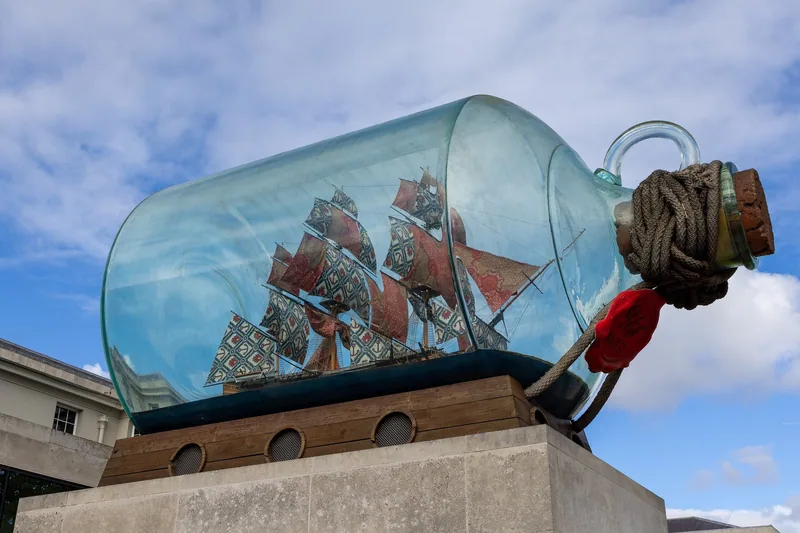
Photo: The wub · CC BY-SA 4.0 · Wikimedia Commons · resized
Who decides, and whether you get a say
The choice is made by the Fourth Plinth Commissioning Group, which the GLA describes as an independent panel of artists, journalists and curators, chaired by Ekow Eshun. The Mayor approves the winner on the group's recommendation.
The public part is real but limited. For the 2026 and 2028 commissions the group worked from a shortlist of seven international artists, from the United States, Argentina, Romania and the United Kingdom, and put the shortlist to a public vote that drew more than 10,000 responses. The vote informs the decision; it does not make it. Shortlist models have been shown at the National Gallery on the north side of the square in past rounds, which is the one time you can see the losing entries.
The free audio guide is better than the plaque. There is no interpretation panel at the plinth worth reading. The Mayor's culture team publishes a digital guide to the current work and every past commission on Bloomberg Connects, a free arts and culture app, and it is the only decent explanation available on the square itself. Our round-up of the apps worth having in London covers the rest.
What is up there now: Lady in Blue
Tschabalala Self's sculpture is bronze, like the three Victorian statues on the other corners, but patinated in the blue of lapis lazuli, a pigment used since antiquity in North Africa, the Middle East and Europe and by painters including Titian and Vermeer. Several of those painters hang eighty metres away in the National Gallery, which is not an accident.
The GLA describes the subject as a young, metropolitan woman of colour and "a contemporary everywoman": a walking figure of the ordinary rather than a monument to one person. Self was born in New York in 1990 and works there, and is better known for paintings that combine paint, fabric and cut-up pieces of her earlier work.
Practical note: the blue reads very differently in flat cloud and in low sun, and it is at its strongest from the south side of the square looking north-west in the late afternoon. Two free galleries are on the same square, so an hour here costs nothing: the National Gallery on the north side and the National Portrait Gallery behind it, both of which appear in our list of free things to do in London.
What is coming in 2028: a horse you can see through
Andra Ursuţa's Untitled will be a shrouded equestrian statue in translucent, pale green. Horse and rider stay anonymous under the folds of the shroud. The artist's own account, published by the GLA, is that the work is either a monument not yet unveiled or one already cancelled, and that the green is deliberately the colour of slime and uranium glass: an unnatural shade that carries its own light.
The clever part is what it does to the plinth. Because the sculpture is literally transparent, the plinth will be occupied and empty at the same time, which is a joke at the expense of the square's other three corners and of the whole idea of putting a man on a horse. Ursuţa was born in Salonta, Romania, in 1979 and lives in London and New York. In clear weather the piece will look more transparent; under cloud it will glow more.
Every commission, in order
One caution about the numbering. The Mayor's own past-commissions page itemises ten works up to 2018, but describes the 2018 piece as the twelfth to appear on the plinth since the programme began, so two of the earliest are not listed individually. The table below gives what the GLA publishes.
| Year | Artist | Work, and what it was |
|---|---|---|
| 1999 | Mark Wallinger | Ecce Homo, the first artwork on the plinth |
| 2005 | Marc Quinn | Alison Lapper Pregnant, 3.6 m and 13 tonnes of Carrara marble |
| 2007 | Thomas Schütte | Model for a Hotel, a 21-storey building in red, yellow and blue Perspex |
| 2009 | Antony Gormley | One & Other: 2,400 members of the public, one an hour for 100 days |
| 2010 | Yinka Shonibare | Nelson's Ship in a Bottle, a 1:30 HMS Victory with 37 sails of African textiles |
| 2012 | Elmgreen & Dragset | Powerless Structures, Fig. 101, a gold boy on a rocking horse |
| 2013 | Katharina Fritsch | Hahn/Cock, a blue cockerel almost 5 m tall |
| 2015 | Hans Haacke | Gift Horse, a bronze horse skeleton with a live Stock Exchange ticker on its leg |
| 2016 | David Shrigley | Really Good, the 10-metre bronze thumb |
| 2018 | Michael Rakowitz | The Invisible Enemy Should Not Exist, a Lamassu of 10,500 date syrup cans |
| 2020 | Heather Phillipson | THE END: cream, a cherry, a drone and a fly |
| 2022 | Samson Kambalu | Antelope, unveiled 28 September 2022, restaging a 1914 photograph |
| 2024 | Teresa Margolles | The 15th commission, unveiled 18 September 2024: 726 plaster face casts |
| 2026 | Tschabalala Self | Lady in Blue, unveiled 10 September 2026. The 16th commission |
| 2028 | Andra Ursuţa | Untitled, a translucent shrouded horse and rider |
The 2024 work has two published titles. When it was announced the GLA called it Improntas (Imprints); by the time it was on the plinth the same website called it Mil Veces un Instante (A thousand times an Instant). Both are the Mayor's own wording for the same sculpture, so if you are looking it up, search for either.
Three of them you can still go and see
Most Fourth Plinth works go somewhere afterwards, and the GLA names three destinations. Shonibare's Nelson's Ship in a Bottle has a permanent home at the National Maritime Museum in Greenwich, where it is free to see. Powerless Structures, Fig. 101 was bought by the Arken Museum of Modern Art in Denmark. Hahn/Cock went on long-term loan to the National Gallery of Art in Washington from the Glenstone Museum in Maryland.
That makes the Greenwich one a genuine day out on the back of a sculpture that stood here in 2010. The others are a reason to look up before you assume a work has been scrapped.
Two things that use the plinth without being on it
The Fourth Plinth Schools Awards run every year, inviting London primary and secondary pupils to design a work for the plinth, with an exhibition of the entries. If you are in London with children who have noticed the sculpture, that is the context: see our family guide for the rest of the square with children.
And the plinth is the reason Trafalgar Square is worth revisiting. Everything else on it has stood still for a century and a half: the lions, Nelson, the three other plinths, and the Victorian memorials down on the Embankment. One corner changes. If you saw the square two years ago, one fourteenth of it is new. Another misnamed London landmark five minutes' walk away is the figure on the fountain at Piccadilly Circus, which is not Eros either.
Frequently asked questions
What is on the Fourth Plinth now?
Lady in Blue by Tschabalala Self, unveiled on 10 September 2026 and the sixteenth commission in the Mayor of London's programme. It is a bronze figure of a young metropolitan woman, patinated with the blue of lapis lazuli, and it stays until the 2028 commission replaces it.
Why is the Fourth Plinth empty in the first place?
It was built to carry a bronze equestrian statue of King William IV designed by Sir Charles Barry, and the statue was never installed. The corner stayed empty until 1999, when the first commissioned artwork went up.
How much does it cost to see the Fourth Plinth?
Nothing. It stands in a public square, in the open air, and is visible at any hour of the day or night. The free digital guide on the Bloomberg Connects app is the only thing you need to download, and there is nothing to book.
How is the next Fourth Plinth artwork chosen?
By the Fourth Plinth Commissioning Group, an independent panel of artists, journalists and curators chaired by Ekow Eshun, with the Mayor approving its recommendation. A shortlist is put to a public vote: the shortlist for 2026 and 2028 had seven artists and drew more than 10,000 votes.
What happens to the sculptures when they come down?
Several find permanent homes. Yinka Shonibare's Nelson's Ship in a Bottle is at the National Maritime Museum in Greenwich, Elmgreen & Dragset's rocking-horse boy is at the Arken Museum of Modern Art in Denmark, and Katharina Fritsch's blue cockerel is on long-term loan to the National Gallery of Art in Washington.
Sources
- Mayor of London - Fourth Plinth in Trafalgar Square (commissioning group and programme; Internet Archive copy, 1 February 2026) (checked September 2026)
- Mayor of London - Fourth Plinth: past commissions (Internet Archive copy, 25 February 2026) (checked September 2026)
- Mayor of London - Fourth Plinth winners for 2026 and 2028 (Internet Archive copy, 30 May 2024) (checked September 2026)
- Mayor of London - What's on the Fourth Plinth now (Internet Archive copy, 1 January 2026) (checked September 2026)