
Serpentine runs two small free galleries in Kensington Gardens, a five-minute walk apart on either side of the Serpentine Bridge, plus the most famous architectural commission in Britain: a temporary pavilion built every summer by an architect who has never built anything in England before. All of it is free, and you can see the lot in ninety minutes.
The names changed a few years ago and older maps have not caught up. The older tea pavilion south of the bridge is now Serpentine South. The converted gunpowder store north of it, with its curved Zaha Hadid extension, is Serpentine North. Both belong to the same organisation, which now calls itself simply Serpentine.
Entry costs nothing and the galleries advise booking a free ticket rather than requiring it. The real planning problem is different, and it catches people out: these are two small buildings with no permanent collection, and between exhibitions they close completely for installation.
Serpentine at a glance
- Serpentine South
- Kensington Gardens, London W2 3XA
- Serpentine North
- West Carriage Drive, London W2 2AR
- Price
- Free, including the Pavilion; booking advised, not required
- Pavilion 2026
- a serpentine by LANZA atelier, 6 June to 25 October 2026
- Pavilion hours
- Monday to Friday 10am to 6pm; Saturday and Sunday 10am to 7pm
- Nearest station
- Lancaster Gate, about 875 metres
Check before you come, or you will find the doors shut
This is the single most useful thing to know about Serpentine. Each gallery shows three or four exhibitions a year, and between them the building closes for a week or two while the next one is installed. In September 2026, both were shut at once: Serpentine North reopened on 23 September and Serpentine South not until 8 October.
Nothing on the ground tells you this. The buildings sit in a public park, so you walk up to them past people having picnics and find a locked door. The announcements are posted on the visit page of the Serpentine website, and reading it takes ten seconds.
Two things stay open during a closure, and they are worth knowing about. The Koenig Bookshop at Serpentine South trades Tuesday to Sunday regardless, and the restaurant at Serpentine North, in the old Magazine building, keeps serving. If your visit falls in a changeover week, that is what is left.
Two small galleries with no collection means two chances to find nothing on. Look at the Serpentine visit page the day before, not the week before. Unlike a national museum, there is no permanent display to fall back on if the temporary one has come down.
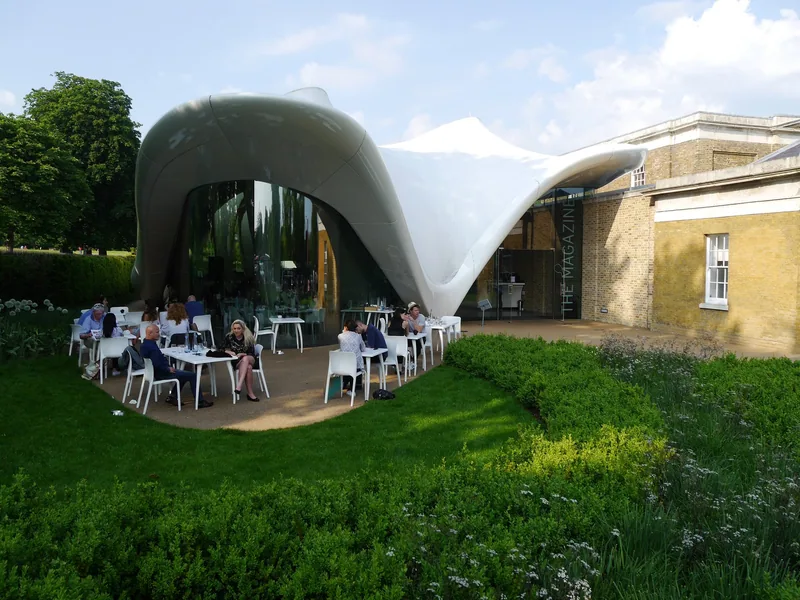
Photo: Edwardx · CC BY-SA 4.0 · Wikimedia Commons · resized
The Pavilion, and why architects care about it
Every summer Serpentine invites an internationally established architect to design a temporary structure on the lawn beside Serpentine South, on one condition: it must be their first completed building in England. The result goes up in June, stands through the summer and comes down in late October, and it is free to walk into.
The 2026 Pavilion is by LANZA atelier, the Mexico City practice founded by Isabel Abascal and Alessandro Arienzo, and is called a serpentine. Its north wall curves around the canopy of a nearby tree, and a translucent roof resting on brick columns lets light and air through, so that the boundary between inside and outside is deliberately soft. It runs from 6 June to 25 October 2026.
Recent commissions give a sense of the range: Marina Tabassum's A Capsule in Time in 2025, Minsuk Cho's Archipelagic Void in 2024, Lina Ghotmeh's À table in 2023 and Theaster Gates's Black Chapel in 2022. If you have an interest in architecture, this is the reason to time a London trip for the summer; our guide to the Open House Festival in September covers the other big architectural weekend of the year.
The Pavilion opens 10am to 6pm on weekdays and 10am to 7pm at weekends, though individual days are cut short for private events, and those exceptions are listed on its page. It is also the venue for Park Nights, a series of evening performances and interventions held on selected dates between July and October; tickets are £10, or £7 concession, which is the only thing Serpentine charges for.
What is on in the galleries
The autumn and winter programme for 2026 is worth planning around, because both shows run into the new year.
| Exhibition | Where | Dates | Price |
|---|---|---|---|
| Amar Kanwar | Serpentine North | 23 September 2026 to 31 January 2027 | Free |
| Justin Caguiat: Change Ringing | Serpentine South | 8 October 2026 to 10 January 2027 | Free |
| Serpentine Pavilion 2026 | Beside Serpentine South | 6 June to 25 October 2026 | Free |
| Jesús Rafael Soto: Pénétrable BBL Jaune | Kensington Gardens | 16 June to 25 October 2026 | Free |
The Kanwar show deserves a warning about time. It is built from films and installations, and the gallery states that the total running time is about three hours. You are welcome to watch everything or to move through at your own pace, but a visitor who allows twenty minutes will see fragments of things rather than any complete work. Decide in advance which you are doing.
The Soto sculpture is the easiest thing here to enjoy and needs no explanation at all. It is a ten-metre hanging block of four thousand yellow PVC tubes suspended from a steel frame, and you walk straight through it. From a distance the strands shimmer; from inside you are in a yellow forest. Children love it and it is outdoors in the park, so it does not depend on the galleries being open.
The walk between the two buildings
Serpentine South sits on the Kensington Gardens side of the water; Serpentine North is across West Carriage Drive, in an early nineteenth-century gunpowder magazine known as The Magazine, with a curving extension by Zaha Hadid Architects. The walk between them takes about five minutes and crosses the Serpentine Bridge, which is the best view in the park.
Do them in the order that suits the weather rather than the map. North has the restaurant and the lavatories; South has the bookshop and the Pavilion. If it is raining, start at North and eat before you move.
What to expect inside, and who it suits
Set your expectations by the size of the buildings. Serpentine South is a handful of interconnecting rooms in a 1930s park pavilion; Serpentine North is one large space and a couple of smaller ones. A show here is one artist's ideas in a confined space, rather than a survey you can browse, and that is why the label-reading matters more than it does in a big museum.
The work is usually recent, often made for the room, and frequently involves film, sound or installation rather than paintings on walls. Visitors who come expecting a small version of the National Gallery are disappointed; visitors who come curious about what a living artist is doing right now generally are not. Free guided tours of the exhibitions run at times listed on the visit pages, and they make a real difference to a first encounter with unfamiliar work.
Both galleries also offer free self-guided visits for schools, colleges and universities, booked in advance, and take group bookings through a form on the website. Neither is somewhere to bring a large group without arranging it first.
The Pavilion in practice
A few things about the Pavilion that the architectural press never mentions. It is open-sided, so it is not shelter in heavy rain, although the roof will keep a shower off. It has seating, and on a warm weekday it is one of the pleasantest free places to sit in central London with a book. It is also, inevitably, full of people photographing it at weekends; a weekday morning is when you can actually look at the thing.
Nothing is sold inside it. If you want coffee, get it at Serpentine North before you walk over, or bring it from one of the park kiosks. And if you are visiting in late October, check the closing date: the structure comes down promptly, and the lawn is bare within days.
Getting there, and why the walk is longer than it looks
Nothing is close. The galleries are in the middle of a royal park, and every station involves a walk of at least ten minutes across grass and gravel.
| From | Line | Distance |
|---|---|---|
| Lancaster Gate | Central | About 875 metres |
| Knightsbridge | Piccadilly | About 1.2 km |
| Hyde Park Corner | Piccadilly | About 1.5 km |
| Paddington | Rail and Elizabeth line | About 1.5 km |
Buses 94, 148, 274 and 390 stop near the park edges. Cycling is the sensible option: there are docking stations directly opposite both galleries, and more at Seville Street by Knightsbridge, South Carriage Drive by Hyde Park Corner and on Bayswater Road by Lancaster Gate. How the scheme works is set out in our guide to Santander Cycles. Metered parking exists inside Kensington Gardens and Hyde Park, but the galleries ask visitors to walk or use public transport.
Both buildings have full disability access and facilities. Serpentine publishes a free digital guide to its exhibitions on the Bloomberg Connects app, worth downloading before you set off because the signal in the park is patchy.
Everything here is free except one thing. The galleries, the Pavilion, the outdoor sculpture, the tours and the digital guide cost nothing. Only Park Nights, the evening performance series in the Pavilion, is ticketed, at £10 or £7 concession. It is one of the cheapest days of serious contemporary art in London.
Building a day around it
The galleries are too small to justify a trip on their own, and everybody who enjoys them does so as part of a day in the park. Hyde Park and Kensington Gardens between them hold the Albert Memorial, the Italian Gardens, the Diana Memorial Playground and several miles of walking. Kensington Palace is at the western end and the Royal Albert Hall just south of the park.
Walk ten minutes further south and you are in South Kensington, where the V&A and its neighbours are free and enormous. For design and architecture specifically, the Design Museum is twenty minutes west along Kensington High Street and has a free permanent collection of its own.
For contemporary art at the other end of the city, the Whitechapel Gallery is the obvious counterpart, with a comparable programme and a very different neighbourhood. The rest of the no-charge options appear on our list of free London museums, and if you are still choosing dates, when to come to London explains why June to October is the Serpentine season.
Frequently asked questions
Are the Serpentine Galleries free?
Yes. Both galleries, the summer Pavilion, the outdoor sculpture commissions and the guided tours are all free of charge. Visitors are advised to book a free ticket but are not required to. The only ticketed events are Park Nights, at £10 or £7 concession.
When is the Serpentine Pavilion open each year?
It usually stands from early June to late October. The 2026 Pavilion, by LANZA atelier, runs from 6 June to 25 October, opening 10am to 6pm on weekdays and 10am to 7pm at weekends. Individual days are occasionally cut short for private events.
What is the difference between Serpentine South and Serpentine North?
They are two separate buildings about five minutes apart on either side of the Serpentine Bridge in Kensington Gardens. South is the original gallery, beside which the Pavilion is built each summer; North is a converted gunpowder store with a Zaha Hadid extension, and it has the restaurant.
Do I need to book the Serpentine Galleries?
No, but the galleries advise booking a free ticket, which takes a moment online. More important is checking whether either building is open at all: between exhibitions they close for installation, sometimes both at the same time.
How long does a visit to the Serpentine take?
Ninety minutes covers both galleries, the Pavilion and the walk between them. A film-based exhibition can take much longer; the Amar Kanwar show running into January 2027 has about three hours of material in it.
Sources
- Serpentine - Plan your free visit (checked September 2026)
- Serpentine - Serpentine Pavilion 2026 by LANZA atelier (checked September 2026)
- Serpentine - Amar Kanwar (checked September 2026)
- Serpentine - Jesús Rafael Soto: Pénétrable BBL Jaune (checked September 2026)
- Serpentine - History of the Pavilion (checked September 2026)