
The London Stone is a worn block of oolitic limestone set behind glass in the front wall of 111 Cannon Street, EC4, on the north side of the street opposite Cannon Street station. It is free, it is visible from the pavement at any hour, and it has been listed at Grade II* since 1972. It takes two minutes to see and eight hundred years to explain.
Almost everything confidently said about it is wrong, and the most authoritative correction comes from the curator who spent years on it: John Clark, Curator Emeritus of the London Museum, who has taken the myths apart one at a time. It is not a Druid altar, it was not a throne for medieval kings, the "ancient saying" about London's fortunes was invented in 1862, and the stone has been moved at least seven times.
Our guide to Roman London and what is still standing places it among the things in the City that look older than they are. This page is the stone itself: what it is made of, where it has been, and which of the stories about it survive contact with evidence.
The London Stone at a glance
- Where
- In the wall of 111 Cannon Street, London EC4, north side, facing the street
- Cost
- Free. Outdoors, on the public pavement, no opening hours
- Listing
- Grade II*, list entry 1286846, listed 5 June 1972
- Material
- Oolitic limestone, in a Portland stone enclosure with a glass front
- Nearest stations
- Cannon Street, directly opposite; Monument and Bank both under five minutes
- How long
- Two minutes. Build it into a City walk, not a trip
What it is made of, and what stood here
The stone is oolitic limestone, a material first brought to London for building and sculpture in the Roman period but also used by Saxon and medieval masons. That is the whole of the physical evidence for its date: the material narrows it to "Roman or later", and nothing narrows it further.
Where it stood is more suggestive. The London Museum's account places its original position in front of the great Roman building usually identified as the provincial governor's palace, which was on the site now occupied by Cannon Street station. One suggestion is that it was a monument in the palace forecourt. The popular idea that it was a Roman milliarium, the central milestone from which distances across the province were measured, has no evidence behind it at all.
There is a second possibility that gets much less attention. The stone also sits at the centre of the grid of streets laid out when King Alfred re-established London in 886, after Viking raids had destroyed the earlier Saxon settlement, so it may have had a function for late Saxon Londoners. Its name belongs to that period: in Old English it was Lundene Stane.
Do not believe the plaque, and do not believe the guidebooks. The bronze plaque on the old 1960s setting said plainly that the stone's origin and purpose are unknown, which is the honest position. Historic England's list entry says "uncertain origin, possibly Roman milestone". Anything more confident than that is somebody's guess dressed up as history.
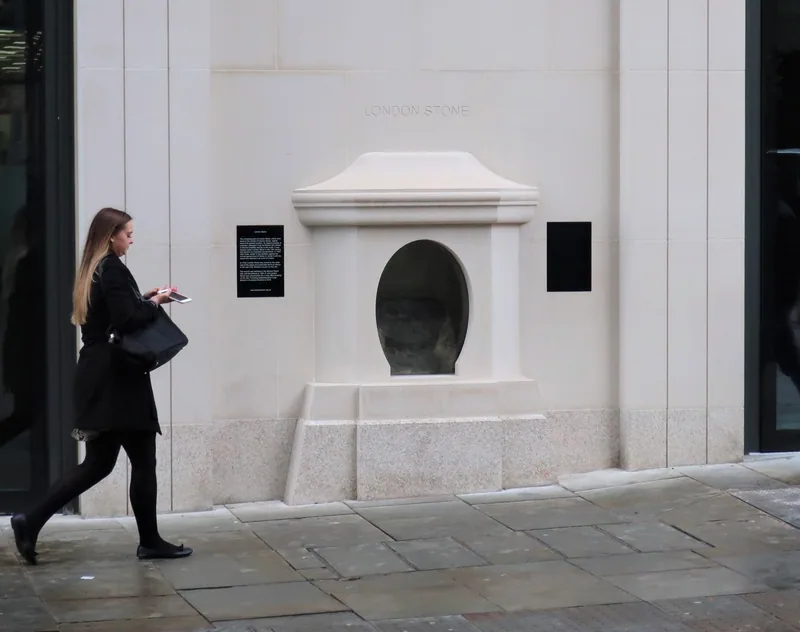
Photo: GrindtXX · CC BY-SA 4.0 · Wikimedia Commons · resized
Seven moves, and one that was not the first
A popular claim is that the stone stood untouched until it was taken away in 2016. It is not close to true. The London Museum's history of the stone reads like a removals log.
| When | Where it went |
|---|---|
| Originally | On the south side of Candlewick Street, now Cannon Street, near the gutter |
| 1666 | Apparently damaged by the Great Fire, which destroyed everything around it |
| By 1720 | What was left protected by a small stone cupola built over it |
| 1742 | Moved because it was a traffic hazard, to the door of Wren's new church of St Swithin |
| 1798 and the 1820s | Two further moves, ending built into the middle of the church's south wall |
| 1960 | The church had been gutted in the Blitz; the stone went to the Guildhall Museum, then in the Royal Exchange, for safekeeping |
| October 1962 | Installed at 111 Cannon Street in a purpose-built grilled and glazed alcove |
| 2016 to 2018 | In the care of the London Museum while the Cannon Street building was rebuilt |
| 2018 | Back at the same address, in a new Portland stone enclosure with a glass front |
That last change matters if you looked for it before 2016 and could not see much. The old setting was an iron grille in a shabby 1960s office block, latterly with a shop in front of it. The current one is a dedicated enclosure with a glazed opening at the front, so the stone is visible rather than merely present.
Jack Cade struck it. Shakespeare invented the rest
The stone enters national history once, in 1450. John or Jack Cade, leading the Kentish rebellion against the government of Henry VI, came into London, struck the London Stone with his sword and claimed to be lord of the city. There is no recorded precedent for the gesture, and the sources cannot even agree on the day: Friday 3 July, when Cade first entered, or the day after.
What almost everyone actually remembers is Shakespeare's version in Henry VI Part 2, where Cade sits on the stone as though it were a throne. That is a stage invention, and it is where the belief that medieval rulers used the stone ceremonially comes from. The London Museum's verdict on this is worth quoting: Shakespeare's inventive genius has a lot to answer for.
The "ancient saying" that dates from 1862
The line most often printed beside photographs of the stone is: "So long as the Stone of Brutus is safe, so long will London flourish." It is presented as an old prophecy. It first appeared in print in 1862, in an article in Notes and Queries, and no earlier writer appears to have known it.
The same article supplied the accompanying legend: that Brutus of Troy, the mythical first king of Britain, brought the base of the statue of Pallas Athena from Troy and set it up as an altar in a temple of Diana in "New Troy", where the ancient kings of Britain swore their oaths. No other writer claimed to know this tradition either. The idea grew out of the late-eighteenth-century romantic habit of linking a city's survival to a talisman, on the model of the palladium that was supposed to protect Troy.
Nobody has ever guarded it
A newer myth holds that the Lord Mayor of London is the stone's custodian or guardian. It is a tidy idea and there is nothing behind it. The London Museum notes that no such belief seems to have existed historically, that the Corporation does not list it among the Lord Mayor's duties, and that until the stone was listed at Grade II* in 1972 neither the Corporation nor the Lord Mayor appears to have taken any responsibility for it at all.
If you want the real ceremonial machinery of the City, it is a five-minute walk away and it is genuinely medieval: see our page on Mansion House and the ceremonies of the City, and the City of London explained for the constitution behind it.
Druids, Blake, ley lines and a cabal of Londonmancers
The occult career of the stone is more recent than it looks and can be traced to individuals. John Strype, editing Stow's Survey of London in 1720, seems to have been the first to suggest that the stone was an object of heathen worship set up by Druids. William Blake then put it into Jerusalem, with Druids groaning aloud on London Stone.
In the late nineteenth century the folklorist George Laurence Gomme called it London's "fetish stone" and made the Lord Mayor the lineal descendant of a village head man, which is where myth six came from. In 1937 Lewis Spence's Legendary London treated the Brutus story as a memory of real events. Writers on geomancy then made the stone a mark stone on several ley lines, and some hold that moving it from its original spot violated the City's sacred geometry.
The modern version is fiction that knows it is fiction. The stone is the beating heart of London, guarded by a cabal of Londonmancers, in China Mieville's novel Kraken, and it appears in Charlie Fletcher's Stoneheart books and Kate Griffin's The Midnight Mayor. None of this is history, and all of it is part of why the stone is protected: as the museum puts it, the case for preserving it rests on the reputation it has acquired as much as on its age.
Two minutes here, and half an hour around it
Do not travel across London for this. Put it into a City walk, where it sits among better things at walking distance.
- Cannon Street station is directly opposite, and the Roman governor's palace was under it.
- The London Mithraeum is about five minutes north-west, free, and needs booking.
- St Stephen Walbrook and Bank junction are both within six or seven minutes north.
- St Mary-le-Bow, whose bells define a Cockney, is eight minutes north-west.
- Guildhall and the Roman amphitheatre are ten minutes north.
All of those except the Guildhall tour are free, which puts this corner of the City among the better entries in our list of free things to do in London. Our guide to the City explains why the streets empty at the weekend, which is the one thing that will spoil a walk built around it.
Frequently asked questions
Where is the London Stone and can you see it for free?
In the front wall of 111 Cannon Street, EC4, on the north side of the street opposite Cannon Street station. It is behind glass in a Portland stone enclosure, on the public pavement, free and visible at any hour. It takes about two minutes to look at.
Is the London Stone Roman?
Possibly, but it is not proven. The material, oolitic limestone, was first brought to London in the Roman period but was also used later. Historic England's list entry says "uncertain origin, possibly Roman milestone", and the London Museum's curator describes the Roman milestone idea as a suggestion with no evidence behind it.
Has the London Stone always been in the same place?
No. It has moved at least seven times: from the south side of the street to a cupola, to the door of Wren's St Swithin's church in 1742, twice more by the 1820s into that church's south wall, to the Guildhall Museum in 1960, to 111 Cannon Street in October 1962, to the London Museum from 2016 to 2018, and back to Cannon Street in 2018.
Is it true that London will fall if the stone is moved?
The saying "So long as the Stone of Brutus is safe, so long will London flourish" first appeared in print in 1862 and no earlier writer seems to have known it. It is a Victorian invention, not an ancient prophecy, and the stone has been moved repeatedly since without incident.
Did kings sit on the London Stone?
No. Jack Cade struck it with his sword in 1450 and claimed to be lord of the city, with no known precedent. The image of someone enthroned on it comes from Shakespeare's Henry VI Part 2 and is dramatic invention.
Sources
- London Museum - London Stone in seven strange myths, by John Clark, Curator Emeritus (checked September 2026)
- Historic England - 'London Stone' with stone surround and iron grille set into base of Number 111, list entry 1286846, Grade II* (Internet Archive copy, 1 January 2026) (checked September 2026)
- London Museum - London Stone, collections object record (checked September 2026)
- City of London Corporation - London Stone (checked September 2026)