
The Albert Memorial stands on Albert Memorial Road in Kensington Gardens, directly opposite the Royal Albert Hall. It is free, it is outdoors, and there is no ticket, no queue and no closing time beyond the park's own gates. Ten minutes in front of it will tell you more about what the Victorians thought they were doing than an afternoon in most museums, provided you know what you are looking at.
Its official name is the Prince Consort National Memorial. Prince Albert, Queen Victoria's husband, died of typhoid fever in 1861 at the age of forty-two; the memorial was designed by George Gilbert Scott and unveiled in 1872. The Royal Parks, which looks after it, describes it as one of the grandest high-Victorian Gothic extravaganzas anywhere, and the form is borrowed from the thirteenth-century Eleanor Crosses - a medieval shrine, blown up to the scale of a public monument and covered in mosaic, gold leaf and semi-precious stone.
Our guide to Hyde Park and Kensington Gardens puts it in the park, and South Kensington explains the museum quarter it was built to celebrate. This page is about reading the monument itself.
The Albert Memorial: practical facts
- Where
- Albert Memorial Road, Kensington Gardens, opposite the Royal Albert Hall
- Cost
- Free
- When
- Whenever Kensington Gardens is open. The Royal Parks gave the pedestrian gate hours as 6am to 7pm in late September 2026; closing follows the light, so it is earlier in midwinter
- Guided access inside
- No tour is listed in the Royal Parks programme as of September 2026
- Nearest stations
- South Kensington (Piccadilly, District, Circle), High Street Kensington (Circle, District) or Knightsbridge (Piccadilly): each a walk of roughly 10 to 15 minutes, our estimate in September 2026
- How long
- Ten minutes to look, half an hour if you read the frieze
- Best light
- Late afternoon: the gilding faces south-east across the road towards the hall
Four tiers, and what each one is for
The memorial is a diagram rather than a statue, and it reads from the ground up. Once you see the scheme you cannot unsee it.
- At the four outer corners, groups in white marble represent the four continents as the Victorians counted them: Europe, Asia, Africa and America. Each is a woman on an animal, with attendants.
- At the corners of the podium, higher up, four more groups stand for manufacture, commerce, agriculture and engineering. These are the industries the memorial is actually proud of.
- In the centre, under the canopy, Albert sits in gilt bronze holding a book. The book is the catalogue of the Great Exhibition of 1851, which he helped organise and which was held a few hundred metres away in Hyde Park.
- Near the top, gilded bronze angels and personified virtues finish the argument.
Continents at the bottom, industry above them, the prince in the middle with a trade catalogue in his hands, and angels at the top. It is a statement about the ordering of the world, made in 1872, and it does not hide what it thinks.
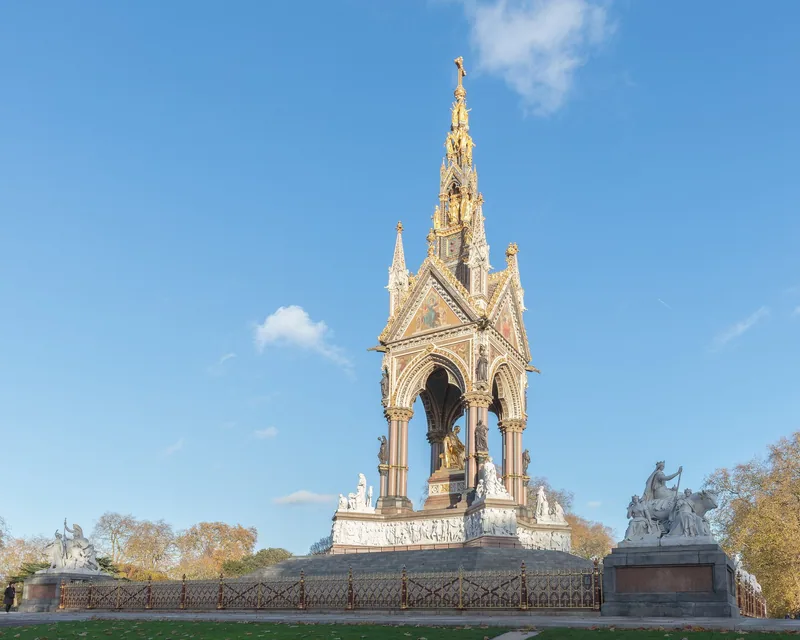
Photo: Diego Delso · CC BY-SA 4.0 · Wikimedia Commons · resized
The Parnassus frieze, and the 187 people in it
The best part is at knee height and almost everybody walks past it. Running right round the base of the podium is the Parnassus frieze, a continuous band of carved figures showing celebrated painters, poets, sculptors, musicians and architects. The Royal Parks gives the count as 187 figures.
It is a Victorian league table of artistic reputation, set in marble, and the interesting thing is who made the cut. Each side of the monument takes a different discipline, so you can walk one face reading composers and the next reading architects. Half an hour spent working round it is the single most rewarding free half-hour in this part of London, and it needs no guide - the names are carved with the heads.
Walk all four sides before you decide you have seen it. Most visitors approach from the Royal Albert Hall, photograph the south face and leave. The frieze changes subject on each side and the continent groups are best from the diagonal corners, so a slow lap takes five extra minutes and doubles what you get.
Can you get inside the railings?
Not on a scheduled tour, on the evidence available. The Royal Parks manages the memorial and publishes its guided walks in one events programme; in September 2026 that programme listed tours of the Hyde Park nursery and a walk with access to the park's pet cemetery, and no tour of the memorial at all. There is no dedicated Albert Memorial tour page on the Royal Parks site.
If you have read elsewhere that guided tours take visitors up onto the podium, treat it as something to check rather than something to plan around, and look at the Royal Parks events listings before you build a day on it. Nothing you need is out of reach from the ground: the continent groups, the frieze and the whole canopy read perfectly well from outside.
What to look at across the road
The memorial and the Royal Albert Hall were designed as a pair and face each other across Kensington Gore. Standing between them, with the gilt canopy at your back and the terracotta drum in front of you, is the clearest view anyone gets of what the Great Exhibition's profits were spent on. The hall's own frieze runs round the outside of the building and is free to walk past; the interior needs a ticket or a concert, and in summer it holds the BBC Proms.
Behind the hall the same money built the museums. The V&A, the Natural History Museum and the Science Museum are ten to fifteen minutes' walk south, all free to enter, and all descended in one way or another from 1851.
A forty-minute loop that uses the park
The memorial is on the southern edge of Kensington Gardens, which makes it the natural start or end of a park walk rather than a destination in itself.
| Stage | Minutes | Notes |
|---|---|---|
| Albert Memorial to the Serpentine bridge | 10 | North-east across the grass; the two Serpentine gallery buildings are on this line |
| Bridge to the Round Pond | 12 | The pond is the centre of the gardens, with tree avenues radiating from it |
| Round Pond to Kensington Palace | 7 | The palace gardens are free even when the palace is not |
| Palace back to the memorial | 10 | South and east along the Broad Walk |
On the way you pass the Coalbrookdale Gates at the south end of West Carriage Drive - cast iron, made for the Great Exhibition of 1851, and moved to that spot in 1871 while the memorial was being built. They still carry damage from a bomb in the Second World War. The bandstand south of the Round Pond dates from 1931, and Queen Victoria's first attempt to allow band concerts in these gardens, in 1855, was cancelled after the Archbishop of Canterbury objected that music here would be unseemly.
The two free gallery buildings on the loop are covered in our guide to the Serpentine Galleries, which are worth checking before you go because their opening depends on what is installed. Kensington Palace is paid, closed on some weekdays, and has its State Apartments partly shut until spring 2027.
With children, and with a pushchair
There is nothing here for a small child except a very large gold man, and five minutes is generous. The useful thing to know is that the paths between the memorial, the Italian Gardens and the Serpentine are flat, wide and continuous, which makes this one of the easier central London walks with a pram - our guide to London with a baby lists the others.
The Diana Memorial Playground is at the far north-west corner of Kensington Gardens, about twenty minutes' walk, and reopened in August 2026 after a rebuild, though its water play was switched off under the hosepipe restrictions. It is the answer to a bored child in this park; the memorial is not.
When to come
Kensington Gardens opens its pedestrian gates at 6am and closes them in the evening, and the closing time follows the light rather than the clock: the Royal Parks was publishing 7pm in late September 2026, and in midwinter it is a good deal earlier. Check before a winter visit, and take the late afternoon light if you can, which is when the gilding works. Spring is the other good argument: the grass around the memorial is one of the better places in London for blossom, as our guide to cherry blossom in London sets out.
It is genuinely free, so it belongs on any low-budget day in the area - see free things to do in London. Five minutes further south-east, the enormous and equally free interior of the Brompton Oratory is the indoor complement to it: the same decade, the same confidence, a completely different aesthetic. For another Victorian monument marooned by traffic, see Marble Arch and Park Lane.
Frequently asked questions
Is the Albert Memorial free?
Yes, entirely. It stands in Kensington Gardens and can be looked at whenever the park is open, from 6am until dusk, with no ticket and no booking. Only guided access onto the podium would ever have carried a charge, and no such tour was listed by the Royal Parks in September 2026.
What is Prince Albert holding?
The catalogue of the Great Exhibition of 1851, which he helped to inspire and organise and which was held in Hyde Park a short distance away. The gilt bronze figure of Albert sits under the canopy at the centre of the monument.
What do the statues at the corners represent?
The four marble groups at the outer corners stand for Europe, Asia, Africa and America. Higher up, at the corners of the podium, four more groups represent manufacture, commerce, agriculture and engineering, and near the top are gilded angels and figures of the virtues.
What is the frieze around the base?
The Parnassus frieze, a continuous band of 187 carved figures of painters, poets, sculptors, musicians and architects, reflecting Prince Albert's interest in the arts. Each side of the monument is given to a different discipline, and the names are carved beside the heads.
How long does a visit take, and what should I combine it with?
Ten minutes to look, half an hour if you read the frieze properly. It works best as one stop on a walk: the Royal Albert Hall is directly across the road, the three big South Kensington museums are a ten to fifteen minute walk south, and a loop through Kensington Gardens to the Round Pond and back takes about forty minutes.
Sources
- The Royal Parks - Kensington Gardens monuments (Albert Memorial, Coalbrookdale Gates, bandstand) (checked September 2026)
- The Royal Parks - Kensington Gardens (checked September 2026)
- The Royal Parks - What's on (guided tours listed for autumn 2026) (checked September 2026)
- The Royal Parks - Diana Memorial Playground (checked September 2026)