
Leake Street is a road tunnel under the platforms of Waterloo station where painting the walls is not only tolerated but encouraged, and it costs nothing to walk through. It is a public street, so there is no opening time and no ticket. Twenty minutes is enough to see it; an hour if you bring cans and paint something yourself.
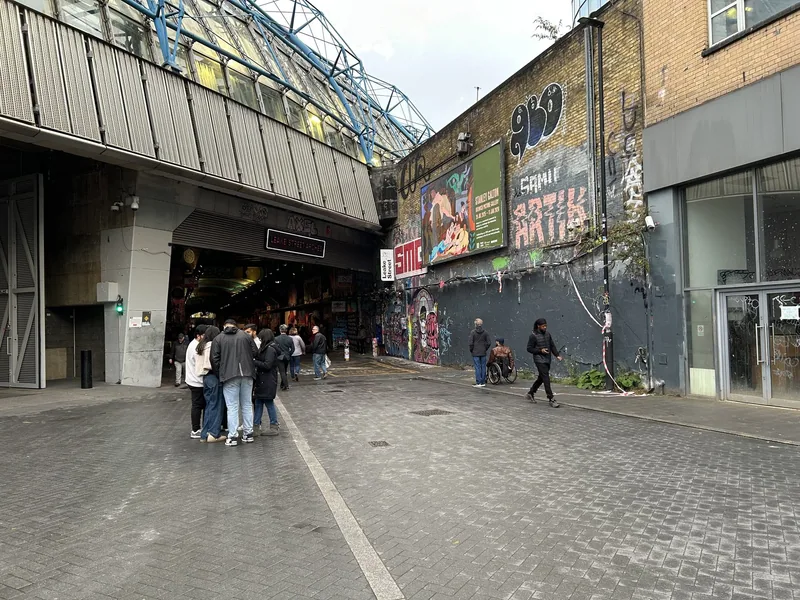
The tunnel runs from York Road, opposite the London Eye end of the station, through to Lower Marsh. It is wide enough for two lanes of traffic that almost never come, lit by strip lights, and every surface from the pavement to head height is covered in layers of spray paint that are repainted constantly. Nothing you see there will still be there in a month.
This is not street art in the sense of a curated wall with a named artist and a plaque. It is a practice space, and most of what is on the walls is lettering by people teaching themselves. That is the point of it, and it is what makes it different from the walls in east London that our guide to Shoreditch street art tours covers.
Leake Street: the basics
- Where
- Leake Street, London SE1, running beneath Waterloo station between York Road and Lower Marsh
- Cost
- Free. It is a public thoroughfare, not an attraction with a gate
- Open
- Always. The businesses in the arches keep their own hours; the tunnel itself does not close
- Painting
- Permitted and encouraged on the tunnel walls. Everything else on the list below is not
- Managed by
- Leake Street Arches, the landlord of the eight railway arches alongside the tunnel
- Nearest stations
- Waterloo and Waterloo East, five minutes. Lambeth North, five minutes. Westminster, ten minutes over the bridge
- How long
- Twenty minutes to look, an hour or more to paint
Why painting here is legal when it is not elsewhere
The tunnel used to be the service road for the international platforms at Waterloo, where Eurostar trains ran until the service moved to St Pancras at the end of 2007. When the trains left, the road emptied. In 2008 Banksy used the disused tunnel for a three-day open-air exhibition, invited other artists to paint alongside him, and the walls have not been clean since.
What turned a one-off event into a permanent arrangement is that the landowner decided not to fight it. The arches beside the tunnel were let to independent businesses, and the tunnel walls were designated a space where painting is allowed. That permission is specific and local. Fifty metres away, on Lower Marsh or York Road, the same act is criminal damage, and people are prosecuted for it.
The distinction matters if you have brought cans with you. Paint the tunnel walls and you are doing what the landlord invites. Paint the shutters at either end, the pavement outside, a train, or anything on the far side of the entrance, and you are not.
The rules, in plain English
Leake Street Arches publishes a set of tunnel rules, and they are worth reading before you go because several of them surprise people:
- Graffiti and street art are allowed on the tunnel walls. Work outside the authorised areas gets removed.
- Discriminatory content and political messaging are not allowed and are painted over.
- Advertising and branding put up without permission are removed.
- Only paint may go on the walls. No stickers, no fixings, no pasted paper.
- Drinking alcohol in the tunnel is not permitted unless it is part of an authorised event.
- Amplified music is not permitted on the same basis, and noise must be kept down after 10pm because people live nearby.
- No cycling, skating or rollerblading. No motorbikes.
- Any organised activity at all, including filming, photo shoots, performances and group sessions, has to be cleared with the landlord in advance. Not-for-profit requests are usually answered within one or two working days.
- Unofficial graffiti workshops are banned. Only the Artist in Residence programme runs authorised ones.
A photo shoot counts as organised activity, and a phone snap does not. Taking pictures of the walls as you walk through is fine. Turning up with a model, a tripod, a lighting rig or a crew needs written permission first, and staff do stop shoots that have not asked.
Painting it yourself without annoying anyone
Nobody hands out spray cans at the entrance. If you want to paint, you buy your own from a graffiti supply shop, of which there are several in central London, and you bring them with you. Expect to pay a few pounds a can, and note that many shops will not sell to under-16s.
The etiquette is simple and unwritten. Paint over old work rather than over something finished that day. Do not go over another artist's piece while they are still standing next to it. Take your empty cans away or put them in the bins; the landlord asks for this explicitly. Wear something you do not mind ruining, and be aware that the tunnel has almost no ventilation, so a session of more than half an hour is unpleasant without a mask.
If you want to be shown how, the only permitted route is the Artist in Residence programme that Leake Street Arches runs, currently led by a collective of four artists who work in the tunnel themselves. They run workshops and community paint days, and sessions are booked through the Leake Street Arches website. Independent operators offering "Leake Street graffiti workshops" are not authorised, whatever their listing says.
When to go, and what the light is doing
The tunnel is lit artificially and has no windows, so the time of day changes the crowd rather than the visibility. Weekday mornings are close to empty and you can photograph the full length without people in the frame. Saturday and Sunday afternoons are the busiest, with painters working along most of the length and a steady flow of visitors walking through, which is more interesting to watch but harder to photograph.
Evenings are when the bars in the arches fill up. After about 9pm the tunnel becomes a route between venues rather than a gallery, and after 10pm the noise rule means the atmosphere changes again. It is well lit and busy rather than threatening, but it is an underpass at night, and the usual advice in our guide to getting home late applies.
The walls are repainted every few days. If you saw a piece you liked in a photograph online, it is almost certainly gone. Come for the layers and the smell of solvent, not for a specific image.
What is in the arches now, and what has gone
Eight railway arches open off the tunnel. At the time of writing they hold a board games café, a Polish restaurant, an American-style dive bar, and a large hireable event space at number 26. The games café charges for a table by the hour and is a genuinely good rainy-afternoon option; the Polish place is the same operation covered in our guide to Polish and eastern European food in London, and it is one of the cheapest full hot meals near the South Bank.
What is no longer here is the festival. VAULT Festival ran in the tunnels under Waterloo from 2012 and grew into one of the largest fringe arts festivals in the country, but its final edition was in 2023 and the organisation has wound up. A great deal of travel writing still describes an eight-week festival in the vaults every January. There is no longer one, and the theatre space it used is now let for events.
Getting there, entrance by entrance
From inside Waterloo station, leave by exit 6 onto York Road and follow the signs; the tunnel mouth is immediately to your left and the walk is about five minutes. This is the fastest route and the one to use with luggage or a pushchair.
From Westminster, cross Westminster Bridge on the north pavement, bear left at the far side onto Westminster Bridge Road, and the entrance to Leake Street is beside the hotel on County Hall. That walk is about ten minutes from the London Eye.
By bus, routes 12, 53, 148, 159, 341 and 453 run past Waterloo around the clock, and N109, N155 and N381 serve it overnight, which our guide to London's night buses explains. There is no parking at Leake Street and the tunnel is closed to ordinary traffic; the nearest public car park is on Upper Marsh, where the posted rate runs from £4 for an hour to £25 for a full day (September 2026).
With children, and with a wheelchair
The tunnel is flat, paved and level from end to end, with no steps and no barriers, which makes it one of the easier things to do near Waterloo with a pushchair or a wheelchair. There are no toilets in the tunnel itself; the station concourse is the nearest reliable option, and our guide to finding a public toilet covers the alternatives.
Children are welcome and many families walk through. Two practical warnings. The first is fumes: if people are painting heavily, the air at the far end can be strong, and small children notice it before adults do. The second is content. The walls are unsupervised and change daily, so the language and imagery are not filtered for age, even though the landlord removes anything discriminatory. Teenagers tend to love it, and it sits well alongside our guide to London with teenagers.
What to do either side of it
Leake Street is fifteen minutes from a lot. West and north, you are at the river end of the South Bank, with the Southbank Centre a ten-minute walk downstream. South, Lower Marsh is a street of small shops and food stalls that most visitors never find, and the Imperial War Museum is fifteen minutes beyond it. The Florence Nightingale Museum sits on the other side of the station approach.
If the tunnel gives you an appetite for places that exist outside the normal visitor circuit, our page on the neon warehouse in Walthamstow is the closest relative. Both are free, both are hard to photograph badly, and both belong on a list of London sights that charge nothing. Anyone staying nearby should read our guide to hotels on the South Bank; anyone photographing seriously should check the national rules in our guide to photography and drones.
Frequently asked questions
Is Leake Street free to visit?
Yes. It is a public road, not a paid attraction, so there is no ticket, no booking and no entrance. The businesses in the railway arches charge for what they sell, but walking the length of the tunnel and looking at the walls costs nothing at any hour.
Can anyone paint on the walls at Leake Street?
Yes, on the tunnel walls, with your own paint. The landlord permits and encourages graffiti there. Political messaging, discriminatory content and unauthorised advertising are painted out, only paint may be applied, and organised group sessions or workshops need permission in advance.
Is Leake Street safe at night?
It is well lit, overlooked by bars that are open late, and busy most evenings, which is the opposite of most underpasses. The usual sense applies: it is a tunnel, the crowd after 10pm is a drinking crowd rather than a painting crowd, and Waterloo station is a couple of minutes away if you would rather leave.
Is the Vault Festival still held at Leake Street?
No. VAULT Festival ran under Waterloo from 2012, and the last edition took place in 2023. The organisation has since wound up and published nothing about a return. The space it used is now hired out for events, so anything you read about an eight-week January festival there is out of date.
How long is the Leake Street tunnel?
Long enough to take three to five minutes to walk end to end at an ordinary pace, running under the whole width of Waterloo's platforms between York Road and Lower Marsh. The landlord describes it as London's longest legal graffiti wall but publishes no measurement, so treat any precise figure you see quoted with caution.
Sources
- Leake Street Arches – Tunnel rules (checked September 2026)
- Leake Street Arches – Getting here, including bus routes and parking (checked September 2026)
- Leake Street Arches – What's here (checked September 2026)
- Leake Street Arches – Artist in Residence programme and authorised workshops (checked September 2026)
- VAULT Festival – archive site stating the festival ran 2012 to 2023 (checked September 2026)