
A Jack the Ripper tour is a guided evening walk of about two hours through Whitechapel and Spitalfields in east London, where five women were murdered in the autumn of 1888 by a killer who was never identified. Tickets for a group walk cost around £20 for an adult, and the best guides tell the story of the victims and of Victorian poverty, not only of the murderer.
In 1888 Whitechapel was one of the poorest districts in London, overcrowded and badly housed. Over a few weeks that autumn, the bodies of five women were found in its streets and in one rented room. The police linked the deaths to one killer, the newspapers turned the case into a sensation, and a letter signed "Jack the Ripper" gave the murderer the name that stuck. The case has never been solved.
Walking tours about the murders have run in the East End for decades, and today many companies sell them every evening. They range from thoughtful local history walks to theatrical shows with projected images and plenty of gore. This guide explains what the tours cover, how to pick a good one and what to know before you go.
Ripper walks in brief
- Where
- Whitechapel, Spitalfields and the eastern edge of the City of London
- When
- Mostly evenings; common start times are 17:00 and 19:30
- Length
- About 2 hours on foot
- Adult price
- Around £20 for a public group walk (London Walks: £20 adult, £15 students and seniors, £5 children, September 2026)
- Booking
- Advised; some small-group tours sell only online
- Nearest stations
- Aldgate East, Whitechapel, Aldgate, Liverpool Street or Tower Hill, depending on the meeting point
- Suitable for children?
- Best for teenagers and adults; content can be graphic
What happened in Whitechapel in 1888
The murders usually counted as the Ripper's took place between the end of August and early November 1888. Mary Ann (Polly) Nichols was killed on 31 August and Annie Chapman on 8 September. On 30 September two women died on the same night: Elizabeth Stride in a yard off Berner Street and Catherine Eddowes in Mitre Square, just inside the City of London. Mary Jane Kelly was killed in her rented room on 9 November.
According to the London Museum, all five women had their throats cut, and four of the bodies were mutilated in a way that suggested the killer understood human anatomy. The similarities led the police to link the deaths to the same man. Other murders in the area at the time have also been linked to him by some writers, but a lack of evidence means nobody can be sure of the true number.
The police and newspapers received thousands of letters about the case. The National Archives holds hundreds of letters in the Metropolitan Police files that claim to come from the murderer, and says there is no strong evidence that any of them were really written by him. Many were hoaxes that simply wasted police time. Guides spend a lot of time on the long list of suspects, but no theory has ever been proven.
The five women behind the story
For more than a century, the victims were described mainly as "unfortunates", a Victorian word for sex workers. Recent historians have challenged that. The London Museum says the police and journalists of the time, and many writers since, wrongly labelled all five women as prostitutes, when only Mary Jane Kelly is known to have been working in the sex trade at the time of her murder.
None of the women was born in Whitechapel. Some were mothers, most came from working-class families, and they earned money in the ways open to poor women at the time. Annie Chapman had worked as a housemaid, and Elizabeth Stride, who had moved to London from Sweden, once helped her husband run a coffee house. The historian Hallie Rubenhold's book The Five (2019) brought their lives to a wide audience and changed how many guides tell the story.
A good tour today gives these women names and lives, and uses the case to show how the poor lived in Victorian London: the crowded lodging houses, the casual work, the drinking and the constant threat of the workhouse. If your guide treats the victims as props for jokes, you have chosen the wrong tour.
What a typical Ripper walk covers
Most walks start near Aldgate, Aldgate East, Whitechapel or Tower Hill station and move through the streets between Whitechapel High Street, Commercial Street and Brick Lane. The route usually includes Mitre Square in the City, where Catherine Eddowes was found, and stops in the Spitalfields area near Christ Church and the Ten Bells pub on Commercial Street, a pub that tours link to the story.
Be prepared for the fact that very little of 1888 survives. Most of the murder sites have been rebuilt beyond recognition over the past century. What the guide does is put the old maps, photographs and records against the streets you are standing in. The best walks also cover the wider history of the area, including its Huguenot, Jewish and Bangladeshi communities.
Expect to stand outside for much of the two hours, with short walks between stops. The pavements are narrow in places and there are no toilets on the way, so go beforehand. Tours generally run in rain or shine, so bring a waterproof jacket in autumn and winter.
Some Ripper tours show real mortuary photographs. Some companies use handheld projectors to throw large images, including crime-scene and post-mortem photographs of the victims, onto walls along the route. If you would rather not see them, or you are bringing a teenager, ask the company before you book whether its walk uses them.
Prices, start times and group sizes
Public group walks are the cheapest option. You book a place, meet the guide at a station or street corner at a set time, and walk with other visitors. In September 2026, London Walks, a long-established walking tour company, charged £20 for adults, £15 for students and seniors and £5 for children on its Ripper walk, which meets at Tower Hill station, close to the Tower of London, at 19:30 and lasts about two hours. Other companies charge similar amounts, and some run two departures each evening, for example at 17:00 and 19:30.
Group size varies a great deal. Some companies cap their walks at around 15 people and sell tickets only online, while others take much bigger groups. A smaller group is easier to hear on busy streets and less of a burden for the people who live along the route. It is worth paying a little more for that.
At the meeting point, make sure you join the company you actually booked. London Walks warns that people sometimes appear at its Ripper meeting point claiming to run the same walk, so check the guide's name before you hand over any money.
A private tour with a qualified guide costs more but can be shaped around your interests and your pace. This makes sense for families, school groups or anyone who wants to spend less time on gore and more on social history. Prices depend on the guide, the length and the size of your group, so ask for a quote. Our round-up of the best walking tours in London explains how to find a qualified guide for other subjects too.
Watch out for "pay what you like" or free tours. These are legitimate, but the guide lives on tips at the end, so budget a fair amount per person. They can also be large and harder to hear.
How to choose a responsible guide
Anyone can lead a walking tour in London, and there is no compulsory licence. That makes it worth looking for signs of quality before you book. These are the questions we would ask:
- Is the guide qualified? The Institute of Tourist Guiding accredits Blue Badge guides, who are trained to guide around a region or city, and Green Badge guides for a town or defined area. Guide London, the association of London's professional guides, lists more than 500 Blue Badge guides.
- How does the tour describe the victims? Read the description and a few recent reviews. Tours that name the women, talk about their lives and use current research are usually more serious.
- How big is the group? Look for a maximum group size, especially on Fridays and Saturdays.
- What images are used? Ask whether crime-scene or mortuary photographs are shown.
- Where does it meet and finish? Check that the end point is near a station you can use easily late in the evening.
Qualified guides are not the only good guides, and some well-known Ripper experts have written books of their own. But a badge tells you the person has completed a recognised, assessed qualification, and it is the simplest check for a visitor who does not know the companies.
Whitechapel is somebody's home, not a film set. Most of the streets on a Ripper walk are residential, and people live above the pubs and shops. A good guide keeps the group on one side of the pavement, keeps voices down in courtyards and never leads you into private property. Do the same if you walk the route yourself.
Is a Jack the Ripper tour suitable for children?
Most tours are designed for adults. They describe violent murders in detail, and some show real photographs of the victims. One company warns that its tour contains graphic descriptions, stories and images that some people may find upsetting, and advises parental guidance. We would not bring children under about 12, and we would check the style of the tour before bringing a younger teenager.
If your children love scary history, the London Dungeon is designed as entertainment and publishes clear age guidance, with a recommended age of 12 and over. For a gentler family evening, our guide to London at night has plenty of other ideas.
Whitechapel and Spitalfields beyond the Ripper
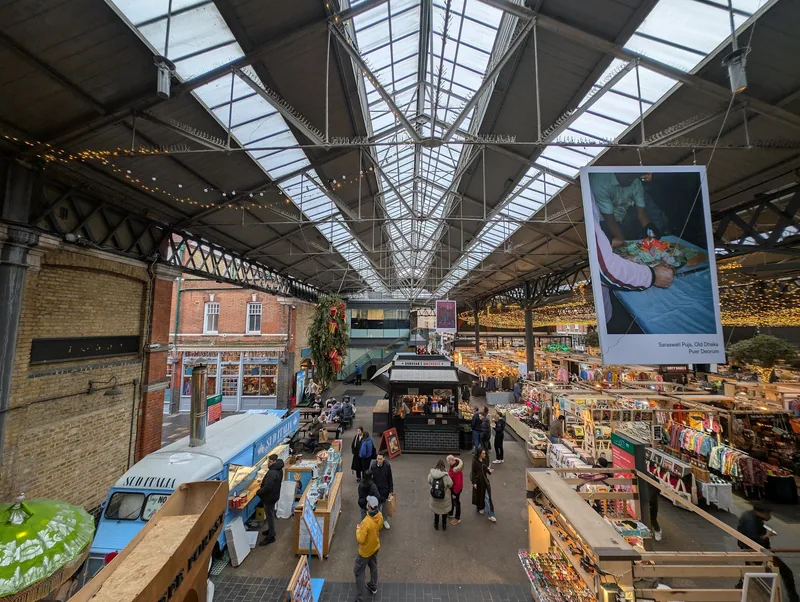
The Ripper story can hide how interesting this part of London is in daylight. Spitalfields has fine early 18th-century houses built by Huguenot silk weavers, and Old Spitalfields Market and the Brick Lane markets are busy on weekends. Brick Lane is the centre of London's Bangladeshi community and is famous for its curry houses; our guide to Brick Lane and the curry scene helps you choose where to eat before or after a walk.
Just to the north, Shoreditch has bars, street art and late-night food, and to the west lies the City of London, empty and quiet in the evenings. If you want a drink after the walk, our list of historic London pubs includes several old taverns in and around the City.
For the social history behind the case, the London Museum's online story about Jack the Ripper and the women he killed is a good, short introduction. The museum's new site at West Smithfield opens on 28 November 2026; see our guide to the London Museum for what is open now.
Getting there and getting back safely
Whitechapel station is served by the Elizabeth line, the District and Hammersmith & City lines and the London Overground, and Aldgate East is on the District and Hammersmith & City lines. Liverpool Street and Tower Hill are within walking distance of most meeting points. The Elizabeth line from Whitechapel is a fast way back to Paddington, Bond Street or Tottenham Court Road after a walk.
The area is busy in the evening, particularly around Brick Lane and Commercial Street, and the tours themselves keep you in a group. Use normal city sense: keep your phone out of reach of passing cyclists and scooter riders, and keep bags closed in crowds. Our guide to staying safe in London covers phone theft and common scams.
On Friday and Saturday nights, the Central line from Liverpool Street is part of the Night Tube, which is useful if you stay out late in Shoreditch after the tour.
Frequently asked questions
How long is a Jack the Ripper walking tour?
Most public Ripper walks last about two hours, including several stops where the guide talks for a few minutes. London Walks, for example, says its walks last two hours and go ahead in rain or shine, so wear comfortable shoes and dress for the weather.
How much does a Jack the Ripper tour cost?
Expect to pay around £20 for an adult on a public group walk. In September 2026 London Walks charged £20 for adults, £15 for students and seniors and £5 for children. Private tours with a qualified guide cost more and are priced per group.
Was Jack the Ripper ever identified?
No. Despite a major police investigation in 1888 and more than a century of research, the murderer was never caught or identified. Hundreds of letters claiming to be from the killer survive, but The National Archives says there is no strong evidence that any of them were genuine.
Who were Jack the Ripper's victims?
The five women usually linked to the murders were Mary Ann (Polly) Nichols, Annie Chapman, Elizabeth Stride, Catherine Eddowes and Mary Jane Kelly, all killed in 1888. Historians now stress that only Mary Jane Kelly is known to have been working in the sex trade at the time.
Where do Jack the Ripper tours start?
Most start near Aldgate East, Whitechapel, Aldgate or Tower Hill Underground stations, usually in the early evening. Each company has its own meeting point, which is given on the booking confirmation, so check it carefully and allow time to find it.
Sources
- London Museum - Jack the Ripper (checked September 2026)
- The National Archives - Hoax letter signed by 'Jack the Ripper' (checked September 2026)
- Institute of Tourist Guiding - Our qualifications (checked September 2026)
- Guide London - Blue Badge Tourist Guides (checked September 2026)
- London Walks - Jack the Ripper walking tour (checked September 2026)
- Transport for London - Night Tube (checked September 2026)