
Forty acres of fenced woodland garden sit in the south-west corner of Richmond Park, free to walk into and open every day of the year. The evergreen azaleas along its ponds and streams are what people come for, and the Royal Parks put their flowering peak at the end of April and the start of May. That is the honest window: about three weeks, after which the colour goes and you are left with a quiet wood and a bed of heather.
This matters because a lot of visitors travel out to Zone 4 expecting the photographs they have seen, arrive in July, and find green. The plantation is genuinely lovely at other times of year, but in a much lower key. Go in the azalea fortnight if you can, and if you cannot, know what you are getting.
Our main guide to Richmond Park covers the deer, the Tamsin Trail and the legally protected sightline to St Paul's from King Henry's Mound. This page goes inside the plantation gates: which pond to head for, which of the five entrances to use, what flowers when, and how to get there without a car.
The Isabella Plantation: the practical details
- Entry
- Free, no booking, open daily on the same hours the park keeps
- Size
- Around 40 acres, fenced off by Lord Sidmouth in 1831 and public since 1953
- Azalea peak
- The end of April into the first days of May, per the Royal Parks
- Pedestrian gates
- Peg's Pond, Broomfield Hill, Bramble, Deer Sanctuary and High Wood
- Toilets
- Peg's Pond gate, year-round. Still Pond, April to November. Both have accessible cubicles
- Baby change
- In the Peg's Pond gate toilet
- Waymarked trails
- Four, colour-coded, marked with log signs
- Nearest bus stop
- Warren Road on the 85 and K3, then a 15-minute waymarked walk from Ladderstile Gate
What the garden is, and what it is not
The plantation is a woodland garden rather than a botanic garden or a formal park. Oak, beech and sweet chestnut planted as a timber crop in the 1830s form the canopy, with more than 25 veteran trees that predate the enclosure. Under them run three ponds and a network of streams, and it is along the water that the planting is concentrated.
It holds a National Plant Collection: the Kurume azaleas known as the Wilson 50, a group the plant collector Ernest Wilson brought out of Japan in the 1920s. Around them are large collections of rhododendron, magnolia and camellia, plus unusual trees, shrubs and herbaceous planting. The garden is run on organic principles and is part of the Richmond Park Site of Special Scientific Interest, so native plants are left growing among the exotics rather than weeded out.
What it does not have is a café, a shop, a visitor centre or a gate that anyone staffs. There is nowhere inside to buy a cup of tea. Pembroke Lodge, the park's main refreshment point, is a long way off on the other side of the park.
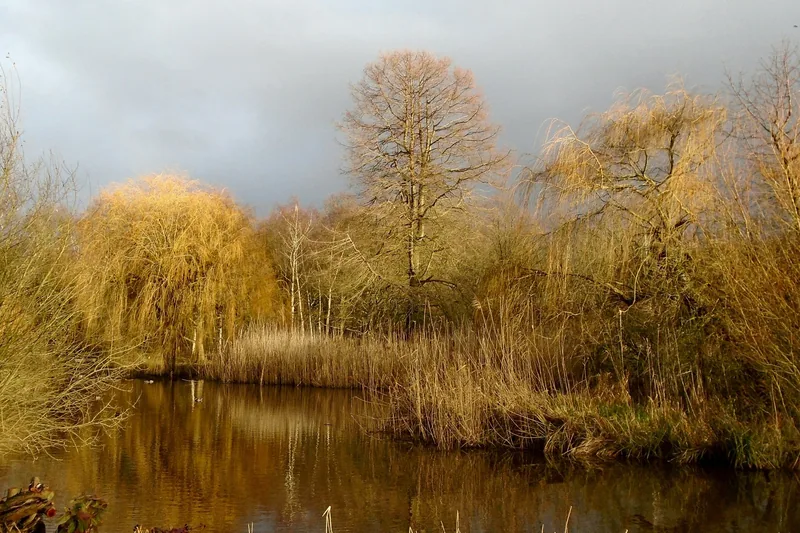
Photo: AndyScott · CC BY-SA 4.0 · Wikimedia Commons · resized
The three ponds, and which one to head for
Still Pond is the one in the pictures. The Kurume azaleas around it were established by George Thomson, park superintendent from 1951 to 1971, working with his head gardener Wally Miller, and it is the densest concentration of colour in the garden. It is also where everyone else goes in the first week of May.
Thomson's Pond sits along the main stream, which was dug in 1960 from the Broomfield Hill Gate end. Peg's Pond is at the north-western corner, next to the gate and the year-round toilets. It was enlarged and planted with reedbeds during the 2011 to 2015 restoration, partly to bring back a habitat that has become nationally scarce. Reed bunting and reed warbler use it, and it is the quietest of the three.
Water is pumped in from the Pen Ponds in the middle of Richmond Park. In 2013 more than 2,500 cubic metres of silt were dredged out of the three ponds along with a large number of carp, which is why the water is clearer than it was a generation ago.
A month-by-month guide to what is out
| When | What you will actually see |
|---|---|
| January to February | Bare wood, early camellias, the brimstone butterfly on the heather from March. Very few people |
| March to mid-April | Magnolias and camellias, wood anemone and the first bluebells on the woodland floor |
| Late April to mid-May | The Kurume azaleas around Still Pond, then the larger rhododendrons. The garden at full strength |
| Late May to July | Green, shaded and pleasant. The Heather Garden and the Bog Garden carry most of the interest |
| August to September | Heathers, bumblebees, red admiral and comma butterflies. Quiet paths |
| October to November | Autumn colour on the acers and the native trees, and fungi in the leaf litter |
The Heather Garden is man-made and mixes Erica and Calluna cultivars with gorse and broom to imitate heathland. It is the part of the plantation with the longest season, and the part most visitors walk past. Recorded wildlife here includes more than 130 species of butterfly and moth, over 70 birds, six bats, upwards of 50 beetles and 40 fungi.
The last week of April usually beats the first week of May. The official flowering window opens at the end of April, and the crowds build sharply once the May bank holiday arrives. A Tuesday or Wednesday morning in the final week of April tends to give you the same colour with a fraction of the people. Our month guides to April and May in London set out what else is on at the same time.
The five gates, and choosing the right one
The plantation is fenced, with five pedestrian entrances: Peg's Pond Gate, Broomfield Hill Gate, Bramble Gate, Deer Sanctuary Gate and High Wood Gate. Which you use changes the visit more than it sounds.
Peg's Pond Gate, on the north-western side, is the one to aim for if you want toilets at the start, if you are cycling (there are cycle stands, and cycling is permitted as far as this gate), or if you are being dropped off. Broomfield Hill Gate, on the south-east, is the one reached from the Broomfield Hill car park, which is about 400 metres away. Bramble, Deer Sanctuary and High Wood gates are quieter and used mainly by people walking across the park.
Inside, four colour-coded trails of different lengths are marked with log signs, so you do not need a map to do a loop. The shortest suits half an hour; the longest will fill an hour and a half at a slow pace.
Getting there by public transport
There is no station at the gate and no direct bus into the plantation. The closest bus stop is Warren Road, on routes 85 and K3, beside Ladderstile Gate, a pedestrian entrance off Kingston Hill on the park's south-eastern side. From Ladderstile a waymarked trail leads to Broomfield Hill Gate in about fifteen minutes.
Coming from central London, the usual approach is South Western Railway or the District line to Richmond, or a train to Kingston, and then a bus. Both are in Zone 4, which our explainer on how London's travel zones work puts in context for fares. Allow a good hour from Zone 1 whichever way you come, plus the walk across the park, which is longer than the map suggests because the plantation sits in the far south-west corner.
The Royal Parks also run a seasonal minibus, the RP1, which stops inside Richmond Park including at Peg's Pond Gate. The description on their Isabella Plantation page still quotes dates from earlier seasons, but a Richmond minibus timetable for 2026 is published on the same page as a download. Check that document, not the text above it, before relying on the service.
Broomfield Hill car park can now only be approached from the west. Changes to Richmond Park's road network mean drivers reach it via Kingston Gate. The separate Peg's Pond car park is reserved for disabled visitors and is reached via Ham Cross from Richmond Gate, Ham Gate or Kingston Gate; it cannot be reached from Roehampton Gate at weekends or from Sheen Gate at any time. On an early May weekend the car parks fill by mid-morning.
Visiting with limited mobility
The 2011 to 2015 restoration resurfaced many of the paths, rebuilt bridges and added benches, and the plantation is now among the more manageable woodland gardens in London for anyone with reduced mobility. It is not flat, but the main circuits are firm underfoot.
A powered chair can be borrowed for the garden itself, weekdays only, from 9am until 3pm. It is not self-propelling: it takes the effort out of pushing rather than removing the need for someone to push. Booking has to be done a minimum of five days in advance, and the final slot goes out at 2pm so that the chair is back on time. Peg's Pond has a car park reserved for disabled drivers, and it operates every day of the week.
Both toilet blocks have wheelchair-accessible cubicles, though the Still Pond one is only open from April to November. Our wider guide to visiting London as a wheelchair user and the notes on step-free travel across the network cover the journey out, which is the harder part.
The deer, the dogs and the rules that apply outside the fence
Getting to the plantation means crossing Richmond Park, where red and fallow deer roam loose. The standing rule is to stay 50 metres or more from any of them, rising to 100 metres during the autumn rut, from September through November, if a stag appears agitated. Feeding them is against the law.
Dogs must be on leads everywhere in Richmond Park from 1 May to 31 July inclusive, which covers the tail end of the azalea season. For the rest of the year they must be on a lead near deer, near water and in skylark areas. During the rut, keep them on a lead near deer or walk somewhere else entirely.
What to do with the rest of the day
The plantation is a two-hour visit at most, so plan something around it. Bushy Park is the next park west and has its own set-piece water garden; Hampton Court Palace is beyond that. Going the other way, Richmond has the riverside and the shops, and Kingston is closer to Ladderstile Gate.
If flowers are the point of the trip, Kew Gardens is twenty minutes north and charges for entry, and the Kyoto Garden in Holland Park does something comparable on a much smaller scale in Zone 1. In late May the Chelsea Flower Show takes over the gardening calendar entirely. For the smaller enclosed gardens scattered across the capital, see our guide to London's walled and hidden gardens, and for another free garden that rewards a weekday morning, the Hampstead Pergola is the northern equivalent.
Where the name comes from
In the 17th century this corner of the park was called The Sleyt, a word used for boggy ground or an open space between woods. By 1771 maps show it as Isabella Slade. Isabella may have been someone's wife or daughter, but the likelier explanation is the old word isabel, used from the 15th century for a dingy greyish-yellow, which is the colour of the soil here.
Lord Sidmouth, the Deputy Park Ranger, fenced off 42 acres in 1831 and planted the timber crop that became the canopy. The garden underneath it is barely seventy years old: Thomson and Miller stripped out swathes of invasive Rhododendron ponticum from the 1950s and replaced it with other species, the wild stream in the northern section was dug in 1989, and the Bog Garden was renovated in 2000.
Frequently asked questions
When are the azaleas out in the Isabella Plantation?
The Royal Parks date the peak of flower to the end of April and the first days of May, which gives you roughly a three-week window. Magnolias and camellias come earlier, from March, and the larger rhododendrons continue into mid-May. Check the Royal Parks website before travelling in a cold spring.
Is the Isabella Plantation free?
Yes. There is no entry charge, no ticket and no booking. It opens daily on the park's own hours, apart from a handful of early closures during April and May. There is no café or shop inside, so bring what you need.
How do I get to the Isabella Plantation by public transport?
Take the 85 or K3 bus to the Warren Road stop near Ladderstile Gate on Kingston Hill, then follow the waymarked trail for about fifteen minutes to Broomfield Hill Gate. Most visitors reach those buses from Richmond or Kingston stations. A seasonal minibus also runs inside the park; check the current timetable first.
Are dogs allowed in the Isabella Plantation?
Dogs are allowed in Richmond Park, but must be on a lead everywhere in the park from 1 May to 31 July inclusive, and near deer, water and skylark areas at other times. That covers the end of the azalea season. Dogs are not permitted in Pembroke Lodge Gardens.
How long does it take to walk round the Isabella Plantation?
Four colour-coded trails are marked with log signs. The shortest takes about half an hour and the longest around an hour and a half at an unhurried pace. Most visitors spend between an hour and two hours inside, longer if they stop at Still Pond to take photographs.
Sources
- The Royal Parks - Isabella Plantation (checked September 2026)
- The Royal Parks - Deer in Richmond Park (checked September 2026)
- The Royal Parks - Richmond Park visitor questions (checked September 2026)