
Holland Park is the largest park in Kensington and Chelsea, 54 acres of woodland, formal gardens and sports pitches behind Kensington High Street. It is free, opens at 7.30am and closes at dusk. The reason most people come is the Kyoto Garden, a small Japanese garden with a waterfall, and the peacocks that wander around it.
It is a quieter park than the royal ones, partly because it is smaller and partly because it is hidden. There is no grand entrance and no view of it from the main road, so visitors walk past the gates without realising a wood starts on the other side. Half the park is genuine woodland with foxes and tawny owls in it, which is unusual this close to the centre of London.
Allow an hour and a half. That is enough for the Kyoto Garden, the ruins of Holland House, a loop through the trees and a coffee, and it combines well with a museum on Kensington High Street afterwards.
Holland Park at a glance
- Entry
- Free, including the Kyoto Garden
- Opening
- 7.30am until dusk; closing times are posted at every entrance and some gates shut up to 20 minutes early
- Size
- 54 acres
- Address
- Ilchester Place, London W8 6LU
- Nearest stations
- Holland Park (Central line) and High Street Kensington (Circle and District lines)
- Not allowed
- Cycling anywhere in the park, barbecues, and dogs in the Japanese Garden
The Kyoto Garden
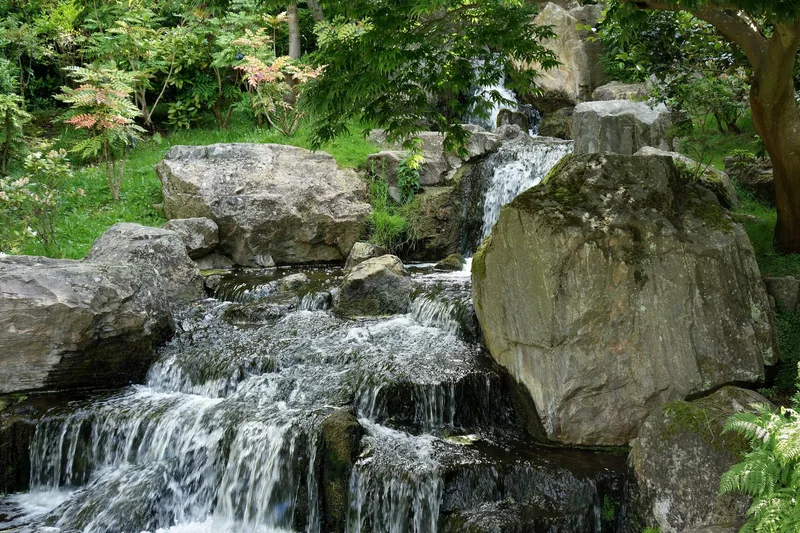
The Kyoto Garden is a small Japanese stroll garden in the middle of the park, with a tiered waterfall running into a koi pond, stone lanterns, maples and clipped pines, and a path that takes about five minutes to walk slowly. It was a joint project between the Royal Borough of Kensington and Chelsea and the Kyoto Chamber of Commerce, designed and built by a Japanese garden designer and his team. The council's pages date the gift to 1991 and connect it to the Japan Festival held in London the following year.
It is beautiful and it is very small, which is the single thing to understand before you go. On a fine weekend afternoon in April or October there can be a queue of people waiting to photograph the waterfall, and the whole garden holds perhaps thirty visitors comfortably. Go before 10am or after 5pm and you may have it almost to yourself.
The best two weeks of the year are in late October and early November, when the Japanese maples turn. Spring cherry blossom is the other peak, and the busiest. Dogs are not allowed in the garden at any time, and nor are picnics; this is a place to walk through rather than sit in.
The Kyoto Garden is empty at 8am. The park opens at 7.30am and almost nobody uses that hour. If you are staying in Kensington or Notting Hill and can manage an early start, this is one of the few famous small sights in London you can have entirely to yourself, and the morning light on the waterfall is better than the afternoon light.
The peacocks
Holland Park keeps a free-roaming population of peafowl, and they are the park's best-known residents. You will usually find them around the Dutch Garden and the Stable Yard, near the Ecology Centre, where the formal beds and the open gravel suit them. In the breeding season the males display, and their call carries a long way across the park; the borough's own advice notes that birds sometimes wander well beyond the gates into neighbouring streets and gardens.
Two things worth telling children before you get there. Do not chase them and do not corner them: these are wild birds with strong claws, and a cornered peacock is not a gentle animal. And do not feed them, which is against the park rules and makes them more aggressive around picnics.
If a peacock appears to be in difficulty or is causing a problem, the Royal Borough's Parks Police deal with it rather than the park keepers.
What is left of Holland House
The park is the grounds of a large Jacobean mansion. Sir Walter Cope, who became Chancellor of the Exchequer under James I, built it in the early 17th century as Cope Castle, and it was renamed Holland House after the Earl of Holland's wife inherited it. For two centuries it was one of the great political houses of London.
Almost all of it was destroyed by bombing in the Second World War. One wing survived and is now used as a youth hostel, and part of the front terrace was saved. Those remaining arcades are the backdrop to the open-air theatre and concerts in summer, and they are worth looking at in their own right: a fragment of Jacobean brickwork standing in a park, with the rest of the house marked out on the ground.
Opera Holland Park in summer
Opera Holland Park runs a summer festival of about three months in a temporary canopied auditorium built against the ruins. The canopy means the performances go ahead in rain, but the sides are open, so the temperature drops sharply after sunset and regulars bring blankets.
It is one of the more approachable ways into opera in London. There is a membership scheme, from £90 to £375 a year, which saves up to £8 per ticket and removes booking fees, and an Inspire scheme that releases tickets at £26. There are picnic tables on site and you may eat before the performance. Check the current season and prices on the Opera Holland Park website; our guide to classical music in London covers the alternatives for the rest of the year.
The woodland, the Ecology Centre and the playgrounds
The northern half of the park is woodland, and it is real woodland rather than parkland with trees: narrow paths, deep shade, bramble and a genuine dawn chorus. The Royal Borough's Ecology Service is based in the park at the Ecology Centre, and runs walks and events through the year.
There are two playgrounds, one for under-5s and one for children aged 5 to 14, plus an outdoor gym. Sports facilities include tennis courts, football, netball, and cricket and golf practice nets, all bookable through the council. There is a café at the Stable Yard.
The park rules, which are enforced
Kensington and Chelsea's parks have their own byelaws in addition to ordinary law, and the borough's Parks Police enforce them. Breaking one can mean a fine or prosecution rather than a word from a keeper, so it is worth knowing the ones a visitor is most likely to trip over.
- No cycling anywhere in Holland Park. Cyclists must dismount and push, and bicycles chained to park fences are removed. This surprises people who have cycled over from Hyde Park.
- No fires or barbecues in any of the borough's parks or open spaces. The council says it will take enforcement action.
- No tents or gazebos, and no excessively loud music.
- Drones, events and professional photography all need permission in advance.
- Do not feed the wildlife, peacocks included.
- Dogs must be on leads in the formal gardens and the woodland of Holland Park, are banned from the Kyoto Garden and from every playground, and must be supervised when off-lead elsewhere. Fouling must be picked up.
- Personal trainers must use the open spaces and outdoor gyms, not the benches and railings.
When to come, and how long to stay
An hour and a half covers the Kyoto Garden, the Holland House ruins, a loop of the woodland and a coffee at the Stable Yard. Add an hour if you have children and are stopping at a playground.
The two peak weeks are the cherry blossom in spring and the maples in late October, and in both the Kyoto Garden is at its busiest between about 11am and 4pm at weekends. Summer evenings belong to the opera audience, which fills the paths near the ruins from about 6.30pm. The quietest and, for photographs, the best time in any season is the first hour after the gates open at 7.30am.
Winter is underrated here. The woodland is bare enough to see through, the peacocks are easy to find because there is less cover, and you will often have the Japanese garden entirely to yourself.
Which gate to use
The park sits on a slope, and the choice of entrance matters more than in most London parks.
- Level access is available at North Abbotsbury Road, Ilchester Place, Duchess of Bedford Walk and the High Street Kensington entrance.
- Avoid on wheels: the Holland Park Road entrance and the southern entrance on Abbotsbury Road are both on a steep incline and are not suitable for wheelchair users.
- Disabled parking is in the car park just off Abbotsbury Road. The rest of the car park is pay by phone.
- Accessible toilets are at the Stable Yard, which also has a Changing Places facility, and at the adventure playground.
From Holland Park station on the Central line it is a short walk down Holland Park Avenue and in from the north. From High Street Kensington on the Circle and District lines you come in from the south-east, which is the flatter approach. Our guide to accessible London covers step-free routes across the network.
What to see on the same walk
Holland Park works best as half of a day. The Design Museum is at the southern edge of the park on Kensington High Street, in the old Commonwealth Institute building. Check its own website for what is free and what is ticketed before you go. Leighton House, the painted Victorian artist's house, is two minutes from the park's south-west corner and is one of the most surprising interiors in London.
North of the park, Notting Hill starts almost immediately, with Portobello Road Market at its busiest on Saturdays. South, you are ten minutes from Kensington Palace and the western end of Kensington Gardens.
If the Kyoto Garden has given you a taste for small, planted, walled places, Chelsea Physic Garden is the other one in this part of London, and Kew Gardens is the full-scale version half an hour west. For the opposite experience, all deer and open sky, see Richmond Park. And as free London goes, this park belongs on the list in our guide to free things to do in London.
Frequently asked questions
Is the Kyoto Garden in Holland Park free?
Yes. The Kyoto Garden, like the rest of Holland Park, is free and needs no ticket or booking. The park opens at 7.30am and closes at dusk, with closing times posted at each entrance. Dogs are not allowed in the garden.
When is the best time to visit the Kyoto Garden?
Early morning, from 7.30am, or after about 5pm. The garden is small and gets crowded at weekend lunchtimes. The maples are at their best in late October and early November, and the cherry blossom in spring draws the biggest crowds of the year.
Are there really peacocks in Holland Park?
Yes, a free-roaming population, usually seen around the formal gardens and the Stable Yard near the Ecology Centre. They are wild birds, so do not corner them, chase them or feed them. In the breeding season they sometimes wander outside the park into nearby streets.
Can you cycle in Holland Park?
No. Cycling is not permitted anywhere in the park, so you must dismount at the gate and push. There are cycle racks near the entrances. Barbecues are also banned, and dogs must be on leads in the woodlands and formal gardens.
What happened to Holland House?
The Jacobean mansion was badly damaged by bombing in the Second World War. One wing survived and is now a youth hostel, and part of the front terrace remains as an open arcade, which is used as the backdrop for the Opera Holland Park summer season and other open-air performances.
Sources
- Royal Borough of Kensington and Chelsea - Holland Park (checked September 2026)
- Royal Borough of Kensington and Chelsea - Ecology, biodiversity and nature conservation (checked September 2026)
- Royal Borough of Kensington and Chelsea - Park rules and byelaws (checked September 2026)
- Opera Holland Park - Season, ticket schemes and membership (checked September 2026)