
Richmond Park is London's largest Royal Park: about 1,000 hectares of open grassland, ancient oaks and ponds in south-west London, where more than 600 wild red and fallow deer roam freely. It is free to enter, open to walkers around the clock for most of the year, and easy to reach by Tube or train from central London.
It does not feel like a city park at all. There are no neat flower beds or lawns, and very few buildings. Instead you get rolling hills, bracken, long views and herds of deer, much as it looked when Charles I turned it into a hunting park in the 1630s. The Royal Parks charity manages it as a National Nature Reserve and London's largest Site of Special Scientific Interest.
The deer are the main attraction for most visitors, and they are genuinely wild. That brings a few rules you need to know before you go, especially in autumn, when the males are at their most aggressive. This guide covers those rules, the protected view of St Paul's Cathedral, the Isabella Plantation, cycling, and how to get there.
Richmond Park essentials
- Entry
- Free; car parking is also free
- Pedestrian gates
- Open 24 hours, except during the deer culls in November to early December and February to early March, when they close from 8pm to 7.30am (not on Friday and Saturday nights)
- Vehicle gates
- From 7am in summer time (7.30am in winter) until dusk
- Size
- About 1,000 hectares; the Royal Parks says it could hold six Hyde Parks
- Deer
- More than 600 red and fallow deer; keep at least 50 metres away
- Nearest station
- Richmond (District line, London Overground and South Western Railway), Zone 4
- Managed by
- The Royal Parks, a registered charity
A royal hunting park that became a nature reserve
The Royal Parks traces the park's royal links back to Edward I, when the area was the Manor of Sheen. In 1625 Charles I moved his court to nearby Richmond Palace to escape plague in London, and he later enclosed the land as a hunting park stocked with red and fallow deer. The herds have lived here ever since 1637, and some of the trees Charles would have ridden past are still standing.
Because it was kept for hunting rather than built on, the landscape has changed little in centuries. The park has ancient oaks, one of them thought to be about 750 years old, and acid grassland that is protected by law. The Royal Parks says the deer's grazing is what keeps this grassland open, and that it counts more than 400,000 anthills, which mowing machines would destroy. It is a haven for stag beetles, bats, skylarks and kestrels as well as deer.
That makes it a place for walking and quiet watching rather than activities. If you want formal gardens, Kew is close by; our guide to Kew Gardens explains how to combine the two.
Seeing the red and fallow deer
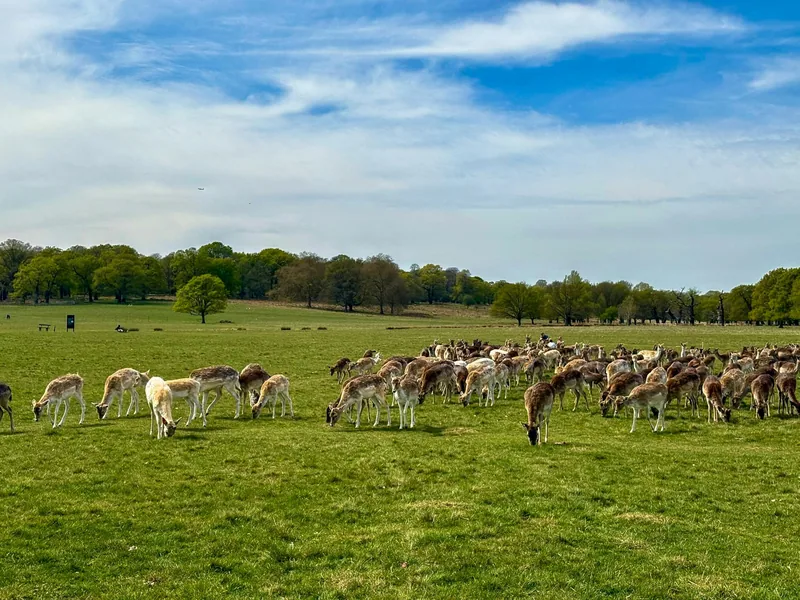
According to the Royal Parks, more than 630 red and fallow deer live in the park. Red deer are the largest land mammal native to the British Isles, with glossy red coats in summer. Fallow deer are smaller, and their summer coats are usually spotted and vary from cream to dark brown. The males of both species grow antlers every spring and shed them at the end of winter.
You do not need to search hard. The herds move across the open grassland all day, and you will often see groups resting in the bracken or under trees. Early morning and late afternoon are the calmest times, with fewer people and softer light for photographs. A long lens is the right tool here, because the rule on distance applies to photographers too.
Please do not feed them. Feeding the deer in Richmond Park is illegal, because it harms the animals and makes them bolder around people. The Royal Parks also asks visitors not to take conkers (horse chestnuts) home, as they are an important part of the deer's winter diet. Three signed deer refuge areas give the herds space to rest; do not walk into them.
Keeping your distance: the deer safety rules
The deer look calm, but they are wild animals and can be unpredictable. The Royal Parks asks everyone to stay at least 50 metres away at all times, which is about the length of an Olympic swimming pool. Never touch the deer, try to feed them or walk up close for a photograph. The Royal Parks also advises against picnicking close to deer. If one approaches your picnic, cover the food, close your bags, move back to a safe distance and wait for it to leave.
Two seasons need extra care:
- The rut, September to November. This is the mating season. Stags and bucks roar, bark and clash antlers, and they can be highly aggressive. The Royal Parks says a male can weigh up to 200 kilograms and run at up to 30 mph. If a male seems active, keep at least 100 metres away.
- The birthing season, May to July. More than 200 deer are born in the park in most years. Mothers hide their young in bracken and long grass and can act defensively, especially towards dogs. Keep out of long grass and bracken, where newborn deer may be hidden.
September to November is rutting season, and 100 metres is the safe distance from an active stag. If you are visiting in autumn, you are visiting during the rut. It is an extraordinary thing to hear and watch, but only from far away. If a deer advances towards you, the Royal Parks advises you not to wave or shout, to back off slowly, and if necessary to put a car or a big tree between you and the animal.
Rules for dog owners
Many visitors bring dogs, and the rules are strict because dogs frighten the deer. From 1 May to 31 July, during the birthing season, dogs must be on a lead everywhere in the park. The rest of the year, a lead is required near the deer, around lakes and ponds including Pen Ponds, and on a short lead in the three skylark protection zones: Lawn Field, Crown Field and The Bog.
During the rut, the Royal Parks advises keeping dogs on a lead near deer or walking them somewhere else. It is an offence for a dog to chase deer, and the owner can be prosecuted. Dogs on leads are allowed in the Isabella Plantation, but not in Pembroke Lodge Gardens.
King Henry's Mound and the protected view of St Paul's
King Henry's Mound stands inside Pembroke Lodge Gardens, on the west side of the park. It is thought to be a Bronze Age burial mound, later used as a viewpoint for hunting and falconry, and legend says Henry VIII stood here. Look west and you get a wide view over the Thames Valley.
Look east and you will see something more surprising: a narrow line cut through the trees that frames the dome of St Paul's Cathedral, far away across London. Generations of gardeners have kept this sightline open, and the view is now protected, so no new building may block it. At that distance the dome looks small, and on a hazy day it can be hard to find.
Clear, dry days after rain give the sharpest view. Our round-up of free viewpoints across London covers the other protected views, from Primrose Hill to Parliament Hill.
Pembroke Lodge and its gardens
Pembroke Lodge is a Georgian mansion on the western ridge of the park, now used as a café and tea room. Its gardens are laid out along the hilltop, with benches and sweeping views over the Thames Valley. The café is one of the two main places to eat in the park, along with the Roehampton Café on the east side, and there are smaller refreshment kiosks around the park.
Dogs are not allowed in Pembroke Lodge Gardens. There is a car park at Pembroke Lodge itself, and the free RP1 minibus links the main car parks (see below).
The Isabella Plantation in azalea season
The Isabella Plantation is a 40-acre woodland garden in the south-west of the park. It was planted in the 1830s and opened to the public in 1953. Ponds and streams wind through it, lined with azaleas, rhododendrons, magnolias and camellias, and it holds the National Collection of the Wilson 50 Kurume azaleas, brought from Japan in the 1920s.
The azaleas are at their peak in late April and early May, and that is when the garden is most crowded. It is open all year at the same times as the park, apart from a few early closures in April and May, and it is lovely in autumn too, when the leaves turn. There are toilets at Peg's Pond Gate, open all year, and at Still Pond from April to November.
Come on a weekday morning in late April for the azaleas without the queues. The Isabella Plantation is at its brightest in late April and early May, and weekend afternoons are busy. A weekday visit before lunch gives you the colour and room to take photographs.
For visitors with limited mobility there is a dedicated disabled car park at Peg's Pond, and the Royal Parks lends a motorised wheelchair for use inside the plantation on weekdays from 9am to 3pm. Book it at least five days ahead.
Cycling, walking and the Tamsin Trail
The Tamsin Trail is a path of just over seven miles (about 11 kilometres) that runs around the edge of the park. It is popular with runners, walkers and families on bikes, and you can join or leave it at many points. Cyclists must keep to the roads and the Tamsin Trail and give way to walkers and wildlife.
You can hire mountain bikes all year from Parkcycle in the Roehampton Gate car park, including junior bikes and child seats, with helmets included. The park roads are also well known among London's road cyclists, so expect fast riders at weekends. For bike hire in the city itself, see our guide to cycling in London.
Walkers have endless choice. A good first walk is from Richmond Gate along the ridge to Pembroke Lodge and King Henry's Mound, then down through the park to Pen Ponds in the middle and back. Allow two to three hours. The park is large and the paths are not all signposted, so download the map from the Royal Parks website before you set off.
Getting to Richmond Park
The easiest route is to Richmond station, in Zone 4, which is served by the District line, the London Overground and South Western Railway trains from Waterloo. The Royal Parks says the walk from Richmond, North Sheen or Norbiton stations to the nearest park gate takes between 15 and 25 minutes. From Richmond it is uphill through the town. For the town itself, see our guide to Richmond.
If you pay with contactless or Oyster, the daily cap covers the trip: travel in Zones 1 to 4 is capped at £12.80 a day. Our pages on how the travel zones work and on Oyster versus contactless explain the details. Buses are the other option; the Royal Parks names routes 85 and K3, which stop near Ladderstile Gate on Kingston Hill, about 15 minutes' walk from the Isabella Plantation. Our guide to London buses explains how to pay.
Inside the park, the free RP1 minibus runs from March to November, calling at 16 stops including the main car parks and the Isabella Plantation, roughly from 10.30am to 5.14pm. From 26 October 2026 it finishes at Richmond Gate at 3.10pm because of the earlier closing time.
Driving is possible but restricted. Parking is free in seven main car parks, but through-traffic is limited: you can drive between Richmond Gate and Kingston Gate at any time, and between Richmond Gate and Roehampton Gate on weekdays only. Other roads lead only to car parks.
When to visit and what to combine
Every season has something. Spring brings the azaleas and newborn deer, summer long evenings on the hills, autumn the rut and the best tree colours, and winter frosty mornings with the herds out in the open. Our guide to the best time to visit London helps you weigh the seasons, and London in October covers what else is on during the rut.
Richmond Park combines well with the town of Richmond and its riverside, with Kew Gardens a short bus or train ride north, and with Hampton Court Palace further up the Thames. If you want a much smaller, more central green space, see our overview of London's parks and gardens. In an emergency in the park, call 999; our page on emergency numbers lists the others.
Frequently asked questions
Is Richmond Park free?
Yes. Entry to Richmond Park is free, and so is parking in its car parks. You pay only for food at the cafés and kiosks and for extras such as bike hire. The free RP1 minibus runs inside the park from March to November.
How close can you get to the deer in Richmond Park?
The Royal Parks asks visitors to stay at least 50 metres from the deer at all times. During the rut, from September to November, keep at least 100 metres from any male that seems active. Never touch or feed the deer; feeding them is illegal.
Is Richmond Park open at night?
For walkers, usually yes: the pedestrian gates are open 24 hours. The exception is during the deer culls in November to early December and February to early March, when the pedestrian gates close from 8pm to 7.30am, except on Friday and Saturday nights. Vehicle gates close at dusk.
Can you really see St Paul's Cathedral from Richmond Park?
Yes. From King Henry's Mound in Pembroke Lodge Gardens, a protected gap in the trees frames the dome of St Paul's, far away across London. The view is clearest on a bright, dry day; on a hazy day the dome can be hard to pick out.
When is the best time to see the azaleas in the Isabella Plantation?
Late April and early May, when the evergreen azaleas around the ponds and streams are in full flower. The plantation is open all year and is also worth visiting in autumn, but spring is its busiest and most colourful time.
Sources
- The Royal Parks - Richmond Park FAQs (checked September 2026)
- The Royal Parks - Deer in Richmond Park (checked September 2026)
- The Royal Parks - Deer safety advice (checked September 2026)
- The Royal Parks - Isabella Plantation (checked September 2026)
- The Royal Parks - King Henry's Mound (checked September 2026)
- The Royal Parks - Richmond Park (checked September 2026)
- Transport for London - Capping (checked September 2026)