
Kenwood is a free house on the northern edge of Hampstead Heath with a Rembrandt self-portrait, a Vermeer and one of Robert Adam's best rooms in it. It opens every day, 10am to 4pm in winter (2 November 2026 to mid-March 2027), and you can get to the front gates by bus: routes 210, 310, 603 and H3 all stop at a stop called Kenwood House on Hampstead Lane.
That bus fact is worth putting near the top, because English Heritage does not give a nearest station on its Kenwood pages and most guides therefore tell you to walk. Walking across the Heath is the better arrival, but it is a 30 to 45 minute climb from the village, and there is no reason to do it in January rain with small children.
Our guide to Hampstead Heath covers the Heath itself and the walk up, and our page on Hampstead covers the village. This page is about the house: what is in it, how long it takes, how to get there without walking, and the things that are open when the house is not.
Kenwood, winter 2026–27
- Price
- Free, house and art collection included. Booking is not required, but a free online ticket guarantees entry.
- House hours
- Daily 10am to 4pm from 2 November 2026 to mid-March 2027; longer hours in summer (checked November 2026).
- Address
- Hampstead Lane, Hampstead, London NW3 7JR.
- Buses to the gate
- 210, 310, 603 and H3, at the Kenwood House and Compton Avenue / Kenwood House stops on Hampstead Lane.
- Grounds
- 112 acres of landscape by Humphry Repton, free, open beyond house hours.
- Guided tour
- £10 adults, £5 English Heritage members, children free. One hour, pay on the day.
- Payment
- Kenwood is a cashless site.
- How long
- An hour for the house, two to three hours with the grounds and the café.
Getting there by bus, which nobody tells you
Transport for London's own stop data lists two pairs of stops beside the house on Hampstead Lane, and four routes serving them. The one that matters is the 210, because of where it goes.
The 210 runs between Finsbury Park station and Brent Cross Shopping Centre, and on the way it calls at Archway station, climbs through Highgate village, passes Kenwood House, carries on past the Spaniards Inn and Jack Straw's Castle, and reaches Golders Green station. Archway and Golders Green are both on the Northern line, so from central London you have a straightforward Tube-plus-bus journey to the gate from either direction.
The 310 and the H3 both run to Golders Green as well, and the 603 runs down to Swiss Cottage. For a visitor the practical version is: Northern line to Archway, then the 210 west; or Northern line to Golders Green, then the 210 east. It is one of the more scenic bus rides in London, and our list of bus routes worth riding for the view covers others in the same spirit.
Come by bus and leave on foot. The best version of a Kenwood day is the 210 up to the house and then a walk south across the Heath to Hampstead or down to Parliament Hill afterwards. You get the house with fresh legs and the view on the way out, and you avoid arriving hot.
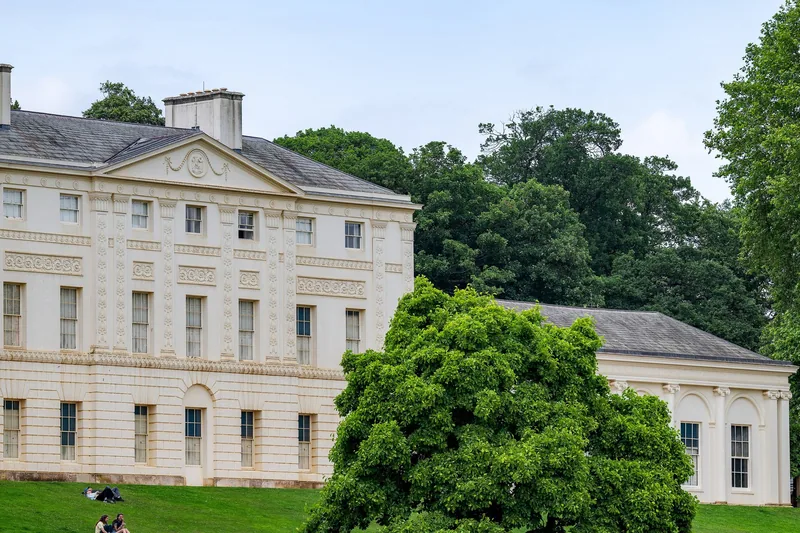
Photo: Tilman2007 · CC BY-SA 4.0 · Wikimedia Commons · resized
The paintings, and where to find them
Kenwood's collection came from Edward Guinness, the brewer, who gave the house and the pictures to the nation. It is small, and it is astonishingly good.
The picture people come for is Rembrandt's Self-Portrait with Two Circles, painted late in his life, with the two arcs on the wall behind him that nobody has fully explained. English Heritage names it as the highlight of the collection, and it is the one you should not rush.
Alongside it are Vermeer's The Guitar Player, one of very few Vermeers in Britain, and English portraits and landscapes by Gainsborough, Reynolds, Turner and Constable. If you know the Wallace Collection or Dulwich Picture Gallery, Kenwood belongs in that company: a house-sized collection you can see properly in an hour rather than a national museum you cannot.
Robert Adam's Great Library
The house was extended and largely redesigned in the eighteenth century by Robert Adam, and the room he is remembered for here is the Great Library, sometimes called the Music Room: a barrel-vaulted ceiling with painted panels, mirrors where you expect windows, and columns screening the ends.
It was returned to its original colour scheme in a refurbishment completed in 2013, and the difference that made is the reason to look twice. Adam's schemes were not the pale cream of Georgian revivalism; the room is blue and pink and gold, and it looks startling to modern eyes because we have seen too many copies of it done in beige.
Lord Mansfield, Dido Belle and why this house matters
Kenwood was the country house of William Murray, 1st Earl of Mansfield, the Lord Chief Justice whose judgments in the 1770s and 1780s shaped English law on slavery. His great-niece Dido Elizabeth Belle, the daughter of a naval officer and an enslaved African woman, grew up here in the household.
English Heritage now puts both of them at the centre of how the house is explained, with hands-on displays and a newly commissioned portrait of Dido Belle. It also runs a dedicated guided tour, Lord Mansfield: Slavery and Justice, on specific dates; four were listed for October 2026. This is the part of Kenwood that has changed most in the last decade, and it is the reason the house is more interesting than its paintings alone.
Tours, talks and the free audio guide
Three ways to get more out of the rooms, none of which needs booking weeks ahead.
- Highlight Tours. One hour, led by volunteers, Wednesdays, Fridays and Saturdays at 11.30am and 2.30pm. £10 for adults, £5 for English Heritage members, children free. Turn up and pay on the day.
- Spotlight Talks. Short free talks on a single object, run by volunteers on other days.
- The digital guide. English Heritage has put a free Kenwood guide on the Bloomberg Connects app, with audio from its curators and conservators and an interactive room map. Download it before you arrive rather than on the drive.
The grounds, the sham bridge and the dairy
Kenwood's 112 acres are a designed landscape by Humphry Repton, not a piece of wild heath, and the difference shows: mown lawns sloping to a lake, planted clumps of trees, and sightlines arranged so that each one ends in something.
Two things to look for. The sham bridge across the lake is a false front, built as scenery to be seen from the house and not to be crossed. The old dairy, in the grounds, is the kind of ornamental farm building an eighteenth-century household kept for show as much as for milk. There are also sculptures set out on the lawns.
The grounds are free and open longer than the house, and they merge straight into the Heath, so an afternoon here can turn into a walk without any decision being made. The bathing ponds are below to the south, and Golders Hill Park is along the 210's route to the west.
Eating, and the bookshop most people miss
The Brew House café is in the old service wing with tables in the courtyard and garden. It does breakfast, sandwiches, salads and baguettes, a children's menu, and a roast on Sundays; the Stewards Room next to it is the grab-and-go counter. Because the house is free, this is one of the few places in London where you can look at a Rembrandt and then eat outdoors having paid for nothing but lunch, as our round-up of the best museum and gallery cafes explains.
The thing almost nobody finds is the secondhand bookshop, in Mansion Cottage next to the garden shop. It is run entirely by volunteers, everything it takes goes back into Kenwood, and it opens Thursday to Sunday from noon to 4pm. Remember that the whole site is cashless.
What is not happening here any more
Kenwood's lakeside summer concerts, with the audience on the grass and the stage across the water, ran for decades and are still the first thing many people associate with the house. There is no English Heritage concert series now and no published programme to book; our page on summer concerts in London's parks sets out what replaced it.
The lawn is still hired out for large third-party events. The Pasture Ground, the lawn south of the house, and the Kenwood car park were closed for a festival until 26 September 2026, so they should be back in use, but if you are driving it is worth a check before you set out. Smaller events do run in the house: a choral performance and the Slavery and Justice tours were listed for October 2026, and Father Christmas appears in December.
Fitting it into a day in north London
Kenwood works best as the fixed point of a half-day rather than a destination on its own. Three combinations that work:
- Archway, Kenwood, Highgate. Bus 210 up, the house, then walk back down into Highgate village for Highgate Cemetery, which does need booking.
- Kenwood and the Heath. The house, then south across the Heath to Parliament Hill for the view, and down to Hampstead Heath station.
- Kenwood and Keats. The house in the morning, then Keats House at the southern edge of the Heath, which is open only on certain days and closes for an hour in the middle of the day.
If free houses full of old paintings are the point of your trip, our list of free museums in London has the rest, and two great houses on the western edge of the city are the obvious companions: Osterley Park and Syon House, both with Robert Adam interiors.
Frequently asked questions
Is Kenwood House free to visit?
Yes. The house, its rooms and the whole art collection are free, and so are the grounds. You do not have to book, but English Heritage says a free ticket booked online guarantees entry to the house. Some exhibitions may charge, and the guided tour costs £10 for an adult.
What is the nearest station to Kenwood House?
There is no station close enough to walk from comfortably, which is why buses matter here. Take the Northern line to Archway or Golders Green and then bus 210, which stops at Kenwood House on Hampstead Lane. Routes 310, 603 and H3 also serve the same stops. On foot it is 30 to 45 minutes across the Heath from Hampstead village.
Which paintings are at Kenwood?
The best known is Rembrandt's Self-Portrait with Two Circles. Vermeer's The Guitar Player is also here, along with works by Gainsborough, Reynolds, Turner and Constable. The collection was given to the nation by the brewer Edward Guinness and is displayed in the house rather than in gallery conditions.
How long do you need at Kenwood?
An hour is enough for the house at a steady pace, and the guided tour is an hour on its own. Allow two to three hours if you want the grounds, the lake and the café, and half a day if you are walking to or from Hampstead across the Heath.
Are there still concerts at Kenwood House?
Not as a series. The lakeside concert programme no longer runs and there is nothing to book. The lawn is still hired for third-party festivals, and English Heritage lists occasional smaller events in the house, including choral performances and specialist guided tours.
Sources
- English Heritage - Kenwood (checked September 2026)
- English Heritage - Things to do at Kenwood (checked September 2026)
- English Heritage - Kenwood prices and opening times (checked September 2026)
- Transport for London - bus route 210 stop sequence (open data) (checked September 2026)
- Transport for London - bus stops near Kenwood House (open data) (checked September 2026)