
The Great Trees of London is a list of 61 trees, and the first thing to know about it is that it is not an official register. It was drawn up by the charity Trees for Cities: 41 trees to begin with, another 20 nominated by the public in 2008, and all 61 published in a book with Time Out in 2010. No government body maintains it, several of the trees have since died, and there is no plaque on most of them.
That sounds like a demolition. It is not. The list is still the best guide to which individual trees are worth crossing London for, and this page takes the ones you can actually find, says where to stand, and explains what protects a tree here if a list does not.
If you want trees by the thousand rather than one at a time, our guides to autumn colour in London and cherry blossom are the seasonal answers, and they carry the timing.
The list, and the registers that are official
- Great Trees of London
- 61 trees. A Trees for Cities initiative: 41 to begin with, 20 added by public nomination in 2008, published with Time Out in 2010
- Status
- No statutory standing. It confers no protection on any tree
- London Tree Map (Greater London Authority)
- Over 1,100,000 public-realm trees mapped. Latest update 2024–25, published May 2025
- How many trees in London
- Over eight million, per the London iTree study cited by the GLA
- Ancient Tree Inventory (Woodland Trust)
- More than 190,000 trees recorded across the UK
- Actual legal protection
- A Tree Preservation Order made by the local planning authority, or being inside a conservation area
- Cost of seeing any of them
- Nothing
Where the list came from
Trees for Cities began in 1993 as the Trees for Life Foundation, founded by four friends who threw parties to raise money for planting. It became Trees for London in 1995 and Trees for Cities in 2003, once it had moved beyond the capital.
The Great Trees came from the middle of that story. In 2008, for the charity's fifteenth birthday, the public was asked to nominate 20 trees to add to what the charity's own timeline calls the existing 41 Great Trees of London, and in 2010 it worked with Time Out to publish a book covering all 61. The charity does not date the original 41 on that timeline, and neither will we: the widely repeated story that they were chosen to mark the tenth anniversary of the 1987 storm is not on any source we could verify.
So the authority behind the list is a well-regarded charity with a public vote behind it, and nothing more. That is worth saying plainly, because the phrase "official register" attaches itself to the list on other websites and it is wrong.
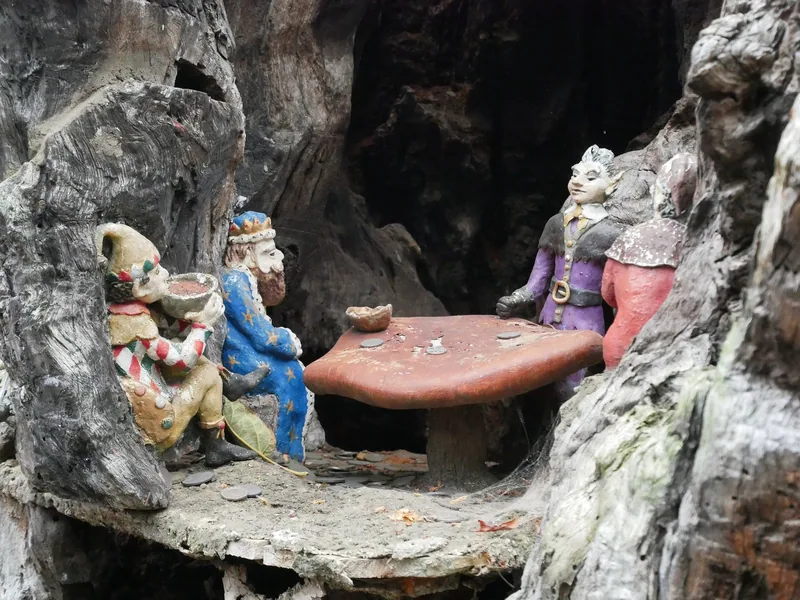
Photo: Ethan Doyle White · CC BY-SA 4.0 · Wikimedia Commons · resized
What actually protects a tree in London
Three things, and none of them is the Great Trees list.
A Tree Preservation Order. This is the real instrument. An Order is made by a local planning authority in England to protect specific trees, groups of trees or woodlands in the interests of amenity, and it prohibits cutting down, topping, lopping, uprooting, wilful damage and wilful destruction without the authority's written consent. The Secretary of State's view is that cutting the roots is prohibited too. If a famous London tree is safe, that is usually why.
Listing, occasionally. A tree cannot normally be listed, but a carved one can. The Elfin Oak in Kensington Gardens is on the National Heritage List for England at Grade II, list entry 1376784, added on 19 December 1997.
The record itself. The Greater London Authority's London Tree Map holds locations and species for more than 1,100,000 public-realm trees, with data from 30 of the 32 boroughs plus the City of London, Transport for London, the Royal Parks, the London Legacy Development Corporation and Quintain at Wembley Park. It was first compiled in 2014–15 and last updated in 2024–25, published in May 2025. It is not protection, but a tree that is on a map is harder to lose quietly. The Woodland Trust's Ancient Tree Inventory does the same job for old trees, with more than 190,000 recorded nationally.
Two of the boroughs are missing from the map, and that is where the gaps are. The GLA says data has not been received from three boroughs and that what is supplied varies a great deal: some boroughs list only street trees, others include parks and housing land. If you search the map and find nothing in an area, that often means nobody sent the data rather than that there are no trees.
Five of the 61 are worth a journey in their own right, because there is something concrete to look at and a story you can check.
Queen Elizabeth's Oak, dated to 1292 and lying on its side
The most remarkable tree in London is lying on the ground. Tree-ring dating puts Queen Elizabeth's Oak at 1292. It died in the nineteenth century but stayed standing until a storm brought it down in 1991, and it is still there, on its side, with a plaque beside it.
Its trunk was hollow, and in the nineteenth century the park used the hollow as a lock-up for people misbehaving in the grounds — it stood conveniently close to the old keeper's cottage. The royal stories are older and less reliable: Henry VIII was born at Greenwich and is said to have danced round the tree with Anne Boleyn, and their daughter, after whom it is named, is supposed to have picnicked in its shade or inside its trunk, depending on the version.
Where to stand: in the eastern half of Greenwich Park, away from the Observatory crowds. Look for the plaque rather than for a tree: a fallen trunk in long grass does not announce itself, and people walk past it.
The Elfin Oak, the only tree in London with a listing
A hollow oak trunk moved to Kensington Gardens and carved with gnomes, fairies, squirrels and imps: the only tree in London with a listing of its own. The idea came from Winifred, Lady Fortescue (1888–1951), an actress turned writer, who in January 1930 wrote to George Lansbury, then the First Commissioner of Works and responsible for the Royal Parks, proposing it for the children of London.
The carver was her friend Ivor Innes, a Scottish artist who had invented a technique he called Griglans after finding a heather root in Cornwall that looked like a gnome. Innes carved the figures into the trunk rather than onto it. The tree has been restored more than once since.
Where to stand: next to the Diana Memorial Playground in Kensington Gardens, where the carvings are protected behind a screen. Our page on Hyde Park and Kensington Gardens has the gates and the walking times.
The Reformers' Tree, which is a mosaic in the grass
This one is not there at all, and it is still worth the two minutes. The Reformers' Tree was an oak that became the focus of protests in 1866 by the Reform League, campaigning for the vote for all adult men. During one protest the tree was set alight, and the charred stump became a notice board and a rallying point — a physical symbol of the right of assembly.
In 1872 an Act of Parliament allowed public speaking in the north-east corner of Hyde Park, on any subject as long as the language was not indecent or obscene, and that corner became Speakers' Corner. A circular black-and-white mosaic in the grass marks where the tree stood; it was unveiled in 2000 by Tony Benn.
Where to stand: on the mosaic itself, at the meeting of paths in the middle of Hyde Park. It is easy to walk across without noticing.
The Japanese pagoda tree, the only one in the Square Mile
The City of London says this is the only Japanese pagoda tree in the Square Mile, which makes it the most specific claim on this page. It stands in Finsbury Circus Gardens, on Historic England's register of parks and gardens at Grade II, with the mature London planes that ring the oval.
The setting is the interest. The gardens are what remains of Moor Fields, described by the City as London's first public park, dating from 1607, with the present layout designed by George Dance the Younger in 1815. Our page on the City's smallest gardens has the rest of the Square Mile's green spaces.
The Greenwich mulberry, and the lost gardens mulberries mark
Mulberries are not native, so every old one in London was planted, and the Royal Parks point out that mulberries over a hundred years old are genuinely scarce. The one in the walled Queen's Orchard, on the edge of Greenwich Park, is the best known of them, and its roots are in a garden that no longer exists.
The wider point is worth carrying around London. Old mulberries mark the sites of lost gardens and estates, which is why they turn up in unlikely yards and car parks. The Morus Londinium project, begun in 2016 by the writer Peter Coles with the Conservation Foundation, mapped them.
Two of these five are within twenty minutes of each other. Queen Elizabeth's Oak and the Queen's Orchard mulberry are both in Greenwich Park, at the Maze Hill end rather than the Observatory end, and the walk between them avoids the crowded half of the park entirely. Do them with the view from Point Hill and you have a morning.
The famous ones that are gone
London's tree list has casualties, and a visitor should know before setting out.
The Hardy Tree in the churchyard of St Pancras Old Church, an ash ringed by gravestones that the young Thomas Hardy is said to have stacked there, collapsed and was taken down. Our page on St Pancras Old Church and its burial ground sets out what happened and what is there now.
The Reformers' Tree burned in 1866 and Queen Elizabeth's Oak fell in 1991, as described above. Both are commemorated on the ground, which is unusual; most lost trees leave nothing.
And the ones still standing are not static either. In Greenwich Park the Royal Parks have been replanting the historic avenues that frame the view from the Queen's House, putting in resilient native elm and lime in place of the declining older trees, a programme they set out in 2022. Avenues you saw ten years ago are being rebuilt.
How to find a particular tree
The Great Trees list itself is scattered across secondary websites of varying quality, and we would not send you to any of them. Two better routes exist.
Use the GLA's London Tree Map, which is searchable by location and gives species, and whose data sits on the London Datastore for anyone who wants to work with it. And for old trees specifically, use the Woodland Trust's Ancient Tree Inventory, which records girth, species and condition, and which anyone can add to.
For the individual trees on this page, the landowner is the best source: the Royal Parks for the two in Greenwich and the two in Hyde Park and Kensington Gardens, and the City of London Corporation for Finsbury Circus. All five are free to visit and none needs booking. Together with the squares and churchyards they stand in, they belong on our list of free things to do in London.
Frequently asked questions
Is the Great Trees of London an official list?
No. It is a list drawn up by the charity Trees for Cities: 41 trees chosen after the 1987 storm, 20 more nominated by the public in 2008, and all 61 published with Time Out in 2010. It carries no legal weight and does not protect any tree. Protection comes from a Tree Preservation Order made by the local council.
What is the oldest tree in London?
The oldest with a scientific date attached is Queen Elizabeth's Oak in Greenwich Park, which tree-ring dating puts at 1292 — but it died in the nineteenth century and fell in 1991, so it is a dead trunk on the ground rather than a living tree. Claims about London's oldest living tree vary, and we are not going to publish a figure we cannot source.
How many trees are there in London?
Over eight million, according to the London iTree study quoted by the Greater London Authority, counting woodlands, parks, streets and private gardens. Of those, just over 1,100,000 public-realm trees are individually mapped on the GLA's London Tree Map.
Is the Elfin Oak a listed building?
It is on the National Heritage List for England at Grade II, listed on 19 December 1997 as list entry 1376784. That is unusual: trees are not normally listable, and the Elfin Oak qualifies because it is a carved sculpture rather than simply a tree.
Can you see the Great Trees for free?
All five trees described on this page are in public parks or public gardens with no admission charge, and none requires booking. The only cost is the travel, and two of the five are in the same park.
Sources
- Trees for Cities – our history: the 41 original Great Trees, the 20 public nominations in 2008 and the 2010 book with Time Out (checked September 2026)
- Greater London Authority – London tree map: 1.1 million mapped trees, the iTree estimate of over eight million, and which boroughs are missing (checked September 2026)
- Ministry of Housing, Communities and Local Government – Tree Preservation Orders and trees in conservation areas (checked September 2026)
- The Royal Parks – Queen Elizabeth Oak in Greenwich Park (dated to 1292; fell in 1991) (checked September 2026)
- The Royal Parks – The Elfin Oak: Lady Fortescue, Ivor Innes and the Griglans carvings (checked September 2026)
- The Royal Parks – The Reformers' Tree and the 1872 Act behind Speakers' Corner (checked September 2026)
- The Royal Parks – Ancient mulberry trees in Greenwich Park and the Morus Londinium project (checked September 2026)
- Woodland Trust – Ancient Tree Inventory (more than 190,000 trees recorded) (checked September 2026)