
The City of London's Gardens team looks after around 180 sites inside the Square Mile — parks, gardens, churchyards, plazas and highway planting — plus 1,400 trees. Most of them are the size of a room, all of them are free, and the City publishes profiles of only fourteen. This page takes the eight of those fourteen that our other pages do not already cover, and joins them into a walk of about two miles.
These are not parks. They are the gaps left by the Great Fire, the Blitz and the road schemes that followed, planted up and fitted with benches for a district whose daytime population has almost nowhere else to sit down out of doors.
Our guide to the City of London explains the weekday-and-weekend rhythm that decides whether any of these will be crowded or empty, and London's secret gardens covers four City gardens in detail, including Cleary Garden and the Barber-Surgeons' herb garden. Neither repeats what is below.
City gardens: the practical frame
- Price
- Free, all of them, with no ticket or booking
- Who runs them
- The City of London Corporation's City Gardens team, around 180 sites and 1,400 trees
- Published hours
- None. The City does not publish a per-garden timetable; gated gardens are locked around dusk and open in the morning
- If you are locked in
- Call the City Gardens team on 020 7374 4127 for 24-hour assistance, and follow the instructions given
- Office hours for enquiries
- 8.45am to 4.30pm, Monday to Friday, on the same number
- Best day
- A weekday between 12 and 2 if you want to see them used; a Sunday if you want them empty
- The walk below
- About two miles, eight gardens, two to three hours with stops
The number is about 180, not 200-plus
Guidebooks and listicles reach for "over 200 green spaces in the Square Mile". The City's own figure, on the page where it explains how it manages its gardens and dated 31 July 2025, is that its Gardens team is responsible for green space management of around 180 sites, and that this total includes highway planting as well as parks, gardens, churchyards and plazas. It also runs Bunhill Fields, which is over the boundary in Islington.
That is the honest scale. A good number of the 180 are planted traffic islands and street beds rather than places to sit. The gardens with gates, benches and names number a few dozen, and the City writes up fourteen of them.
There is no published closing time for any City garden. We looked for one in September 2026 and the City publishes none, garden by garden. What it publishes instead is a telephone number for people who have been locked inside: 020 7374 4127, staffed 24 hours for that purpose. Read that as the warning it is. If a garden has a gate, assume it shuts at dusk, and do not settle onto a bench at twilight in a walled churchyard.
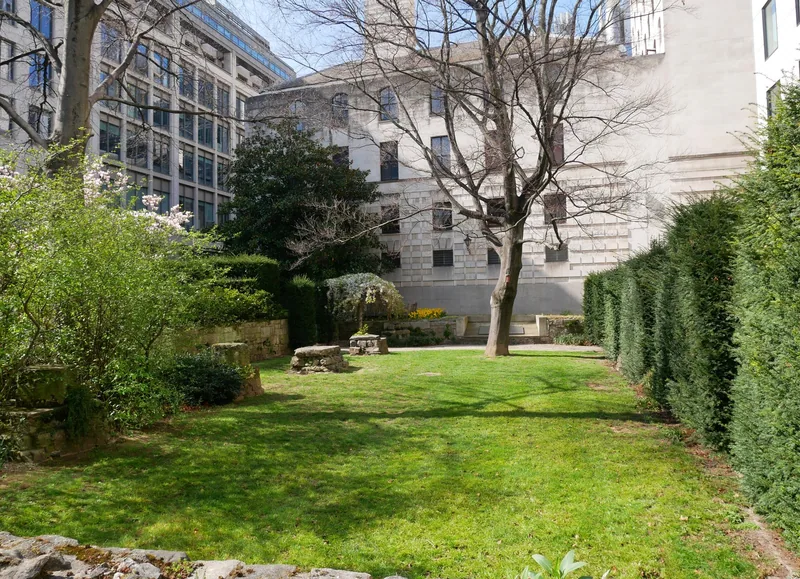
Photo: Doyle of London · CC BY-SA 4.0 · Wikimedia Commons · resized
Eight gardens, and what is actually in each
| Garden | What you go for | Nearest station |
|---|---|---|
| Finsbury Circus Gardens | What remains of Moor Fields, London's first public park, from 1607. The present garden was laid out in 1815 to a design by George Dance the Younger. Mature London planes and a Japanese pagoda tree, the only one in the City | Moorgate or Liverpool Street |
| Aldgate Square | A central lawn between a school and St Botolph without Aldgate, with raised planters, a curve of pleached hornbeams along the south side and a water feature of parabolic jets that children play in. Drinking fountains here and at Middlesex Street | Aldgate |
| Seething Lane Garden | Samuel Pepys's ground: he lived and worked at the Navy Office here and watched the Great Fire from it. Carved pavers set into the garden refer to his life, including one of the parmesan cheese and wine he is said to have buried during the fire. Formal lawn and a pergola | Tower Hill |
| St Mary Aldermanbury Garden | The footprint and lower walls of a Wren church that is no longer here: the remains were shipped to Fulton, Missouri in 1966 and rebuilt as a memorial to Churchill's Iron Curtain speech. Flower beds and benches inside the outline | St Paul's, Moorgate or Bank |
| Distaff Lane Garden | The newest of them, opened in 2018 to a design by Tom Stuart-Smith. A water wall patterned on fish scales, for the fish market that was here, and Michael Ayrton's 1973 sculpture Icarus, moved in from Old Change Court | Mansion House or St Paul's |
| Festival Gardens | The City's contribution to the 1951 Festival of Britain, laid out by Sir Albert Richardson: benches round a lawn beside a fountain, with the south side of St Paul's above it. The shape follows the streets the Blitz removed | St Paul's or Mansion House |
| Whittington Garden | Named for Dick Whittington, buried in 1423 in St Michael Paternoster Royal next door. Planted beds round a central fountain and shaded grass. The quietest of the eight | Cannon Street |
| Beech Gardens, Barbican Estate | Wide beds of mixed perennials, grasses and bulbs chosen for the estate's unusual growing conditions, planted for colour from spring to autumn and for seed heads and texture in winter, with multi-stemmed trees and shrubs for height | Barbican |
Finsbury Circus is the one with a legal status
Of the eight, only Finsbury Circus is a registered historic landscape. It is on Historic England's Register of Parks and Gardens at Grade II, entered on 1 October 1987 as list entry 1001259, which is the reason its outline survived the Crossrail works that used it as a construction site for years.
It is also the one with the strongest claim on the word "first". The City describes it as what remains of Moor Fields, London's first public park, dating from 1607, with the present oval laid out in 1815 by George Dance the Younger. The planes round the rim are the mature ones; the Japanese pagoda tree is the specimen the City singles out as the only one in the Square Mile.
Go at lunchtime on a weekday and it is full. Go on a Saturday and you will have the oval to yourself, which is the pattern for every garden on this page.
Seething Lane and the rose that costs a rent
Seething Lane Garden sits between Seething Lane and 10 Trinity Square, a couple of minutes from Tower Hill, and it rewards looking down rather than around. The paving is carved with references to Pepys's life, and the one people photograph is the parmesan cheese and the wine he is supposed to have buried in a garden here as the Great Fire came up the hill.
The other thing attached to this ground is a rent. The City records the Knollys Rose Ceremony here as an ancient custom dating from 1381: permission to build a bridge across Seething Lane carried an annual charge of one red rose from the garden. It is one of the City's smallest ceremonies and it belongs to a garden most visitors walk straight past.
From here the bombed shell of St Dunstan in the East is five minutes west. Its own page has the detail; in short, the church was begun about 1100, Wren's tower and steeple survived the bombing of 1941, the decision not to rebuild was taken after the war, the City resolved to make a garden of the remains in 1967 and it opened in 1970.
The garden that is somewhere else
St Mary Aldermanbury Garden is the strangest of them, and the strangeness needs explaining because the sign does not do it justice. The medieval church burned in the Great Fire of 1666, Wren rebuilt it, and the Blitz gutted it in 1940, leaving the walls.
In 1966 the remains were shipped to Fulton, Missouri, and rebuilt there as a memorial to the speech Winston Churchill gave at Westminster College in 1946, the one that gave the phrase Iron Curtain its currency. What is left in London is the plan of the church on the ground, with flower beds and benches inside it, a few minutes from Guildhall.
If ruined-church gardens are the thread you want to follow, our page on the City's Wren churches and what time they open is the companion piece, because several of these gardens are the churchyards of buildings that are still in use.
The route, west to east, in about two hours
Start at Barbican station and drop into Beech Gardens on the estate's high walk, which is also the way to the Barbican Conservatory if you have timed your day for one of its open afternoons. Walk south through the estate to St Mary Aldermanbury Garden, then to Guildhall.
From Guildhall go south-west to Festival Gardens beside St Paul's, then south to Distaff Lane Garden, then south-east to Whittington Garden near Cannon Street. Cut north-east to Postman's Park if you have not seen the memorial tablets; otherwise carry on east.
Finish at Seething Lane and Aldgate Square, which are ten minutes apart at the eastern end, and come out at Aldgate or Tower Hill. Finsbury Circus is the one that does not fit the line: add it at the start from Moorgate, or treat it as a separate stop.
Beech Gardens is the one to check before you set out with a wheelchair or a pushchair. It sits on the Barbican Estate's raised walkway level rather than on the street, and the lifts and ramps up to it are signed but easy to miss; allow extra time. The other seven are at street level, though the City publishes no accessibility detail for individual gardens, so we would not promise a level entrance at every gate.
What is missing, and where to find it
Three things a visitor expects and will not find. There are no cafés inside these gardens and no kiosks; the food is on the surrounding streets, and our guide to eating near St Paul's covers the middle of the route. There are no public toilets in any of them. And there is no information board in most: the City's garden pages carry the history, and there is often nothing at all on site.
There is also no drinking water except at Aldgate Square, which has fountains in the square itself and at the junction of Middlesex Street and St Botolph Street. On a hot day, fill up there.
All eight belong on our list of free things to do in London, and they are the best answer to the question of what a visitor does in the Square Mile at the weekend, when the offices, and with them most of the cafés, are shut. If you want the reason the City behaves like this at all, our explainer on how the City of London works covers the Corporation, the wards and the 11,000 acres of green space it owns outside its own boundary. Travellers arriving at London City Airport are a straightforward DLR ride from Aldgate and Tower Hill, at the eastern end of this walk.
Frequently asked questions
How many gardens does the City of London have?
Its Gardens team manages around 180 sites, a figure that includes parks, gardens, churchyards, plazas and highway planting as well as 1,400 trees, plus Bunhill Fields Burial Ground just outside the City in Islington. The City publishes individual profiles for fourteen of them.
What time do the City of London gardens close?
The City does not publish closing times garden by garden. Gardens with gates are locked around dusk and unlocked in the morning. The City does publish a 24-hour number, 020 7374 4127, for anyone who finds themselves locked inside a City park, garden or churchyard.
Are the City gardens free?
Yes, every one of them, with no ticket, booking or donation. They are funded and maintained by the City of London Corporation, which also looks after around 11,000 acres of green space across London and the South East.
Which City garden is the oldest?
Finsbury Circus Gardens has the oldest claim: the City describes it as what survives of Moor Fields, London's first public park, dating from 1607, with the present layout designed by George Dance the Younger in 1815. It is the only one of the gardens on this page that is a registered historic landscape, at Grade II.
Is there a garden in the City with a water feature children can play in?
Aldgate Square. Its parabolic jets are designed to be watched and played in, and there are drinking water fountains in the square. It sits between The Aldgate School and the church of St Botolph without Aldgate, just west of Aldgate Underground station.
Sources
- City of London Corporation – How we manage our gardens (around 180 sites, 1,400 trees, dated 31 July 2025) (checked September 2026)
- City of London Corporation – Find a garden (checked September 2026)
- City of London Corporation – City gardens, including the 24-hour number for visitors locked in (checked September 2026)
- City of London Corporation – Finsbury Circus Gardens (checked September 2026)
- City of London Corporation – Seething Lane Garden and the Knollys Rose Ceremony (checked September 2026)
- City of London Corporation – Distaff Lane Garden (checked September 2026)
- Historic England – National Heritage List for England open data (Finsbury Circus, register entry 1001259, Grade II, 1 October 1987) (checked September 2026)