
Filipino food in London is concentrated in a short stretch of Earl's Court Road, with a second cluster around Kentish Town and Camden and shops scattered near the big hospitals. Order adobo if you want one dish, sisig if you want the dish Filipinos order, and halo-halo afterwards.
This is the cuisine London noticed last. Filipino families have been here since the 1970s, many of them recruited to work in hospitals and care homes, but for decades the food stayed inside the community: church halls, remittance shops with a hot counter at the back, parties. In the last few years it has come out, and our food and drink section now has a growing number of places serving it to people who have never eaten it.
It tastes nothing like the Chinese, Thai or Vietnamese food most visitors expect from South East Asia. The dominant flavours are sour and salty rather than hot: vinegar, soy, garlic, tamarind, fish sauce and the small green citrus called calamansi. Chilli is a condiment, not a base.
Filipino London at a glance
- Earl's Court
- Earl's Court Road, Zone 1 and 2, District and Piccadilly lines. The densest concentration of shops and restaurants
- North London
- Kentish Town and Camden, Zone 2, Northern line
- Elsewhere
- Bayswater, Woolwich, Barking, Croydon, Hounslow and near several large hospitals
- Jollibee, Earl's Court
- 180 Earl's Court Road, SW5 9QG. Open 09:00 to 23:00 daily (September 2026); check current hours on the company's own page
- Order first
- Chicken adobo with garlic rice; sisig if there are two of you
- Best day
- Sunday, when the community eats out and the shops are busiest
- Christmas
- Filipino Christmas starts in September and peaks with dawn masses from 16 December
Why Earl's Court
Earl's Court was a cheap, central place to live when Filipino nurses, domestic workers and hotel staff began arriving in numbers, and it had the two things a new community needs: rented rooms and a church. The shops followed the people, and although many families have long since moved out to Barking, Woolwich and Croydon, they still come back to Earl's Court Road to shop.
What you find there is a short run of businesses that do three jobs at once: sell frozen fish and ube jam, send money home, and serve hot food from a counter at the back. Our guide to Earl's Court and West Brompton covers the area, which most visitors only see on the way to an exhibition or a hotel.
The north London cluster around Kentish Town grew the same way, around a church and a hospital. Both are ordinary high streets with Filipino businesses on them, not districts you visit to look at.
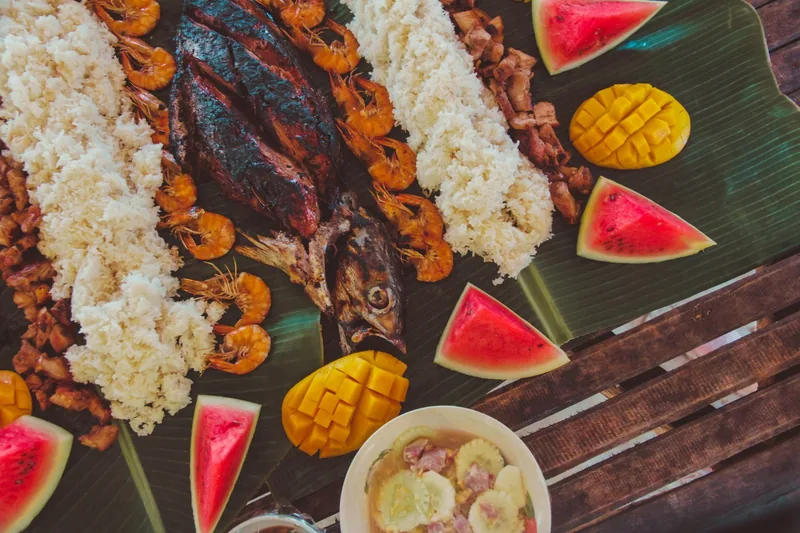
Turo-turo: point, point
The counter at the back of a Filipino shop is called a turo-turo, which means "point-point". A row of trays holds whatever was cooked that morning, you point at two or three, and they go over rice in a box. It is the same idea as the West African hot counters described in our page on Nigerian and Ghanaian food, at a similar price, and it is the cheapest sit-down meal in that part of London.
Two practical notes. The trays are cooked in the morning and the best things go by early afternoon, so one o'clock beats four. And nothing is labelled in English in some shops, so pointing and asking "what is this?" is expected rather than rude.
What to order, in the order to order it
| Dish | What it is | Notes |
|---|---|---|
| Adobo | Chicken or pork braised in vinegar, soy, garlic, bay and black peppercorns | The national dish and the right first order. Sour, salty, dark, not hot |
| Sisig | Chopped grilled pork cheek and ear on a sizzling iron plate, with onion, chilli and an egg cracked over it | Squeeze calamansi over it and mix at the table. Designed to be eaten with beer |
| Sinigang | A clear sour soup, usually with pork or prawns, soured with tamarind | Sharper than it sounds. The comfort food most Filipinos miss most |
| Kare-kare | Oxtail and vegetables in a thick peanut and annatto sauce | Deliberately under-seasoned; the salt comes from the bagoong served beside it |
| Lechon kawali | Pork belly boiled then deep-fried until the skin shatters | Eaten with a sour dipping sauce or liver gravy |
| Pancit | Noodles: bihon (thin rice), canton (wheat), or palabok with shrimp sauce and crushed pork crackling | Served at every birthday, because long noodles mean long life |
| Lumpia | Spring rolls. Shanghai are small and fried; fresh lumpia are soft and unfried | Ordered by the plate to share |
| Silog breakfasts | Garlic fried rice and a fried egg with cured meat: tapsilog with beef, tocilog with sweet pork, longsilog with sausage | Eaten at any hour. The best-value thing on most menus |
Rice comes with everything, including breakfast, and it is plain unless the dish says garlic. The table condiments matter more than in most cuisines: patis is fish sauce, suka is vinegar, usually with crushed garlic and chilli in it, and bagoong is fermented shrimp paste, which is pungent, salty and the making of kare-kare.
Calamansi is not a small lime. It is a separate citrus, more orange than lime inside, and it is squeezed over sisig, grilled meat and noodles rather than served as a garnish. If a wedge arrives beside your plate, use it. Most dishes are built assuming you will.
Jollibee, and whether it is worth the queue
Jollibee is the Philippine fast-food chain that outsells the American ones at home, and its first British branch opened on Earl's Court Road in 2018 to queues that lasted days. It is still there, at 180 Earl's Court Road, two minutes from the station, and the company lists it as open from 09:00 to 23:00 every day; there are now other branches across London.
What to have: Chickenjoy, fried chicken with a thin, brittle crust and a small tub of savoury gravy; Jolly Spaghetti, which is sweet and contains sliced hot dog and is either delightful or baffling depending on whether you grew up with it; and the peach mango pie, which is a deep-fried pastry turnover and is genuinely good. Palabok appears on the menu too and is closer to real Filipino cooking than anything else on it.
It is a fast-food restaurant, not a cuisine lesson. Go for the fried chicken and the curiosity, then eat at one of the small places down the road for the actual food. Our guide to burgers and fried chicken in London sets it against the rest of the city's chicken.
Halo-halo, ube and the sweet end
Halo-halo means "mix-mix" and that is the instruction. A tall glass is packed with shaved ice, evaporated milk, sweetened beans, strips of jelly, preserved fruit, a cube of leche flan and a scoop of purple ube ice cream, and you stir the whole thing into a slush before eating it. It is a hot-afternoon dish and it is the single best thing to order on a first visit after the main course.
Ube, the purple yam, is everywhere else too: in ice cream, in the jam called ube halaya sold in jars, in cakes and in the bread rolls. Leche flan is a dense caramel custard, turon is banana and jackfruit rolled in pastry and fried in caramelised sugar, and pandesal, a soft slightly sweet roll, is the everyday bread. For the wider picture, see our guide to desserts, ice cream and chocolate in London.
The shops, and what to carry home
Filipino grocers are small and densely stacked. The freezers hold longganisa sausages, tocino, milkfish and banana leaves; the shelves hold ube halaya, banana ketchup, sachets of sinigang mix that make the soup properly at home, coconut vinegar, and a wall of instant noodles. Most also sell bread and cakes from a Filipino bakery, including ensaymada, a soft brioche-like roll topped with butter, sugar and grated cheese.
A packet of sinigang mix, a bottle of coconut vinegar and a jar of ube costs very little and travels in hand luggage. Our page on eating cheaply in London covers the rest of the low-cost options, and London's food markets the fresh end.
Sunday is the day the community eats out. Filipino London still works largely around Sunday, the traditional day off for care and hospital staff, and the shops, the counters and the restaurants are all at their busiest and best-stocked early on a Sunday afternoon. If you are planning one visit, make it then. Our page on how a Sunday works in London covers what else is open.
Christmas, which starts in September
The Philippines keeps the longest Christmas season in the world, and Filipino London keeps it too: decorations go up in the shops from the start of September, and the parol, a star-shaped lantern, appears in windows from then on.
The intense part runs from 16 to 24 December, when Simbang Gabi, a series of dawn masses, fills Filipino churches before six in the morning. Outside afterwards you will find bibingka, a rice cake baked over coals and topped with salted egg and cheese, and puto bumbong, purple rice steamed in bamboo tubes and served with butter, sugar and coconut. It is the one time of year the food is sold on the street. Our guide to Christmas in London covers the rest of the city's December.
Vegetarians, allergies and children
Filipino cooking is heavily pork- and fish-based and vegetarians will find it hard work. Fish sauce and shrimp paste season a great deal of what looks vegetable, including pinakbet and many noodle dishes. Ask specifically about patis and bagoong. Lumpiang sariwa, some ginataang vegetable dishes and plain garlic rice are workable; see vegan and vegetarian London.
Peanuts are the base of kare-kare. Shellfish appears as shrimp paste and in palabok. Soy and wheat are in most braises and noodles. Say what you cannot eat when you order at a counter, before anything is put in the box; our page on gluten-free eating in London explains what a business must tell you.
Children generally take to this food quickly, because so little of it is hot: adobo, pancit, lumpia, fried chicken and rice cover most of a family table. Our family guide to London has more on eating out with children.
Where it sits among London's other Asian kitchens
If you have eaten the Chinese and Vietnamese food covered in our guides to Chinese food beyond Chinatown and Vietnamese food on Kingsland Road, Filipino cooking will surprise you: Spanish colonial names on Chinese-derived noodles, American processed meat in the breakfasts, and a sourness that neither of the others has. It is the most mixed cuisine in the region and London is only now catching up with it.
Frequently asked questions
Where can I eat Filipino food in London?
Earl's Court Road has the highest concentration of shops, counters and restaurants, with a second cluster around Kentish Town and Camden and more near large hospitals in Woolwich, Barking, Croydon and Hounslow. Sunday afternoon is when all of them are busiest.
What should I order first in a Filipino restaurant?
Chicken adobo with rice is the safest and most representative dish: braised in vinegar, soy, garlic and bay, salty and sour rather than hot. If there are two of you, add sisig, and finish with halo-halo.
Is Filipino food spicy?
Rarely. The defining flavours are sour and salty rather than hot, and chilli usually arrives as a condiment on the table or in the dipping vinegar. Bicol Express and some sisig versions are the exceptions.
What is halo-halo?
A dessert of shaved ice, evaporated milk, sweet beans, jelly, preserved fruit, caramel custard and purple yam ice cream served in a tall glass. The name means "mix-mix", and you are meant to stir it all together before eating rather than work down through the layers.
Is the Jollibee in Earl's Court worth visiting?
For the fried chicken and the curiosity, yes. It is at 180 Earl's Court Road, two minutes from the station, listed as open 09:00 to 23:00 daily in September 2026. It is fast food rather than a representative Filipino meal, so eat there and then try a turo-turo counter nearby.
Sources
- Jollibee UK - Earl's Court: address and opening hours (checked September 2026)
- Transport for London - Fare capping (checked September 2026)
- Food Standards Agency - Food allergy and intolerance advice for consumers (checked September 2026)
- Food Standards Agency - Food hygiene ratings search (checked September 2026)