
Proper fish and chips means a fillet of white fish, usually cod or haddock, fried in crisp batter and served with thick-cut chips, salt and vinegar. In London you can buy it to take away from a local "chippy" or sit down to it in a fish and chip restaurant, and knowing a few words on the menu makes ordering much easier.
Fish and chips is Britain's best-known takeaway, and it has been sold in London since the 19th century. It is simple food, so the difference between a great plate and a sad one is all in the details: fresh fish, clean oil, batter that shatters rather than bends, and chips that are fluffy inside. A good chippy fries to order, and you can hear it.
This guide explains how a chip shop works, what the extras on the board mean, and where to find reliable fish and chips in central London. For the other great British dishes, see our overview of traditional British food.
Fish and chips at a glance
- Classic order
- Cod or haddock and chips, with salt, vinegar and mushy peas
- Chippy
- A fish and chip shop, mainly for takeaway, sometimes with a few tables
- Restaurant
- Table service, knives and forks, often a wider fish menu and a service charge
- Portion size
- Large; a large portion of chips is often enough for two
- Payment
- Contactless cards widely accepted; some small shops prefer cash
- Allergies
- Batter contains wheat; ask about gluten-free batter and shared fryers
Chippy or restaurant: which to choose
There are two ways to eat fish and chips in London. The traditional chippy is a small shop with a counter, a menu board and a row of fryers. You order at the counter, wait a few minutes, and take your food away wrapped in paper or in a cardboard box. Some chippies have a few tables for eating in. They are usually the cheapest option and often the most authentic.
A fish and chip restaurant works like any other restaurant: a waiter takes your order, the fish arrives on a plate, and you may be offered wine or beer. The menu is often longer, with grilled fish, starters and puddings. It costs more, and a service charge may be added. On a cold or wet day, or with children, a sit-down restaurant is more comfortable.
Many pubs also serve fish and chips, sometimes very well. Pub versions are usually a little more expensive than a chippy but cheaper than a restaurant, and come with a pint if you want one. Our guide to London's historic pubs covers places where the building is part of the experience.
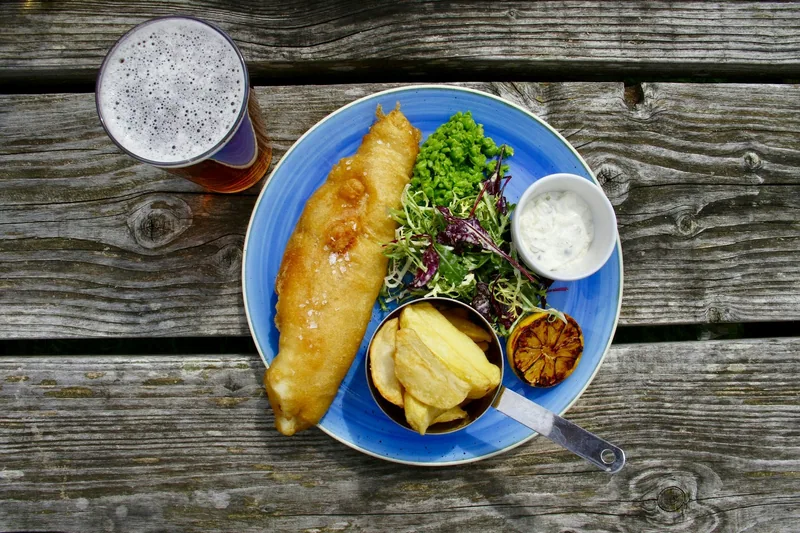
How to order in a chippy, step by step
Chip shops can move fast at busy times, and the staff may speak quickly. This is the usual sequence:
- Choose your fish. Say the fish first: "cod and chips, please" or "haddock and chips". Some shops offer small and large fish.
- Choose your chips. You may be asked "small or large chips?" A small portion is often enough for one adult with fish.
- Eat in or take away. This affects how the food is packed and, in some places, the price.
- Salt and vinegar? Staff will often ask before wrapping. Say yes, no, or ask for them on the side.
- Add extras. Mushy peas, curry sauce, a pickled onion or a drink (the list below explains them).
- Pay. Contactless card is normal; a few small shops prefer cash or set a minimum card spend.
Say "open" if you want to eat it straight away. Takeaway fish and chips is often wrapped closed to keep it hot. If you plan to eat on a bench round the corner, ask for it open, or at least ask for a wooden fork. Closed wrapping steams the batter and softens it within minutes.
The fish on the menu
Cod and haddock are the two classics, and preferences are partly regional: haddock is traditionally more popular in the north of England and Scotland, and cod in the south. In London you will almost always find both.
| Fish | What it is like |
|---|---|
| Cod | Large, white, flaky and mild. The default choice in most London chippies. |
| Haddock | Slightly firmer and a little more flavourful than cod. |
| Plaice | A thin flatfish with a delicate, sweet taste. The restaurant name Rock & Sole Plaice is a pun on three fish. |
| Rock (or rock salmon) | Not salmon at all but a small shark, also called huss or dogfish. Firm, with a central bone. |
| Skate | A flat, wing-shaped fish with soft, stringy flesh and cartilage instead of bones. |
| Scampi | Breaded langoustine (a kind of small lobster), usually served with tartare sauce. |
If sustainability matters to you, look for the blue Marine Stewardship Council (MSC) label on the menu or in the window, or ask where the fish comes from. Many London fish and chip restaurants now say on their websites where they buy their fish.
What the extras on the board mean
The side orders are where visitors most often get lost. Here are the ones you will see most:
- Mushy peas: dried marrowfat peas soaked and cooked until soft. Bright green, thick and slightly sweet. The classic side.
- Curry sauce: a mild, thick, slightly sweet sauce for dipping chips. Nothing like an Indian restaurant curry, but much loved.
- Gravy: more common in the north of England, but some London shops sell it.
- Pickled onion and pickled egg: sold from big jars on the counter. Sharp and vinegary.
- Gherkin: a large pickled cucumber.
- Saveloy: a bright red, smoked pork sausage, boiled rather than fried.
- Battered sausage: a sausage dipped in batter and deep-fried.
- Fishcake: fish and potato shaped into a patty and fried; a cheaper alternative to a whole fillet.
- Scraps (or "bits"): loose pieces of fried batter, sometimes given free on request in some shops.
- Chip butty: chips in a buttered bread roll. Starchy and filling.
- Tartare sauce: mayonnaise with capers and gherkins, usually served with fish in restaurants.
On vinegar: in many chip shops the liquid in the bottle is a vinegar substitute called "non-brewed condiment" rather than malt vinegar. It tastes similar. Restaurants usually bring real malt vinegar to the table.
Where to eat good fish and chips in central London
London has hundreds of chippies, and the best one is often simply the busy one near where you are staying. A queue of locals at a small neighbourhood shop is a stronger recommendation than any sign in a tourist street. That said, a few long-established places are easy to reach and well known.
Rock & Sole Plaice, Covent Garden
On Endell Street in Covent Garden, Rock & Sole Plaice says it was established in 1871 and describes itself as London's oldest fish and chip restaurant. It has indoor seating and tables outside, which makes it a convenient stop before a West End show. Check the menu and book on the restaurant's website.
Poppies: Spitalfields, Soho, Camden and Portobello
Poppies traces its story back to 1952, when its founder, known as "Pops", set out to make the best fish and chips in London. It now has four restaurants, in Spitalfields, Soho, Camden and on Portobello Road, all decorated in a retro style. The branches are handy for the Spitalfields and Brick Lane markets, for Soho, for Camden Town and for Portobello Road Market. Addresses and menus are on the Poppies website.
Other names worth knowing
The Golden Hind on Marylebone Lane in Marylebone says it has served fish and chips since 1914. Outside the centre, many neighbourhoods have their own respected chippies with decades of history, and locals are loyal to them. None of these places is the only good choice: use them as a starting point, and look at recent reviews and the Food Standards Agency's food hygiene ratings before you go.
Takeaway is the cheapest way to eat it well. The same fish often costs noticeably less from the counter than at a table, and there is no service charge. On a dry evening, take it to a nearby square or park bench, and eat it hot from the paper.
What it costs and how to keep it cheap
Prices vary a lot between a neighbourhood chippy and a central London restaurant, and they change often, so check the menu before you order. As a rough guide, takeaway from a chippy costs clearly less than a sit-down meal, and a restaurant may add a discretionary service charge to the bill. By law, all tips and service charges must be passed to staff in full; see our guide to tipping in London.
For a family, sharing works well. Chip portions are generous, and many chippies sell children's portions or a small fish. Two adults and two children can often manage on three fish and two portions of chips. Our guide to cheap eats in London has more ideas for eating well on a budget.
Where to eat takeaway fish and chips is part of the fun. On a fine day, a park bench is hard to beat; Regent's Park and Primrose Hill are an easy walk from Camden. Remember to take your rubbish with you or use the bins.
Gluten-free, vegetarian and allergy advice
Traditional batter is made with wheat flour, so standard fish and chips is not suitable for people with coeliac disease. Some chippies and restaurants offer gluten-free batter, sometimes only on certain days or in a separate fryer. Ask before you order, because chips cooked in the same oil as battered fish may not be safe. Our guide to gluten-free eating in London has more advice.
Food businesses must be able to tell you if a dish contains any of the 14 regulated allergens, which include fish, crustaceans, molluscs, cereals containing gluten, eggs and mustard. The information may be on the menu or available from staff. Vegetarians should ask what oil and fat are used for frying: some traditional shops use beef dripping, which gives a particular flavour but is not vegetarian.
Shared fryers make "fish-free" chips uncertain. If you have a fish or shellfish allergy, chips fried in the same oil as fish and scampi may still cause a reaction. Tell staff about the allergy before ordering and ask whether chips are fried separately.
When to go, and a taste of the seaside
Friday is traditionally a fish day in Britain, and chippies are busiest on Friday evenings. Lunchtime and early evening on weekdays are quieter. Many chippies stay open into the evening, which makes them a useful late meal after a show or a night out; our guide to London at night has more after-dark ideas.
If you want fish and chips the way many British people remember it, by the sea, take a day trip. Brighton is an easy day trip by train, and eating chips on its seafront is a British summer ritual.
Frequently asked questions
What is the best fish to order in a London chip shop?
Cod is the most popular choice in London, with large, mild, flaky fillets. Haddock is slightly firmer and has a little more flavour. If you want something different, try plaice or rock, but ask the staff what is freshest that day.
What are mushy peas?
Mushy peas are dried marrowfat peas that are soaked and cooked until they break down into a thick, bright green purée. They are the traditional side dish with fish and chips, slightly sweet and often eaten with a splash of vinegar.
Is fish and chips gluten-free?
Not usually. Traditional batter is made from wheat flour. Some London chippies and restaurants offer gluten-free batter, sometimes on set days or cooked in a separate fryer. If you have coeliac disease, ask how the fish and chips are cooked before you order.
Do I need to tip in a fish and chip shop?
No. In a takeaway chippy you order and pay at the counter, and tipping is not expected. In a sit-down fish and chip restaurant a discretionary service charge may be added to the bill; check the menu and the bill.
What is the oldest fish and chip shop in London?
Several places claim a long history. Rock & Sole Plaice in Covent Garden says it was established in 1871 and calls itself London's oldest fish and chip restaurant. The Golden Hind in Marylebone says it has been serving since 1914.
Sources
- Rock & Sole Plaice - London's oldest fish and chip restaurant (checked September 2026)
- Poppies Fish & Chips - Traditional fish and chips in London (checked September 2026)
- Food Standards Agency - Food allergy and intolerance advice for consumers (checked September 2026)
- Food Standards Agency - Food Hygiene Rating Scheme (checked September 2026)
- GOV.UK - Distributing tips fairly: statutory code of practice (checked September 2026)