
Two separate food cultures share this page because they share a shelf in London: Georgian restaurants, which cook cheese bread, walnut sauces and soup dumplings, and the Central Asian bakeries that bake bread and meat pastries by sticking them to the inside wall of a clay oven. The first is a sit-down meal. The second is a counter where you point, pay a couple of pounds and walk out with something hot.
Georgian food is the more familiar of the two, having arrived in London properly in the last fifteen years, mostly in Islington, Holloway and Hackney with a few rooms in west London. Central Asian bread is much older here and almost invisible: Afghan, Uzbek and Uyghur bakeries have been working in Southall, Hounslow, Tooting, Wembley and Walthamstow for years, largely serving their own communities. Our guide to Turkish food in London covers the nearest thing most visitors have eaten.
Nothing on either menu is hot with chilli. The seasoning is walnut, coriander seed, fenugreek, cumin, garlic and sour fruit, which puts both closer to the cooking described in our page on Persian food in London than to anything further east.
Georgian and Central Asian London
- Georgian restaurants
- Islington, Holloway Road and Hackney, with a few in Bayswater and Kensington
- Tandoor bakeries
- Southall and Hounslow (Afghan), Tooting and Wembley, Edgware Road, Colindale, Green Street and Walthamstow
- Order first
- Adjaruli khachapuri and five khinkali in a Georgian restaurant; a round of non and two samsa at a bakery
- Bakery prices
- Bread and samsa are sold by the piece for small change. Some counters are cash only
- Drink
- Georgian amber wine from clay qvevri; green tea from a bowl in Central Asian cafes
- Timing
- Bakeries bake through the morning and sell out. Georgian meals run long; book at weekends
Khachapuri, and which of the four to order
Khachapuri is bread and cheese, and there is a regional version for almost every part of Georgia. Four turn up on London menus and they are not interchangeable.
| Type | What arrives | Who it is for |
|---|---|---|
| Imeruli | A flat round loaf with the cheese sealed inside, cut into wedges | The everyday one. Order it for the table alongside other dishes |
| Megruli | The same, with more cheese melted over the top | Richer; one between three people |
| Adjaruli | An open boat of dough filled with molten cheese, a raw egg yolk and a slab of butter | The one people photograph. Stir the egg and butter into the cheese immediately, then tear off the crust and dip |
| Lobiani | The same bread filled with spiced beans instead of cheese | The vegan-friendly version, and the one Georgians eat in winter |
An adjaruli is a meal on its own for one person and a shared starter for three. Ordering one each, which is what most first-time tables do, is the commonest mistake in a Georgian restaurant and it ends the evening early.
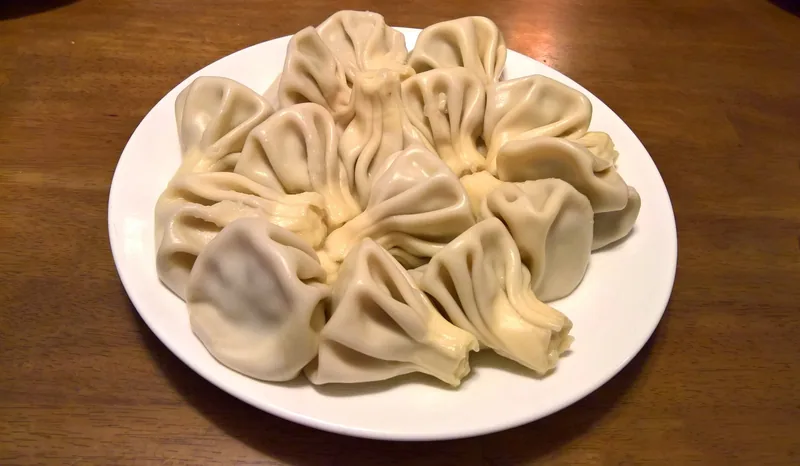
Photo: MIKHEIL · CC BY-SA 4.0 · Wikimedia Commons · resized
Khinkali, and the correct way to eat them
Khinkali are large pleated dumplings, filled with spiced minced meat and, crucially, with broth that forms as they cook. They are ordered by the piece, usually a minimum of five, and they arrive plain with black pepper on the side.
There is a method, and getting it wrong means soup on the table.
- Pick one up by the thick knot of dough at the top, with your fingers. Do not use a fork; the skin will tear.
- Turn it upside down and bite a small hole in the side.
- Drink the broth out before you eat anything else.
- Eat the rest, and leave the knot on your plate.
The pile of knots at the end is how Georgians count who ate most, and leaving them is the normal thing rather than waste. Grind black pepper over each one before you start. For the same idea executed in a different tradition, see our guide to dim sum in London.
Order in two waves in a Georgian restaurant. Start with pkhali, badrijani and one imeruli khachapuri, eat those, then decide about khinkali and a main. The starters are small plates of vegetables and walnut and look modest; the bread and dumplings that follow are enormous. Georgian portions are built for a feast with toasts, not for two people having dinner before the theatre.
The rest of the Georgian menu
The cold starters are the part visitors skip and should not. Pkhali are small pâtés of spinach, beetroot or beans pounded with walnuts, garlic and coriander, served as coloured mounds topped with pomegranate seeds. Badrijani nigvzit are slices of fried aubergine rolled around the same walnut paste. Both are vegan, both are cheap, and both are better than they look.
For mains: shkmeruli is chicken cooked in milk and an alarming quantity of garlic; chakhokhbili is chicken stewed with tomato and herbs; ostri is a sour, peppery beef stew; mtsvadi is grilled pork or lamb, eaten with tkemali, a sharp sauce of sour plums; and lobio is a clay pot of red beans with coriander and walnut, served with cornbread. Satsivi, cold turkey or chicken in a thick cold walnut sauce, is a winter and new year dish.
Churchkhela is the sweet: walnuts or hazelnuts threaded on a string and dipped repeatedly in thickened grape juice until they look like a knobbly candle. They hang in rows in Georgian shops and keep for months.
Georgian wine, and why it is orange
Georgia makes wine in qvevri, large egg-shaped clay vessels buried to the neck in the ground, and the method is inscribed on UNESCO's list of intangible cultural heritage. White grapes fermented on their skins in a qvevri come out amber rather than pale, with tannin and a dried-apricot character that surprises people expecting a light white.
Ask for Rkatsiteli or Kisi if you want to try that. Saperavi is the main red, dark and firm. Chacha, the clear grape spirit, is what arrives at the end whether or not you asked. Our guide to wine bars in London covers where else amber wine has reached in the city, which is further than most people realise.
The other thing to know is the supra, the Georgian feast, run by a tamada or toastmaster who proposes a long sequence of toasts in a fixed order. You will not be in one as a visitor unless you are invited, but it explains why the portions and the wine arrive in the quantities they do.
The tandoor bakeries, and what to say at the counter
A Central Asian bakery is a small shop with a clay oven set into the floor or the wall. Discs of dough are stamped in the middle with a small spiked tool, slapped onto the hot inner wall and peeled off a few minutes later. The result is non, sometimes written naan: a round loaf with a thin crisp centre and a thick chewy rim, usually seeded with nigella or sesame.
The counters are quick and largely wordless, and nothing much is labelled in English. What to ask for:
- Non or naan, by the piece. Hold up fingers for how many. One is usually enough for two people and it is stale by the next morning.
- Samsa. A baked pastry of lamb, onion and fat, cooked stuck to the oven wall so the bottom is crisp and the top is glazed. Not the same thing as a fried Indian samosa, and much better.
- Bolani in Afghan bakeries: a thin flatbread folded around potato, leek or lentil and griddled, eaten with yoghurt.
- Halva and nabat from the jars on the counter, sold by weight.
Southall and Hounslow have the Afghan bakeries; Tooting, Wembley, Green Street and Walthamstow have a mix; the Edgware Road end of the trade overlaps with the Middle Eastern bakeries. Our guides to Southall and Walthamstow cover two of those areas, and the Elizabeth line puts Southall about twenty minutes from Paddington.
Two pounds at a tandoor bakery buys a better lunch than most sandwich shops. A samsa and a piece of non, eaten warm on a bench outside, cost less than a supermarket meal deal and are worth more. Buy them within an hour of baking; both are designed to be eaten immediately and neither improves on the journey home. Our page on eating cheaply in London has the rest of the low-cost map.
Plov, lagman and the Central Asian sit-down meal
Where there are bakeries there are usually one or two restaurants behind them. Plov, also written palov, osh or pilau, is the centrepiece: rice cooked slowly with lamb, yellow carrot, cumin and often chickpeas and raisins in a wide iron pan, then turned out in a mound. Uzbek palov and Tajik oshi palav each hold their own place on UNESCO's heritage list, and both are cooked for guests rather than for a weekday.
Lagman is hand-pulled wheat noodles with lamb and peppers, served either as a soup or stir-fried. Manti are big steamed dumplings of lamb and onion, eaten with yoghurt. Shashlik is grilled meat on a skewer, usually lamb, cooked over charcoal. Afghan kitchens add qabili palau, rice with lamb buried underneath and carrot and raisin on top, and ashak, leek dumplings under yoghurt and mint.
Tea is green, unsweetened and poured into small bowls rather than cups, and it is refilled constantly. Most of these places do not serve alcohol at all. Nearly all are halal; our guide to halal food in London explains how to confirm it.
Vegetarians, allergies and children
Georgian food is unusually good for vegetarians because the Orthodox fasting calendar produced a whole category of meat-free dishes: pkhali, badrijani, lobio, lobiani and most of the salads are vegan as cooked, and a table of them is a full meal. Central Asian food is much harder, being built on lamb and lamb fat, though bolani, non and some noodle dishes work. See vegan and vegetarian London.
Walnuts are the defining ingredient of Georgian cooking and they are in the starters, the sauces and the sweets, so a nut allergy makes a Georgian restaurant genuinely difficult; say so when booking. Wheat is in every bread on both menus, and dairy in most of the Georgian one; see gluten-free eating in London.
Children usually like both. Cheese bread, plain dumplings, grilled meat and rice are not a hard sell, and nothing needs explaining beyond how to hold a khinkali. Our family guide to London has more on eating out with children.
Where to fit it into a trip
Georgian restaurants sit mostly on the Northern and Piccadilly lines in north London, which makes them an easy dinner after a day in the centre; our guides to Islington and to Angel and Finsbury Park cover that ground. The bakeries are a morning errand rather than an evening out, and they combine well with the other food of the same suburbs.
If the sour, fermented, dill-and-soured-cream end of this food appeals, our page on Polish and eastern European food covers the other large community in London cooking in that direction, and London's bakeries puts the tandoor loaf next to the sourdough.
Frequently asked questions
What should I order on a first visit to a Georgian restaurant?
Pkhali and badrijani to start, one imeruli khachapuri for the table, then five khinkali between two people. Add an adjaruli khachapuri only if there are at least three of you. Drink an amber Rkatsiteli or a red Saperavi.
How do you eat khinkali?
Pick one up by the thick knot at the top with your fingers, turn it over, bite a small hole in the side and drink the broth out first. Then eat the rest and leave the knot on your plate. A fork tears the skin and loses the soup.
What is Georgian amber wine?
White grapes fermented on their skins in qvevri, large clay vessels buried in the ground, which gives the wine an amber colour, a tannic grip and a dried-fruit flavour. The qvevri method is on UNESCO's list of intangible cultural heritage. Rkatsiteli and Kisi are the grapes to ask for.
Where can I find Central Asian bread in London?
Afghan and Uzbek tandoor bakeries work in Southall and Hounslow, in Tooting and Wembley, around Green Street and Walthamstow, and at the Edgware Road end of the Middle Eastern trade. They sell round non by the piece and baked lamb samsa alongside it.
Is a samsa the same as a samosa?
No. A samsa is baked, not fried: the pastry is stuck to the inside wall of a clay oven, which gives it a crisp base and a glazed top, and it is filled with lamb and onion rather than spiced potato. It is denser, richer and usually cheaper.
Sources
- UNESCO Intangible Cultural Heritage - Ancient Georgian traditional qvevri wine-making method (checked September 2026)
- UNESCO Intangible Cultural Heritage - Palov culture and tradition (Uzbekistan) (checked September 2026)
- UNESCO Intangible Cultural Heritage - Oshi Palav (Tajikistan) (checked September 2026)
- Food Standards Agency - Food allergy and intolerance advice for consumers (checked September 2026)
- Food Standards Agency - Food hygiene ratings search (checked September 2026)