
A Somali meal in London is built round three things: suqaar, cubes of beef or lamb fried fast with onion, pepper and cumin; bariis iskukaris, rice cooked with a spice blend called xawaash; and canjeero, a thin fermented pancake eaten at breakfast. It arrives with a banana on the plate, not after it, and a main course is usually £8 to £14.
This is not Ethiopian food, although the two are often filed together. Our guide to Ethiopian and West African food covers injera, the coffee ceremony and the Camberwell cluster, and mentions Somali cooking in a paragraph. This page is the paragraph expanded: what the dishes are, where the restaurants actually are, how to pay, and why the whole tradition is among the best value in the city.
The cooking carries an Italian layer that surprises people. Southern Somalia was an Italian colony, and pasta - suugo suqaar, spaghetti with a spiced meat sauce - sits on Somali menus as a matter of course, eaten with the same banana alongside.
Somali food: the short version
- Order first
- Suqaar with rice, canjeero at breakfast, and a goat dish if it is on the board.
- Typical main
- £8 to £14 (our estimate from menus read in September 2026).
- The banana
- Served with the savoury food, to be eaten alongside it. This is not a mistake.
- Alcohol
- Almost never served. Tea, juice and soft drinks instead.
- Payment
- Cards are usual now, but the smallest cafes still prefer cash. Carry some.
- Where
- Woolwich, Tottenham, West Kensington and Fulham, Manor Park, Hounslow.
The dishes, in the order you will meet them
Canjeero (also canjeelo, and elsewhere lahoh). A fermented batter pancake, thinner and more lacy than Ethiopian injera, cooked on one side only. At breakfast it comes with sesame oil and sugar, or torn into a bowl with tea poured over it, or under suqaar. If a place is doing its own canjeero rather than buying it in, it will taste faintly sour and smell of the ferment.
Suqaar. The workhorse dish. Small cubes of beef, lamb, goat or chicken cooked hard and fast with onion, green pepper and a spice mix, and served with rice, canjeero or chips. Not saucy: the point is the browning on the meat.
Bariis iskukaris. Rice cooked with xawaash - a household blend built on cumin, coriander, cardamom, cinnamon and black pepper - often with a little sugar, raisins and sometimes a whole roasted pepper on top. Served under or beside meat.
Hilib ari. Goat, roasted or boiled and then fried, usually on the bone. The best thing on most menus and the most likely to sell out.
Sambusa. The Somali samosa: thicker pastry than the Indian version, filled with spiced mince or lentil, and the standard thing to eat while you wait.
Malawah, a sweet pancake, and basbaas, the green chilli and coriander sauce that comes to the table in a squeeze bottle. Use the basbaas: the food is deliberately mild without it.
Eat the banana with the rice, not after it. A whole or half banana on the side of a savoury plate is standard across Somali cooking. It is there to be mashed into the rice or eaten in alternate mouthfuls, and it works.
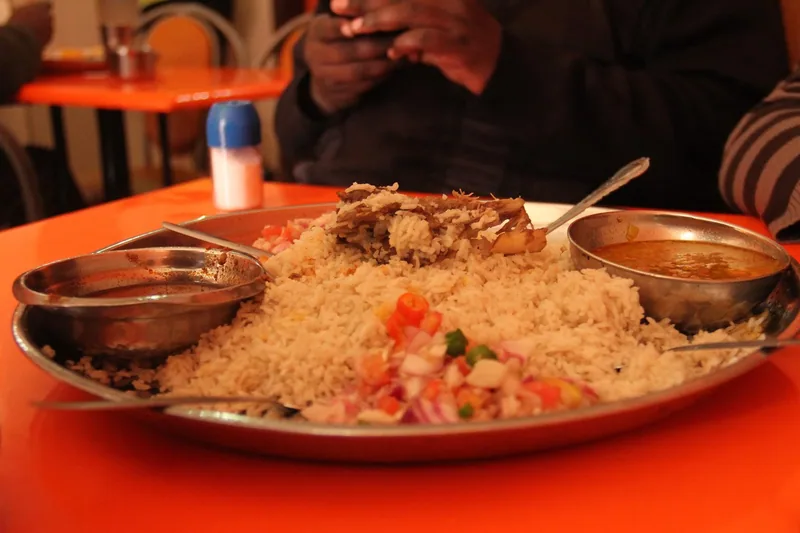
Photo: Andiwa Dixon · CC BY-SA 4.0 · Wikimedia Commons · resized
Woolwich, which is the strongest cluster
Woolwich has the most Somali businesses of any single town centre in London, and since 2022 it has also had the Elizabeth line, which puts it twenty-three minutes from Bond Street and makes it the easiest of these clusters to reach on a short trip.
Basbaas Authentic Somali Cuisine at 21 Anglesea Road, about four minutes on foot from the station, is registered with the Food Standards Agency as a catering premises and was rated 4 at its inspection in July 2025. The surrounding streets, Powis Street and Plumstead Road in particular, have Somali grocers and tea shops that are not restaurants in any formal sense: a counter, a kettle and four tables. Our Woolwich guide covers the town, the ferry and the foot tunnel.
Tottenham, and the restaurant most worth the journey
Sabiib Somali Restaurant at 5-6 Grand Parade, on the Green Lanes side of Tottenham, was rated 5 when it was inspected in November 2025, which is the highest current rating of any Somali restaurant we found in London. It sits on a parade that is otherwise Turkish and Kurdish, which tells you something about how these high streets layer.
Manor Park has Shanta Somali at 757 Romford Road, rated 3 in March 2026, on a stretch of the Romford Road that is worth walking for its own sake. Hounslow has Taste of Somalia on School Road, a takeaway rated 3 in June 2026, in the same town centre as the Afghan bakeries covered on our page about Afghan food in London.
West London, and the honest position on Shepherd's Bush
Sufra Somali Cuisine at 110 North End Road, between West Kensington and Fulham Broadway, was rated 4 in June 2026 and is the most central Somali kitchen we can point at with confidence.
Shepherd's Bush is the cluster everybody names, and it is real: the Uxbridge Road end has Somali cafes among the Middle Eastern, North African and Caribbean places, and our Shepherd's Bush guide describes that mix. We have not named one here, because the cafes on that stretch trade under general names and change hands, and we could not match a specific address to a current inspection. Walk it and look for canjeero on a handwritten board rather than trusting a list.
Check the individual address on the public register before you eat. On these high streets ratings run the full range within a hundred metres, and a Somali cafe is as likely to be rated 5 as the restaurant next door is to be rated 2. We name nothing rated below 3 anywhere on this site.
Tea, and the thing that takes an hour
Shaah - Somali tea - is black tea boiled with cardamom, cinnamon, clove and often ginger, sweetened heavily and sometimes made with milk. It is served in small glasses and refilled, and in a Somali tea shop nobody expects you to leave when the glass is empty. The tea shop is a social institution rather than a cafe with a menu, and the etiquette is simple: buy a tea, sit down, and stay as long as you like.
This is the opposite of the Ethiopian coffee ceremony, which is a formal sequence with three rounds and its own timing; our page on the Ethiopian coffee ceremony in London explains how that works and where to sit through one.
What it costs, and why
Our estimate from menus read in September 2026: sambusa £1 to £2 each, a main with rice £8 to £14, tea £1 to £2, sometimes free with a meal. Two people can eat properly for £25, which puts this among the cheapest full sit-down meals in London. Our guide to cheap eats in London has the comparison, and Tooting Market is the other end of the same value spectrum.
Two reasons for the price. These are neighbourhood restaurants with no drinks margin, because alcohol is not served, and the cuts used are the cheap ones cooked long. The corollary is that service is brisk, tips are not expected in the way they are in the centre, and nobody will try to sell you a second course.
Cards are normal, but keep some cash: the smallest tea shops and grocers still work on it, and a card minimum of £5 or £10 is common. Our page on money in London covers where cash still matters.
Halal, fasting and eating with your hands
Somali restaurants serve halal meat as a matter of course; the certification question and what British labelling law actually requires are set out on our page about halal food in London. During Ramadan the kitchens close through the day and open after sunset, often until one or two in the morning, and that is the best time of year to eat this food if you can manage the hours.
Canjeero is eaten with the right hand, torn and used to pick up the meat. Cutlery is always available and nobody minds which you use. Hand-washing before the meal is normal and many places have a sink in the dining room rather than in the toilets; use it.
Where this fits with the rest of East Africa
Eritrean cooking overlaps almost entirely with Ethiopian, down to the same fermented flatbread under a different name, with an Italian layer like the Somali one. Djiboutian food is close to Somali with more French influence. Kenyan and Tanzanian Swahili-coast cooking is a different thing again, built on coconut, tamarind and grilled fish, and it appears in London mostly in home catering rather than restaurants.
North African cooking - Moroccan, Algerian, Tunisian - is not part of this family at all, despite being filed next to it. Our page on Moroccan and North African food in London covers tagine, couscous and the Golborne Road cafes, and the two traditions share almost nothing beyond a continent.
Frequently asked questions
What is the difference between Somali and Ethiopian food?
Ethiopian food is built on injera, a thick spongy fermented flatbread, with wet stews called wat served on top of it and no cutlery. Somali food is built on rice and on canjeero, a thinner pancake, with drier fried dishes such as suqaar, an Italian-derived pasta tradition, and a banana served alongside the savoury course.
Why is there a banana with my Somali meal?
Because it belongs there. Across Somali cooking a banana is served with rice and meat, not as a dessert, and it is eaten in alternate mouthfuls or mashed into the rice. It sweetens and cools a spiced plate in the same way a chutney does elsewhere. Eat it with the food.
Where can I eat Somali food in central London?
There is very little in Zones 1 and 2. The closest we can recommend is on North End Road between West Kensington and Fulham Broadway, rated 4 in June 2026. Otherwise the clusters are Woolwich, which is now twenty-three minutes from Bond Street on the Elizabeth line, and Tottenham on the Victoria line.
Do Somali restaurants serve alcohol?
Almost none do, and most would rather you did not bring any. Somali tea, fruit juice and soft drinks are the alternatives, and the tea is usually the best of them: black tea boiled with cardamom and cinnamon, served sweet in small glasses and refilled without being asked.
Is Somali food spicy?
Mildly. The spicing is aromatic - cumin, coriander, cardamom, cinnamon - rather than hot, and the heat comes from basbaas, a green chilli sauce that arrives separately in a bottle so you can add as much or as little as you want.
Sources
- Food Standards Agency - food hygiene ratings register, every business named on this page, searched by name and by address (checked September 2026)
- Office for National Statistics - International migration, England and Wales, Census 2021 (checked September 2026)
- Transport for London - the Elizabeth line, for journey times to Woolwich (checked September 2026)
- GOV.UK - the Food Hygiene Rating Scheme and what each rating means (checked September 2026)