
Two very different traditions sit under the heading "African food in London". Ethiopian and Eritrean restaurants serve stews on a large sour pancake called injera, eaten with the hands and shared from one plate. West African restaurants, mostly Nigerian and Ghanaian, serve jollof rice, soups thickened with seeds and nuts, and grilled meat rubbed with chilli and peanut. Both are concentrated in south and east London.
Neither is difficult to eat once somebody explains the mechanics, and both are among the better value sit-down meals in the city. The obstacle for most visitors is not the food but the geography: almost none of it is in Zone 1.
This page covers the dishes, how each is meant to be eaten, and which streets to walk down. For the Caribbean shops that often share the same parade, see our guide to Caribbean food in London.
Where to eat
- Ethiopian and Eritrean
- Camberwell and Kennington, Dalston, and parts of west London. Denmark Hill, Zone 2, Windrush line, serves Camberwell
- Nigerian and Ghanaian
- Peckham's Rye Lane, Dalston's Ridley Road, Woolwich, Tottenham and Elephant and Castle
- Somali
- Southall, Wembley and parts of east London
- North African
- Moroccan and Algerian cafes around Golborne Road, close to Portobello
- Eating style
- Hands, not cutlery, in both traditions. A bowl of water is usually offered
- Alcohol
- Ethiopian restaurants serve tej, a honey wine; some West African restaurants are unlicensed
Injera, and how an Ethiopian meal works
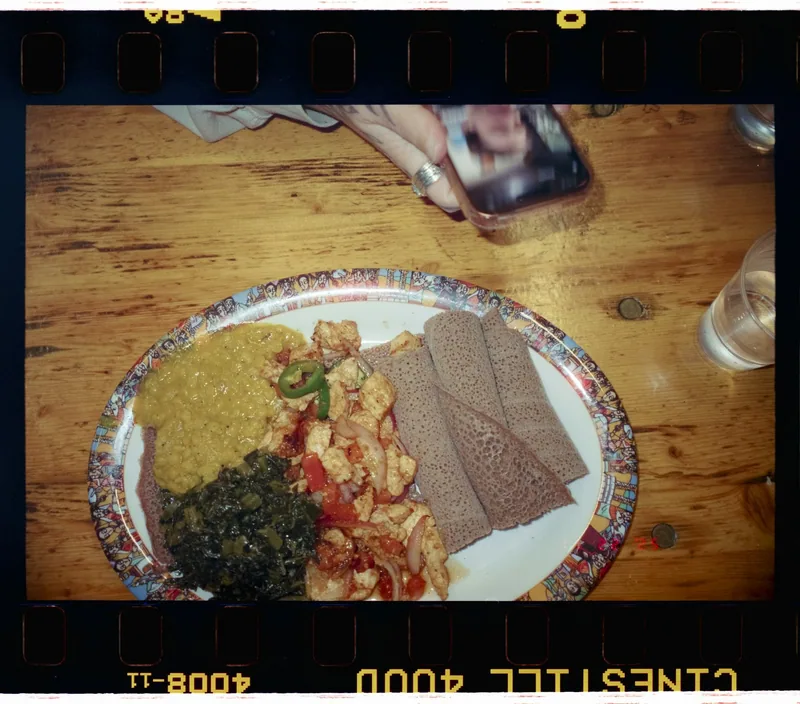
Injera is a large, soft, slightly spongy pancake made from teff flour, a tiny grain grown in the Ethiopian highlands, fermented for a day or more. The fermentation gives it a sour taste closer to sourdough than to a crepe, and a surface covered in small holes.
A meal arrives as a single round tray, lined with injera, with mounds of different stews placed around it and more rolled injera on the side. You tear a piece from the side, use it to pinch up some stew, and eat the parcel. No cutlery, and the right hand only by convention. The injera under the stews soaks up the sauces and is eaten last, which is the best part of the meal.
| Dish | What it is | Heat |
|---|---|---|
| Doro wat | Chicken stewed slowly with onion, berbere spice and spiced butter, with a hard-boiled egg. The national dish | Hot |
| Key wat | Beef in the same red berbere sauce | Hot |
| Tibs | Meat cut small and fried quickly with onion, rosemary and green chilli, sometimes brought sizzling | Medium |
| Kitfo | Minced raw beef warmed with spiced butter and chilli. Order it leb leb if you want it lightly cooked | Medium |
| Shiro | Ground chickpea stew, thick and savoury. The everyday dish | Mild |
| Misir wat | Red lentils in berbere | Medium to hot |
| Gomen | Collard greens with garlic and ginger | Mild |
| Beyaynetu | A vegetarian platter of several of the above at once | Varies |
Berbere is the spice mix that defines the red dishes: chilli, fenugreek, ginger, cardamom and a dozen others. Niter kibbeh is butter clarified with spices, and it is what gives Ethiopian stews their distinctive smell.
The vegetarian platter is the best order for a first visit and often the cheapest. Beyaynetu gives you five or six different stews at once on one injera, which means you learn what you like without ordering four dishes. Ethiopian Orthodox fasting days exclude all animal products, so many restaurants cook an entirely vegan menu on Wednesdays and Fridays as a matter of routine. See vegan and vegetarian London.
The coffee ceremony
Coffee comes from Ethiopia, and the way it is served in a traditional restaurant is a small ceremony rather than a drink. Green beans are roasted in a pan in front of you, ground, and brewed in a clay pot called a jebena, then poured from a height into small handleless cups. Incense is usually burning. Three rounds are served and it is polite to take all three.
It takes half an hour or more, so it is not something to ask for when you are in a hurry. Not every restaurant offers it, and some do it only at weekends or by arrangement. Our guide to coffee in London covers the rest of the city's coffee, most of which owes its existence to this bean.
Camberwell, Kennington and the Ethiopian cluster
South London has the largest concentration of Ethiopian and Eritrean restaurants, in Camberwell and around Kennington, with more in Dalston and in pockets of west London. Camberwell has no Underground station, which is the single reason most visitors never go: the nearest rail station is Denmark Hill, in Zone 2 on the Windrush line of the Overground and on Thameslink and Southeastern services, and a large number of buses run from Elephant and Castle and Oxford Circus.
The area is worth the journey for more than dinner. The Horniman Museum is further out in Forest Hill, and Peckham is the next stop south, which makes a combined afternoon straightforward. Our page on London buses is more use than the Tube map in this part of London.
Jollof, egusi and the West African table
Nigerian and Ghanaian food is built around a starch, called swallow, and a soup or stew to go with it. The starch is not eaten with a fork: you pinch off a piece, roll it into a ball in your fingers, make a dent with your thumb, scoop up soup and swallow it without much chewing. That is where the name comes from.
- Jollof rice. Rice cooked in a tomato, pepper and onion base until it takes on the colour and, if done well, a faint smokiness from the bottom of the pot. Nigeria and Ghana each claim the better version, loudly and permanently, and you should not take sides in a restaurant.
- Egusi. A thick soup of ground melon seeds with leafy greens and meat or fish. Nutty and rich.
- Efo riro. Spinach stew with peppers, often with smoked fish and assorted meats.
- Suya. Beef sliced thin, rubbed in a spice mix of ground peanut and chilli called yaji, and grilled over charcoal. Sold from street grills in the evening.
- Pounded yam, eba, fufu. The swallows: yam pounded smooth, cassava granules, or plantain and cassava flour, each with a different texture.
- Moi moi. Steamed bean pudding, soft and savoury, often with egg or fish inside.
- Waakye and kelewele. Ghanaian: rice and beans cooked with sorghum leaves, and fried plantain cubes with ginger and chilli.
805 Restaurants, on the Old Kent Road in SE15, is one of the longer-established Nigerian dining rooms in south London and a straightforward place to try several of these at once. It is one option among a great many on that road and on Rye Lane, and the smaller places are often better.
Pepper soup is not a soup course. Nigerian pepper soup is a thin, very hot broth with goat, catfish or chicken in it, and the chilli level is set for people who grew up with it. Order a small one to share the first time, and have something starchy on the table. Asking for it mild is a reasonable request and nobody will mind.
Peckham, Dalston and the market streets
Rye Lane in Peckham is the single best street in London for West African food shopping. Grocers sell yam tubers by the metre, scotch bonnets by the bag, smoked fish, egusi seeds, palm oil and stockfish; butchers sell goat and cow foot; and the restaurants and takeaways are threaded between them. Peckham Rye station is in Zone 2 and served by the Windrush line as well as Southern and Thameslink.
Ridley Road Market in Dalston does the same thing on a smaller scale, and opens Monday to Saturday from 09:30 to 16:00, closed on bank holidays except Good Friday. Woolwich, Tottenham and Elephant and Castle have their own concentrations of shops and restaurants with almost no visitors.
Our Dalston and Stoke Newington guide and the page on London's food markets cover these streets from other angles.
North African, Somali and the rest
Golborne Road, at the northern end of Portobello, has Moroccan and Algerian cafes serving mint tea, tagine and msemen pancakes, and it is the easiest North African eating for a visitor staying in the centre. See our guides to Notting Hill and Portobello Road Market, since the two sit on the same street.
Somali restaurants in Southall, Wembley and parts of east London serve rice with goat, bananas eaten alongside the savoury food rather than after it, and sambusa pastries. Eritrean food overlaps almost entirely with Ethiopian, with injera under a different name and an Italian influence in the pasta dishes on some menus.
Practical points
- Timing. West African restaurants often serve late and fill up after 21:00. Ethiopian restaurants keep more conventional hours.
- Pace. Ethiopian stews are cooked in advance and arrive quickly. West African soups and swallows can take a while; this is not fast food.
- Hands. A bowl of water or a wet towel is usually brought. Use your right hand in both traditions.
- Sharing. One Ethiopian platter between two is normal and is how the food is designed.
- Allergies. Peanut is central to suya and common in West African sauces. Teff, the grain in injera, contains no gluten, but many London restaurants mix it with wheat or barley flour, so ask rather than assume.
See gluten-free eating in London on that last point, and tipping in London for the service charge. For more cheap sit-down meals across the city, cheap eats in London covers the comparison, and late-night food covers the hours.
Frequently asked questions
What is injera?
A large, soft, slightly sour pancake made from fermented teff flour, used as both plate and cutlery in Ethiopian and Eritrean meals. Stews are placed on top of it, and you tear pieces from the side to pinch up the food. The injera underneath absorbs the sauces and is eaten at the end.
Where can I eat Ethiopian food in London?
Camberwell and Kennington in south London have the largest concentration, with more restaurants in Dalston and in west London. Camberwell has no Underground station: use Denmark Hill, in Zone 2 on the Windrush line and on Thameslink and Southeastern trains, or take a bus from Elephant and Castle.
What is jollof rice?
Rice cooked in a base of tomato, red pepper, onion and spices until it takes on a deep orange colour and, when properly made, a slight smokiness from the pot. It is eaten across West Africa, and the relative merits of the Nigerian and Ghanaian versions are an argument that has no end.
Is African food in London vegetarian-friendly?
Ethiopian food is, unusually so: Orthodox fasting days exclude all animal products, so many restaurants serve a full vegan menu on Wednesdays and Fridays, and the vegetarian platter is a standard order. West African menus are more meat and fish based, though bean and vegetable dishes exist, and stocks often contain dried fish.
Do I eat with my hands?
In both traditions, yes, and staff will bring water or a towel. Ethiopian stews are pinched up in torn injera; West African swallows are rolled into a ball with the fingers and dipped in soup. Cutlery is usually available if you ask for it, and nobody will be offended either way.
Sources
- 805 Restaurants, Old Kent Road SE15 - Nigerian restaurant website (checked September 2026)
- Hackney Council - Ridley Road Market opening times (checked September 2026)
- Transport for London StopPoint data - Denmark Hill and Peckham Rye lines and fare zones (checked September 2026)
- Food Standards Agency - Food allergy and intolerance advice for consumers (checked September 2026)
- Food Standards Agency - Food hygiene ratings search (checked September 2026)