
The Ethiopian coffee ceremony takes about an hour, produces three small cups from beans roasted in front of you, and cannot be hurried or cut short without being rude. In London it is not on any menu we could find. It happens in Ethiopian and Eritrean restaurants when you ask for it in advance, usually with a day's notice, and the honest instruction on this page is to telephone rather than turn up.
Our guide to Ethiopian and African food in London covers injera, how a shared meal works and where the restaurants are. This page is only about the coffee: what each stage is called and why it takes as long as it does, what is eaten alongside it, how to behave, and which London restaurants are the ones to ring.
The ceremony at a glance
- How long
- Between 45 minutes and an hour and a half. Roasting alone takes 10 to 15 minutes
- How many cups
- Three, from the same grounds, brewed in sequence. All three are expected
- The pot
- A jebena: a round-bellied clay pot with a long neck, a spout and a straw lid, brewed directly over heat
- What comes with it
- Popcorn, and often roasted barley. Frankincense burning beside the tray
- Sweetening
- Sugar is normal. In some regions salt or a spoonful of butter is used instead. Never milk
- Booking
- Ring the restaurant. We found no London restaurant that advertises it in a form we could read, and several will only do it by arrangement or at weekends
Why it takes an hour
Because nothing is prepared in advance. A ceremony begins with green, unroasted beans, and every step happens in front of you in the room.
The beans are washed and then roasted in a flat pan over a small stove, shaken constantly, until they darken and begin to crack and smoke. The pan is carried round the room so that everyone present can take the smoke in their hands and breathe it, which is not a performance for tourists but the actual custom. The beans are then ground, in many houses still by hand in a wooden mortar, and the grounds go into the jebena with water and are brought to the boil over the same stove.
Pouring is the part people photograph. The jebena is raised well above the cups and the coffee is poured in one continuous stream into a line of small handleless cups without stopping, which both aerates it and keeps the grounds in the pot. Getting it into six cups without a pause and without spilling takes practice.
Then it is refilled with water and boiled again, and again. That is where the three rounds come from: the same grounds, brewed three times, each weaker and each with its own name. The commonest Amharic names for them, with transliterations that vary from book to book, are abol for the first, tona for the second and baraka for the third. Baraka means blessing, and it is the one you are least likely to be allowed to refuse.
Three small cups is a lot of coffee at ten at night. Each cup is perhaps 60 to 80 millilitres, but the brew is strong and there are three of them over an hour. If you are sensitive to caffeine, ask for the ceremony after a late lunch rather than after dinner. There is no decaffeinated version of this.
What is on the tray, and what is not
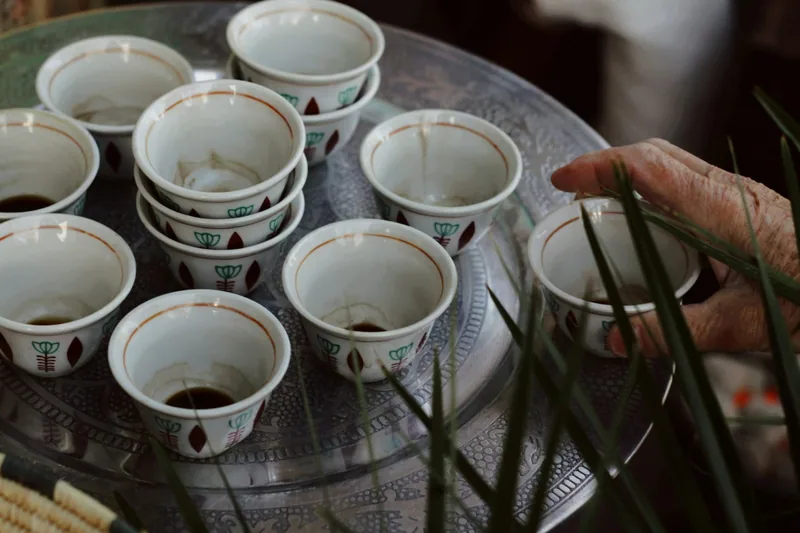
The tray, or low table, holds the cups, the pot, a bowl of sugar and usually a bowl of popcorn. Popcorn with coffee sounds wrong to a British palate and is the standard accompaniment; it is unsweetened, sometimes lightly salted, and it works. Roasted barley, dry and nutty, often appears with it, and in some households a piece of bread or a sweet.
Frankincense burns in a small censer beside the tray through the whole ceremony, which is why an Ethiopian restaurant smells the way it does and why the smell stays in your coat. In Ethiopia freshly cut grass is scattered on the floor as well; in a London restaurant that is usually represented by a mat.
What is not on the tray: milk, and any expectation that you will drink it fast. There is no takeaway version and no cup to carry out.
How to behave, in five points
- Do not leave after one cup. This is the only rule that really matters. Accepting the first and declining the second and third is the equivalent of getting up during a meal, and the third round is explicitly a blessing on the company.
- Take the cup with your right hand, or with both hands. The same convention applies to eating injera.
- Smell the roasting beans when the pan comes round. You are meant to. Cup your hands and draw the smoke towards you.
- Sugar is added to the cup, not the pot, so say how much you want before it is poured. Two spoons is normal in Ethiopia and more than most visitors expect.
- Talk. The hour is the point. In Ethiopia the ceremony is how neighbours conduct an argument, a reconciliation or a piece of business, and sitting in silence looking at your phone misses what it is for.
Where to ring in London
We checked the Food Standards Agency register for every Ethiopian and Eritrean restaurant we could identify in London and looked at the websites of those that have one. The result is worth stating bluntly: not one of them published a price, a day or a booking method for the coffee ceremony anywhere we could read. So the list below is a list of restaurants worth ringing, with their hygiene ratings and inspection dates, not a list of confirmed ceremonies.
| Restaurant | Where | Hygiene rating | Last inspected |
|---|---|---|---|
| Habesha restaurant and bar | 41 Camberwell Church Street, SE5 | 5 | 12 July 2025 |
| Addis Restaurant | 40-42 Caledonian Road, N1 | 5 | 2 December 2025 |
| Addis Kitchen | 244 Old Kent Road, SE1 | 5 | 12 February 2026 |
| Yeshi Ethiopian Cuisine | 328 Hornsey Road, N7 | 5 | 29 October 2025 |
| Buna Ethiopian Restaurant | 87 Holloway Road, N7 | 4 | 17 August 2026 |
| Orit Ethiopian Restaurant & Bar | 388 Wandsworth Road, SW8 | 4 | 16 January 2026 |
| Adulis Restaurant (Eritrean) | 44-46 Brixton Road, SW9 | 4 | 22 February 2025 |
| Andu Cafe (Eritrean, vegan) | 528 Kingsland Road, E8 | 4 | 4 August 2026 |
| Enu Ethiopian and Eritrean | Broadway Market, Tooting High Street, SW17 | 5 | 13 May 2026 |
| Agelgil Ethiopian Restaurant | 327 Caledonian Road, N1 | 3 | 19 January 2026 |
| Merkato Cafe & Restaurant | 196 Caledonian Road, N1 | 3 | 25 March 2025 |
A detail that pleases anyone who likes names: buna is the Amharic word for coffee, so the restaurant on the Holloway Road is called, in effect, Coffee.
Two well-known names are not on this list for different reasons. One long-standing north London Ethiopian restaurant no longer appears on the Food Standards Agency register at all, which in practice means it has stopped trading, although it is still listed in guides. And one restaurant in east London holds a hygiene rating of 1, so we will not name it. Look any address up at ratings.food.gov.uk before you book.
North London, not just Camberwell
The usual account puts Ethiopian London in Camberwell and Kennington, and that is where the oldest restaurants are. But when we counted what is actually on the hygiene register in September 2026, north London had at least as many: a run of restaurants, delis and shops along the Caledonian Road, the Holloway Road, Hornsey Road and Blackstock Road, in the triangle between King's Cross, Archway and Finsbury Park.
For a visitor that is useful, because the Caledonian Road cluster is walkable from King's Cross and the Camberwell one is not near an Underground station at all. If you are in central London and want to do this in an evening, the north London addresses are the practical ones. If you want the fuller picture of the community, Camberwell is still where to go, and the buses are more use there than the Tube map.
Two other places are worth knowing. Dalston has an Eritrean vegan cafe on Kingsland Road, five minutes from the grills covered in our page on Dalston and Stoke Newington. And there are Ethiopian and Eritrean stalls inside Greenwich Market and Tooting's covered market, which is the cheapest way to try the food, though a market stall is the one place a ceremony will not happen.
Asking for it, and what it should cost
The phrasing that works is simple: ask whether they do the coffee ceremony, whether it needs booking, and how long it takes. Most restaurants that offer it will want notice, because somebody has to be free for an hour and because the beans are roasted from green.
On price we can only give a band, because we read no menu that listed it: our estimate for September 2026 is between £6 and £15 for a ceremony for two people sharing, and in some restaurants it is included with a meal or charged as a token amount. That is a wide band, which is honest rather than useful, and the telephone call that establishes whether it happens at all will also establish the price.
One further practical point: a ceremony is easier to arrange for a group of four than for one person, for the obvious reason that an hour of somebody's work is being spent on it. If you are alone, ask whether you can join a table that has already ordered one.
Ethiopia, coffee, and the rest of London's cups
Coffee is native to Ethiopia, and the plant still grows wild in the forests of the south-west. Everything in a London coffee shop descends from beans that came out of those forests, went to Yemen, and reached Europe in the seventeenth century, when the first coffee houses opened in the City of London and turned into newspapers, insurance markets and the Stock Exchange.
Which makes the comparison instructive rather than sentimental. A flat white in a Shoreditch roastery is a highly engineered product: a controlled roast, a calibrated grind, a measured shot, three minutes from order to cup. The ceremony is the opposite discipline and produces a different drink from the same species: lighter-bodied, sharper, faintly tea-like, and never the same twice. Our guide to coffee in London covers the modern end of the city's coffee, and tea and coffee to take home covers where to buy Ethiopian beans by the bag.
If you like the idea of spending an hour on something because the hour is the point, London has one other ceremony in the same spirit: the Ceremony of the Keys at the Tower of London, which takes seven minutes and requires booking months ahead. This one takes an hour and requires a phone call.
Frequently asked questions
What happens at an Ethiopian coffee ceremony?
Green coffee beans are washed and roasted in a pan in front of you, then ground and boiled in a clay pot called a jebena, and poured from a height into small handleless cups. The same grounds are brewed three times, giving three rounds of decreasing strength, and the whole thing takes about an hour with popcorn and burning frankincense alongside.
How long does the Ethiopian coffee ceremony take?
Between 45 minutes and an hour and a half. Roasting alone takes 10 to 15 minutes, and the three rounds are brewed one after another. It is not something to fit in before a train.
Where can I experience an Ethiopian coffee ceremony in London?
At Ethiopian and Eritrean restaurants in Camberwell, along the Caledonian Road and Holloway Road in north London, in Brixton and in Tooting, but only by arrangement. No London restaurant we checked publishes the ceremony as a bookable item, so telephone in advance and ask, ideally a day ahead.
Do I have to drink all three cups?
You are strongly expected to. The third round is called baraka, meaning blessing, and it is offered to the company rather than to you individually, so leaving after the first cup is the discourtesy people remember. If you cannot manage three cups of strong coffee, ask for smaller pours rather than declining a round.
Why is popcorn served with Ethiopian coffee?
It is the standard accompaniment, unsweetened and sometimes lightly salted, along with roasted barley. The combination is not a novelty for visitors: it is what is put on the tray in Ethiopian households, and it balances a very strong, slightly sour brew.
Sources
- Food Standards Agency - Food hygiene ratings for Habesha, 41 Camberwell Church Street SE5 8TR; Addis Restaurant, 40-42 Caledonian Road N1; Addis Kitchen, 244 Old Kent Road SE1 5UB; Yeshi Ethiopian Cuisine, 328 Hornsey Road N7 7HE; Buna Ethiopian Restaurant, 87 Holloway Road N7 8LT; Orit Ethiopian Restaurant & Bar, 388 Wandsworth Road SW8 4TN; Adulis Restaurant, 44-46 Brixton Road SW9 6BT; Andu Cafe, 528 Kingsland Road E8 4AH; Enu Ethiopian and Eritrean, Broadway Market, Tooting High Street SW17 0RL; Agelgil Ethiopian Restaurant, 327 Caledonian Road N1 1DW; Merkato Cafe & Restaurant, 196 Caledonian Road N1 0SQ (checked September 2026)
- Food Standards Agency - The Food Hygiene Rating Scheme, and what leaving the register means (checked September 2026)