
Taiwanese food is not Chinese food with a different label, and the dish to order is beef noodle soup: braised shin and tendon in a dark, star-anise broth with pickled mustard greens. Bubble tea is the other thing Taiwan gave London, and it is now sold on almost every street in Soho and Chinatown. The two are worth separating, because the noodles are the meal and the tea is a drink with sugar in it.
Our guide to Chinatown covers Gerrard Street as a whole, the dim sum rules and the Chinese bakeries, and Chinese food beyond Chinatown covers the regional cooking in the suburbs. This page is narrower: what Taiwanese cooking actually is, where in London it is done, and how to order a bubble tea that tastes of something.
What to order, and what it costs
- Beef noodle soup
- Niu rou mian. Braised shin and tendon, wheat noodles, dark broth with star anise, pickled greens on top. A meal in one bowl
- Lu rou fan
- Minced pork belly braised in soy and rice wine over rice, with a soy egg. The Taiwanese comfort dish, usually the cheapest thing on the menu
- Gua bao
- A folded steamed bun with braised pork belly, crushed peanut and pickled mustard greens. Two make a light lunch, not a dinner
- Popcorn chicken
- Small pieces of marinated chicken, fried with basil leaves and dusted with five spice and white pepper
- Bubble tea
- Tea, milk or fruit, ice, and chewy tapioca pearls. You choose the sugar level and the ice level, and you should
- Price level
- Our estimate, September 2026: £10 to £16 for a bowl of noodles in central London, £5 to £7 for a large bubble tea
What makes it Taiwanese and not Chinese
Taiwan's cooking grew out of Fujianese food, then absorbed fifty years of Japanese rule and, after 1949, cooks from every province of mainland China arriving at once. The result has a distinct vocabulary: braises rather than stir-fries, soy and rice wine rather than chilli oil, a lot of pork belly, basil where a Cantonese kitchen would use spring onion, and a fondness for chewy textures that western palates either love or never get used to.
The clearest marker is the breakfast and night-market tradition. Taiwanese street food is built for eating standing up at ten at night, which is why so much of it comes in a bun, a paper cone or a single bowl. If you have eaten your way round Sichuan and Xi'an cooking in London and found it all fiercely hot, Taiwanese food is the opposite corner of the same region: savoury, sweet, gently spiced, and heavy on things you can pick up.
Where the Taiwanese kitchens are
There are not many, and almost all of them are within ten minutes of Leicester Square. We checked every business named here on the Food Standards Agency register before writing it, and the ratings and inspection dates are given because on this particular subject they vary more than anywhere else in London.
Leong's Legend, 39 Gerrard Street, W1D. The Taiwanese address in Chinatown, and the one to go to for beef noodle soup and for xiao long bao, the soup dumplings you lift with a spoon rather than chopsticks. Food hygiene rating 3, last inspected 1 September 2025.
Old Tree Daiwan Bee, 26 Rupert Street, W1D. A small, plain room on the Soho side of Chinatown doing the night-market end of the repertoire: lu rou fan, popcorn chicken, oyster omelette. Food hygiene rating 3, last inspected 22 September 2025.
The Bao group. Five London sites, describing themselves as Taiwanese restaurants, each doing a different slice of it: the original steamed-bun shop off Lexington Street in Soho, a small-plates room, a grill house, one in Marylebone and one on Stoney Street in Borough. The Lexington Street site holds rating 3, inspected 8 January 2026; the Stoney Street one rating 5, inspected 20 October 2026. This is the version of Taiwanese food most Londoners have eaten, and it is a stylised version: small, careful, expensive for the quantity.
Two of the three Taiwanese restaurants in Chinatown hold a hygiene rating of 3. Three out of five means "generally satisfactory" and it is the lowest rating we will name at all. It is not a reason to stay away, but it is a reason to check the sticker in the window, which every food business in England must show on request. The register is at ratings.food.gov.uk, and it is free to search by street.
How to order beef noodle soup, and what to do with it
The bowl arrives with the noodles submerged and the meat on top. There is a spoon and there are chopsticks, and you are meant to use both at once: chopsticks to lift noodles, spoon underneath to catch the broth. Nobody minds noise.
Two choices are worth making deliberately. The first is clear broth against braised: the braised version, hong shao, is the dark one with soy, rice wine and star anise and is what most people mean by beef noodle soup; the clear version, qing dun, is a lighter beef consommé and tastes almost European by comparison. The second is noodle thickness, where it is offered. Thick wheat noodles hold the braise better; thin ones go soft faster.
The pickled mustard greens on top are not garnish. Stir them in early: they are the acidity that stops a bowl of braised beef becoming heavy halfway down. If the bowl comes with a dish of chilli oil and a dish of black vinegar, the vinegar is the more useful of the two.
Bubble tea: what is actually in it
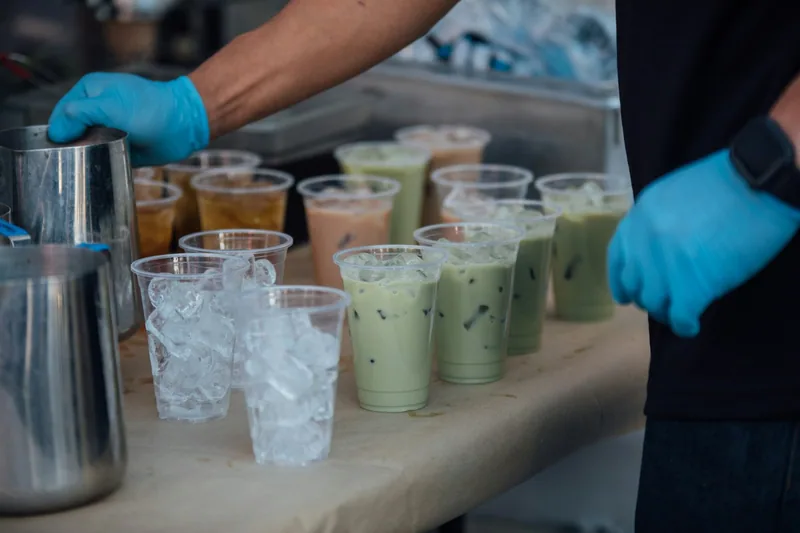
Tea, sweetened, usually with milk, over ice, with tapioca pearls in the bottom and a wide straw to get them up. The pearls are boiled cassava starch, chewy rather than sweet, and they are cooked in batches through the day, which is why a shop at four in the afternoon gives you better pearls than the same shop at ten at night.
The three things worth knowing before you order:
- The sugar level is yours to set. Most shops offer 0, 25, 50, 75 and 100 per cent. The default is 100, which is a great deal of sugar. Fifty is where tea starts to taste of tea.
- Brown sugar milk tea is not tea. It is milk, tapioca and brown sugar syrup, and it is delicious and enormous. If you want the tea to show, ask for an oolong or a jasmine base rather than the black default.
- "Cheese foam" is not cheese. It is a lightly salted whipped cream cap, drunk without a straw by tilting the cup. On a fruit tea it works; on a milk tea it is sugar on sugar.
The alternatives to pearls are the reason to go back: grass jelly, which is a bitter herbal set jelly and the best thing in the shop; aiyu jelly; red bean; taro; and popping boba, which are juice-filled spheres and the one children always want. Our guide to desserts in London covers the dessert cafés that sit alongside these shops.
Which shop is which, and the ratings that differ
Bubble tea in central London is dominated by chains, most of them Taiwanese in origin, and their shops are run under different arrangements from one branch to the next. That shows up sharply in the hygiene data, and it is the single most useful thing we found while researching this page.
| Branch | Hygiene rating | Last inspected |
|---|---|---|
| Bubbleology, 23 Cromwell Place, SW7 | 5 | 19 September 2025 |
| Bubbleology, Westfield London, W12 | 5 | 2 December 2025 |
| Bubbleology, 45 Pembridge Road, W11 | 5 | 14 May 2025 |
Those are the branches we are willing to name. Two well-known central branches of other chains are rated 2 out of 5 and we will not name them, because we are not going to send a visitor somewhere the regulator has told to improve: one is on Garrick Street in Covent Garden and one is at Tower Hill. A third central branch has not been inspected recently enough for us to name it.
A hygiene rating belongs to the address, not the brand. The same bubble tea chain has branches rated 5 and branches rated 2 within three miles of each other in London. Look up the specific shop, not the logo, and do the same for any chain anywhere in the city. Our advice on eating cheaply in London explains how the rating scheme works.
The Chinatown walk that gets you both
Gerrard Street is 250 metres long and you can do this in an hour. Come in from Leicester Square, eat noodles at the Gerrard Street end, walk the length of the street, cross Wardour Street into Rupert Street for the night-market dishes if you are still hungry, and pick up tea on Shaftesbury Avenue on the way out.
Times matter more here than in most of London. Chinatown's kitchens are busiest between 12:30 and 14:00 and again from 18:30, and a beef noodle shop with thirty covers has no waiting area. Between 15:00 and 17:00 you will walk into anywhere. Bubble tea shops run the other way round: they are quiet at lunchtime and queue out of the door after school and after the theatre.
Eating Taiwanese with children, or with restrictions
Taiwanese food suits children better than most of what is on offer around Leicester Square. Lu rou fan is minced pork and rice, gua bao are handheld, popcorn chicken is popcorn chicken, and nothing on a standard menu is chilli-hot unless it says so.
Vegetarians have a harder time than in a Cantonese restaurant, because the braises are pork-based and the broths are beef- or pork-based. Ask specifically rather than assuming: a vegetable dish may be cooked with dried shrimp or lard. Bubble tea is usually made with non-dairy creamer rather than milk, which makes it accidentally dairy-free and not necessarily vegan; the pearls themselves are starch and sugar. Anyone avoiding gluten should be careful of the noodles, the buns and the soy, which is wheat-based.
Where else Taiwanese food turns up
Outside the centre, the Taiwanese presence is thinner than the Hong Kong, Fujianese or Sichuan ones, and it mostly appears as a stall or a counter rather than a restaurant: in the Asian food halls of north-west London, on the food-market circuit covered in our guide to London's food markets, and in the student districts around Bloomsbury, where our page on eating near the British Museum picks up the same trade.
One thing not to expect: a Taiwanese night market. London has nothing of the kind, and the closest experience is a summer weekend at a street-food market, which is a different proposition at four times the price. If you are in London for Chinese New Year, the Chinatown celebrations are pan-Chinese rather than Taiwanese, and the food stalls reflect that.
Frequently asked questions
Where can I eat Taiwanese food in London?
Chinatown and Soho hold almost all of it: Leong's Legend on Gerrard Street for beef noodle soup and soup dumplings, Old Tree Daiwan Bee on Rupert Street for night-market dishes, and the Bao group's five sites across Soho, Marylebone and Borough for a more stylised version. All were checked on the Food Standards Agency register in September 2026.
What is Taiwanese beef noodle soup?
Braised beef shin and tendon with wheat noodles in a dark broth flavoured with soy, rice wine and star anise, topped with pickled mustard greens and spring onion. A clear-broth version also exists and is much lighter. It is a single-bowl meal rather than a starter.
Is bubble tea Taiwanese?
Yes. It was invented in Taiwan in the 1980s and most of the chains selling it in London are Taiwanese in origin. The tapioca pearls are boiled cassava starch, and the sugar and ice levels are meant to be chosen by the customer rather than left at the default.
How much does bubble tea cost in London?
Our estimate for September 2026 is £5 to £7 for a large cup in central London, with extra toppings adding 50p to £1 each. Prices sit at the top of that range in Covent Garden and Leicester Square and at the bottom in Chinatown and the suburbs.
Are bubble tea shops in London clean?
It varies a great deal by branch rather than by brand. We found central London branches of the same chains rated anywhere from 2 to 5 out of 5 on the Food Standards Agency register, so look up the individual shop by address on ratings.food.gov.uk rather than trusting the name over the door.
Sources
- Food Standards Agency - Food hygiene ratings for Leong's Legend, 39 Gerrard Street W1D 5QD; Old Tree Daiwan Bee, 26 Rupert Street W1D 6DH; Bao, 53 Lexington Street W1F 9AS; Bao, 13 Stoney Street SE1 9AD; Bubbleology, 23 Cromwell Place SW7 2LD, 45 Pembridge Road W11 3HG and Westfield London W12 7HT (checked September 2026; Bao, 13 Stoney Street checked November 2026)
- Food Standards Agency - How the Food Hygiene Rating Scheme works and what each rating means (checked September 2026)
- GOV.UK - Food allergen labelling and information requirements (checked September 2026)