
Cecil Court is a pedestrian alley about seventy metres long between Charing Cross Road and St Martin's Lane, one minute from Leicester Square station, and it holds two dozen specialist dealers in books, prints, maps, coins, medals, banknotes, porcelain, silver and paintings. Come on a weekday afternoon. Most of the shops open at 10 or 11 and close between 5 and 7, several shut on Sunday, one shuts on Monday, two are by appointment only, and one closes for an hour at lunch.
The other thing to know is that almost nothing here is what it looks like. The court feels seventeenth-century and is late Victorian: the buildings were put up between 1889 and 1894, and not one of them is a listed building. What is old is the trade, the street line and the ownership.
Our guide to the best bookshops in London covers the city's bookselling and names several shops here. This page is about the court itself, what each dealer actually sells, and the streets around it. The theatres and cinemas at the western end are covered by Leicester Square and Theatreland.
Cecil Court in brief
- What it is
- A covered-in pedestrian court of about two dozen independent dealers, WC2N
- Between
- Charing Cross Road at the west end, St Martin's Lane at the east
- Built
- 1889 to 1894, shops with mansion flats above
- Listed buildings
- None. A search of the National Heritage List for England returns no entry inside the court
- Owner
- Still the Cecil family of Hatfield House, by the estate's own account; the land was bought in 1609
- Nearest station
- Leicester Square, 131 m and 1 to 2 minutes
- Cost
- Nothing to walk through or browse. Stock runs from a few pounds to five figures
- Worst day
- Sunday, when most of the court is shut
Why a seventeenth-century alley looks Victorian
Cecil Court was laid out on open ground between St Martin's Lane and Leicester Square as London spread west. It is generally dated to the 1670s, though it is absent from William Morgan's very detailed map of 1682 and does not appear in the parish rate books until 1695. The name comes from the ground landlord: the land was bought in 1609 by Robert Cecil, first Earl of Salisbury, and the estate's own history of the court says it is still owned by his descendants at Hatfield House. Cranbourn Street nearby carries another of the family's titles.
By the 1880s the old buildings had become a slum, and they were cleared. The agreement for realigning the court between Charing Cross Road and St Martin's Lane is dated 8 May 1889 and is held at Westminster City Archives, and the estate's history explains what it did: the line of the court was straightened and shifted several yards south. The old northern shopfronts now lie under the shops on the north side, and the original southern shopfronts lie under the middle of the open court you walk along. The new buildings — shops with mansion flats above — were finished in 1894, under the third Marquess of Salisbury, Prime Minister from 1886 to 1892 and again from 1895 to 1902.
That is why the National Heritage List for England holds no listing inside Cecil Court. Its buildings are a competent, well-proportioned late-Victorian commercial terrace, not a survival. The listed fabric is all around it: the late eighteenth-century bow-fronted shops of Goodwin's Court, two minutes east, are grade II* with their original wooden shopfronts and wall-mounted gas lamps of the mid nineteenth century, and 31 St Martin's Lane, also grade II*, is the oldest house in the lane.
Goodwin's Court is the alley people mean when they say Cecil Court. If you are looking for the narrow lane of dark bow windows and gas lamps that appears in every photograph of "old London", it is Goodwin's Court, off St Martin's Lane, and it has no shops open to the public. Cecil Court is the wider, brighter one with the trade in it. Both are worth five minutes; they are not the same place.
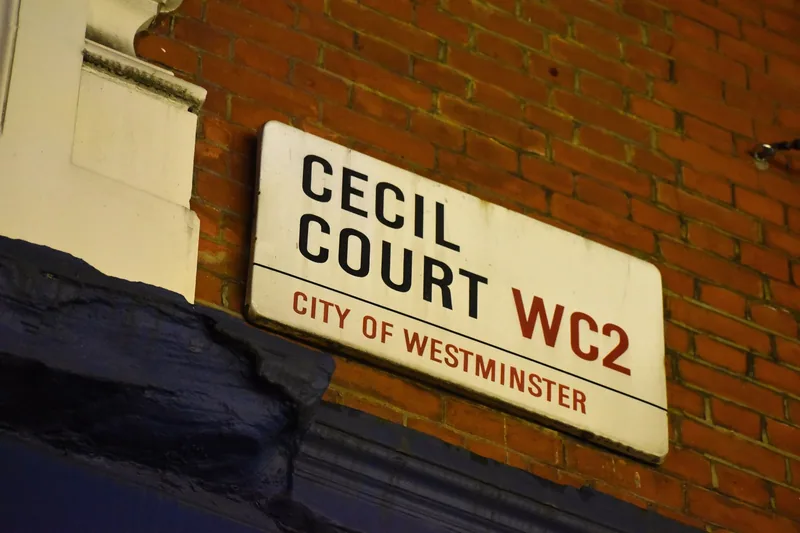
Photo: Phlizz · CC BY-SA 4.0 · Wikimedia Commons · resized
What each dealer actually sells
The specialisms barely overlap, so it is possible to find something very particular in ten minutes. The house numbers matter, because several shops are easy to walk past.
| What you want | Where in the court | Usual days |
|---|---|---|
| Maps, atlases and sea charts, 15th to 20th century | Bryars & Bryars, no. 7 | Monday to Saturday |
| Original maps and prints to 1960, and framing | Storey's Ltd, nos. 1 and 3 | Monday to Sunday |
| Signed and first editions of new fiction | Goldsboro Books, nos. 23 to 27 | Monday to Saturday |
| Rare and antiquarian books across every subject | Sotheran's, no. 8 | Monday to Saturday |
| Children's and illustrated books; Lewis Carroll | Marchpane, no. 16 | Monday to Saturday |
| Alice in Wonderland editions, prints and objects | Alice Through The Looking Glass, no. 14 | Monday to Saturday |
| Music, scores, opera programmes, playbills, libretti | Travis & Emery, no. 17 | Monday to Saturday |
| Esoteric and philosophical books, tarot, incense | Watkins Books, nos. 19 to 21 | Every day, including Sunday |
| Contemporary art, design, fashion and photography books | Tenderbooks, no. 6 | Tuesday to Saturday |
| World banknotes and paper money | Colin Narbeth & Son, no. 20 | Monday to Saturday |
| Orders, decorations and medals; coins; polar and militaria | London Medal Company, no. 13 | Monday to Saturday |
| British military medals, bought as well as sold | Stephen Wheeler Medals, no. 20 | Monday to Saturday |
| Ancient and modern coins | Coin Heritage, no. 20 | Monday to Saturday |
| Antique silver and objects of vertu, 17th to 20th century | Daniel Bexfield Antiques, no. 5 | Every day, including Sunday |
| Meissen, Sèvres, KPM and other European porcelain | Serhat Ahmet, no. 10 | Monday to Saturday |
| Art Deco and Modernist jewellery and collectables | Art Deco Gallery London, no. 11 | Every day, telephone first |
| Paintings and works on paper, 16th to 20th century | Darnley Fine Art, nos. 2 to 4 | Monday to Saturday |
| Contemporary British and 20th-century continental paintings | Panter & Hall, nos. 22 to 24 | Monday to Saturday |
| Prints and drawings, 16th century to now, with exhibitions | Emanuel von Baeyer, no. 18 | Wednesday to Saturday |
| Vintage tailoring, suiting and ties, Edwardian to 2010s | Liberty Joy Archive, no. 11 | Wednesday to Monday, not Tuesday |
| Fine art and antiques at auction, and previews | Sworders, no. 15 | Monday to Friday |
| Antiques and curiosities, general | Mark Sullivan, no. 9 | Every day, including Sunday |
Two shops in the court trade by appointment only and will not be open when you walk past: November Books at no. 7, in fashion, design and subcultural material, and Emanuel von Baeyer on Mondays, Tuesdays and Sundays. Days and hours here are set shop by shop and do change, so if you are travelling for one dealer, telephone.
The hours that decide the visit
Cecil Court has no single opening time, and the practical rules are these. Nothing much is open before 10am, and the majority start at 11. Sunday removes most of the court: four businesses trade on a Sunday, and the rest are shut. Monday removes Tenderbooks and closes Emanuel von Baeyer's shopfront; Tuesday removes Liberty Joy Archive. Panter & Hall closes for an hour between 2pm and 3pm. Sworders keeps office hours, Monday to Friday, and stays open until 7pm on Thursdays.
The best hour is between about 2pm and 4pm on a Tuesday, Wednesday or Thursday. The dealers are experts, most of them own the shop, and a quiet afternoon is when you can ask a real question about a first edition, a plate or a condition report. At 5.30pm on a Friday you are competing with theatre crowds walking through to St Martin's Lane.
How to buy from an antiquarian dealer
Nothing here has a barcode and very little has a fixed retail price, which puts visitors off unnecessarily. Four things make it straightforward.
- Trade bodies are the check on a dealer. Shops in the court advertise membership of the Antiquarian Booksellers' Association, the Provincial Booksellers Fairs Association, the British Antique Dealers' Association, LAPADA, ILAB and the International Banknote Society. Each has a code of practice and a complaints route, and each publishes its member list.
- Ask for the description in writing. For a book that means edition, issue, binding and a frank statement of condition; for a print, whether it is an original impression or a later strike. Both are normal requests and a good dealer will already have it typed out.
- Prices are set by condition, scarcity and demand, in that order, and dealers here say so openly. Cheap stock exists: several shops keep material at a few pounds alongside items worth thousands.
- Printed books carry no VAT in Britain, so there is nothing to reclaim on those. There is no visitor VAT refund on anything else either, as our page on tax-free shopping in the UK explains.
What was here before the booksellers
Three earlier lives are documented, and one of them is genuinely surprising.
Mozart lodged here in 1764. The Survey of London recorded it in 1940: "In Cecil Court, on the west side of St. Martin's Lane, the child Mozart lodged in 1764 at the house of 'Mr. Couzin hare cutter.'" He was eight. The family took three rooms from the barber John Couzin at twelve shillings a week between 24 April and 6 August, and the address was the first they had in London. The court's renumbering after the 1889 realignment means the old number 21 is now roughly number 9, with the threshold itself under the open street.
It was the centre of the British film trade. Among the first tenants of the new 1894 buildings were film distributors, equipment suppliers and trade journals, and the court was nicknamed Flicker Alley. Cecil Hepworth released the first film version of Alice in Wonderland in 1903 from an office at number 17; the Pioneer Film Company held number 27 from about 1912 to 1915. That there is now an Alice specialist at number 14 and a Lewis Carroll specialist at number 16 is a coincidence, but a neat one.
Two famous bookselling names started here. Watkins, which calls itself the oldest esoteric bookshop in London, arrived at number 21 in 1901 and is still in the court. In 1904 the brothers William and Gilbert Foyle opened their first West End shop at number 16, at a rent of £60 a year, before the business moved to Charing Cross Road and became the chain that still trades there. Graham Greene, who bought books here, is quoted by the estate as thanking God that Cecil Court remains Cecil Court.
The book streets around it, and what is actually left
Charing Cross Road at the west end was London's bookselling street for most of the twentieth century, and most of the second-hand shops have gone. A general second-hand dealer survives at number 56, the big modern Foyles flagship is at 107, and the address made famous by Helene Hanff's 84, Charing Cross Road no longer holds a bookshop at all. Do not go looking for a street of dealers: Cecil Court is where the density is now.
St Martin's Lane at the east end is theatres, not books, with the Coliseum, the Duke of York's and the Garrick all within three minutes; our guide to West End theatre covers what is on. Five minutes north-east, Seven Dials holds the map and travel specialist and the rest of the shopping, in shopping in Covent Garden and Seven Dials and Seven Dials and Neal's Yard.
Two free indoor stops are within four minutes if the weather turns: the National Portrait Gallery at the southern end of Charing Cross Road, and the digital screens described in Outernet and free digital art at the northern end. Soho begins across the road.
Getting there
Leicester Square station is 131 metres away on Transport for London's measure, one to two minutes on foot. Charing Cross station is 465 metres and about 8 minutes, the better arrival by main-line train. The court is level, paved and pedestrian, but the shops are small, mostly with a step at the door and narrow aisles, so a wheelchair user should expect to browse some of them from the doorway.
There is nowhere in the court to sit down and nothing to eat in it; the nearest places are on St Martin's Lane and Charing Cross Road, and our page on eating near Charing Cross handles that corner. Allow forty minutes for browsing, two hours if you came for something specific and found the dealer who knows about it.
Frequently asked questions
Is Cecil Court open on Sunday?
The court itself is a public thoroughfare and never closes, but most of the shops do. Four of the two dozen businesses trade on a Sunday, among them the esoteric bookshop at 19 to 21, the print and map dealer at 1 and 3, the silver dealer at 5 and the general antiques shop at 9. Everything else is a weekday and Saturday proposition.
How old is Cecil Court?
The court was laid out in the late seventeenth century, first appearing in the parish rate books in 1695, but every building you can see dates from a rebuilding of 1889 to 1894. The street line was also moved several yards south at that point, so even the ground plan is Victorian. Nothing inside the court is a listed building.
Why is Cecil Court called Flicker Alley?
Because the new 1894 buildings filled up with the early British film business: distributors, equipment suppliers and trade journals. Cecil Hepworth released the first film of Alice in Wonderland from number 17 in 1903, and the Pioneer Film Company traded from number 27 shortly before the First World War. The nickname belongs to that period, not to the present bookshops.
Did Mozart really live in Cecil Court?
He lodged there for about three months in 1764, aged eight, with his family, in rooms rented from a barber. The Survey of London recorded the address in 1940 from parish sources. It was the family's first London address, and because the court was renumbered after 1889 the house they used stood roughly where number 9 is today.
Is Cecil Court the alley with the bow windows?
No. That is Goodwin's Court, a couple of minutes east off St Martin's Lane, a late eighteenth-century row listed at grade II* with original wooden bowed shopfronts and mid nineteenth-century gas lamps on the wall. It has no shops open to the public. Cecil Court is the wider court with the dealers in it.
Sources
- Survey of London, volume 20 (1940), St Martin's Lane, via British History Online - Mozart's lodging in Cecil Court and No. 31 St Martin's Lane (checked September 2026)
- Historic England - 1 to 8 Goodwin's Court, list entry 1066764, grade II* (checked September 2026)
- Historic England - 31 St Martin's Lane, list entry 1236021, grade II* (checked September 2026)
- Historic England - Search the National Heritage List for England; a boundary search of the court returned no listed building inside Cecil Court (checked September 2026)
- GOV.UK - Tax-free shopping and the zero rate on printed books (checked September 2026)
- Transport for London - journey planner, walking distances from Leicester Square and Charing Cross (checked September 2026)
- Shop numbers, specialisms and opening days were read from the court's own published shop directory in September 2026. This site does not link to the websites of independent dealers, so those details are printed in plain text above for you to check against the shop itself before travelling.