
Bermondsey Street runs about half a mile south from the railway at London Bridge to Bermondsey Square, and along it are ten listed buildings, a churchyard with nine listed tombs and a watch house in it, a bright orange and pink museum, and roughly forty places to eat and drink. Transport for London measures 1.2 kilometres and seventeen minutes on foot from London Bridge station to the far end. Almost nobody on the coach tours at Tower Bridge comes down here.
The street is old, and its shape shows it: a single narrow line running south from the river crossing towards Bermondsey Abbey, with the railway slicing across the top of it on brick arches. For eight hundred years it was a working street of tanners and leather dressers, and the street names around it still say so.
Our Borough and Bermondsey guide covers the district and the market at Borough, and where to eat near London Bridge names the restaurants on this street with prices and explains why the walk is worth making. Maltby Street and the Bermondsey markets owns the Friday antiques market in the square at the bottom. This page is the street itself, north to south, with what is listed, what is open when, and which end to start from.
Bermondsey Street at a glance
- Runs
- From the railway arches by London Bridge station, SE1, south to Bermondsey Square
- Length
- About half a mile of street. TfL gives 1.2 km and 17 minutes from London Bridge station to the southern end
- Stations
- London Bridge at the top (Jubilee and Northern lines, National Rail, Zone 1, lifts); Bermondsey on the Jubilee line about ten minutes east of the middle
- Listed buildings on the street
- Ten, all Grade II, plus the Grade II* parish church and nine listed monuments in its churchyard
- Best time
- Weekday lunchtime for a table; Friday morning for the antiques market at the bottom; Saturday evening if you want it busy
- Museum
- The Fashion and Textile Museum, which closes between exhibitions
Walking it from the top, and what the numbers tell you
Leave the station towards Tooley Street, pass beneath the viaduct, and the street begins among the tallest and newest buildings on it: offices, a cricket bar, a Burmese restaurant in a converted warehouse, the low numbers in the thirties and forties. The railway viaduct arches you have just walked under are themselves listed Grade II, added to the list on 7 July 2011.
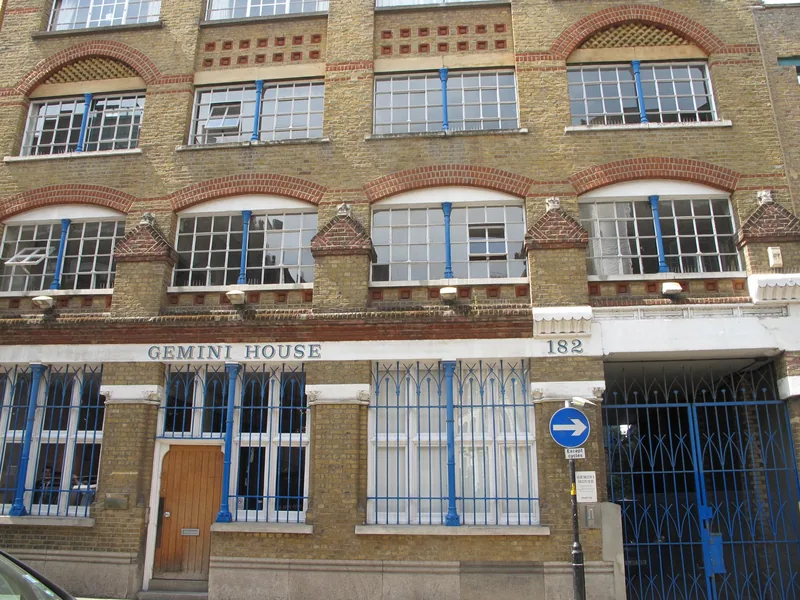
From there the numbers climb south and the buildings get older as you go, which is the opposite of what usually happens in London. By the sixties and seventies you are among Georgian houses; by the hundreds you are in the Victorian middle of the street with the museum and most of the restaurants; by the one-nineties you are at the church; and the two-hundreds bring you out at Bermondsey Square.
The single most rewarding thing to look at is the terrace at numbers 68 to 76. Historic England lists it Grade II, first listed on 24 April 1970, and describes five mid-eighteenth-century houses, now with shops and offices, of red brick with later stuccoed fronts and parapets: three storeys, with an archway through to the rear at ground level in the left-hand bay, altered twentieth-century timber shopfronts, and sash windows with glazing bars and stucco sills. The listing notes that the interiors were not inspected and little of interest was thought to survive inside. What survives is the front, and it is the best row of Georgian shopfronts in this part of Southwark.
The other nine street listings, all Grade II, are numbers 2–5 with their railings, 55, 59–63 with railings, 78, 8–11 with the railings to number 11, 124–130, 132, 173, 187 and 189, and 191. The dates of listing run from 1970 to 1998, which is itself a piece of history: the street was rediscovered in stages.
Walk south, not north. Starting at London Bridge means the street gets steadily older and quieter as you go, and it ends at a square with a market in it. Starting at Bermondsey Square means finishing in a railway underpass among office workers. It is the same half mile and a completely different walk.
The churchyard, which is the part people walk past
Two-thirds of the way down, on the east side, is the parish church of St Mary Magdalene. It is listed Grade II*, and it was one of the earliest buildings in the whole borough to be listed: 6 December 1949.
The churchyard beside it is now a public recreation ground, and it is the most concentrated piece of listed history on the street. Nine separate things in it carry their own Grade II listings, almost all added on 17 September 1998:
- A watch house, listed earlier, on 27 September 1972. This is the small building by the gate, put up so that a watchman could guard the graves against body-snatchers, and it is the thing visitors photograph without knowing what it is.
- A table tomb near the entrance from Bermondsey Street, the first monument you meet if you come in from the street.
- A chest tomb about sixty metres south of the church, near Abbey Street, and the Harrison family chest tomb south of the church.
- The tomb of John Sargeant at the south-west corner of the church, and a further tomb about fifteen metres to the south-south-east.
- A dedication stele about thirty-five metres south of the church, and a drinking fountain about forty-five metres to the south-south-east.
- The gates and gate piers at the north-east entrance, and the wall of the recreation ground, listed in 1977.
It costs nothing, it takes ten minutes, and it is open as a public garden. If you have any interest in London's burial grounds this is a better example than most of the famous ones, because it is still in use as a place where local people eat their lunch.
The orange and pink building
The Fashion and Textile Museum stands on the street in a block painted in two flat, unmissable colours. Our page on the Fashion and Textile Museum has the ticket prices, the current exhibition, the architect of the colour scheme and, most importantly, the warning that the museum shuts completely between exhibitions. Do not walk down here for it without checking that it is open.
It is worth saying what the building does for the street even when it is closed: it is the landmark that tells you where you are, visible from three hundred metres in either direction, and it is the reason a passer-by looks up.
Eating and drinking, and the ratings we checked
Forty-one establishments came back when we searched the Food Standards Agency's register for Bermondsey Street in September 2026, and the standard was high: only one was below four stars, at three. Our London Bridge eating page names the Spanish pair, the French bistro, the Italian and the coffee shop with prices, and owns that ground.
What it leaves for us are the pubs and the ordinary daytime places, which are what you actually want on a walk. Two pubs on the street held five stars at their last inspection: The Woolpack at 98, inspected November 2025, and The Hand and Marigold at 244 down near the square, inspected September 2025. A Japanese ramen bar at 177 and an all-day café at 199 both held five stars in inspections in December 2025 and January 2026, and there is a delicatessen at 80 and a grocer's at 88, also five stars.
Ratings change at every inspection and they are the kitchen's, not the street's, so check the current figure on the Food Standards Agency register before you commit. Our guide to pub etiquette explains ordering at the bar if this is your first British pub.
Come on a weekday for a table, on Friday for the market. The restaurants here take bookings and several are very small, so a Saturday evening without one is a wasted journey. A Friday morning gets you the antiques market in Bermondsey Square at the bottom of the street and a quiet lunch at the top of it, which is the best single combination the street offers.
What is round the corner, in three directions
Bermondsey Street is short, and half its value is what it connects to.
West, two minutes: Leathermarket Street and Weston Street, where the Leather Market building still stands, listed Grade II on 27 September 1972, along with the London Leather, Hide and Wool Exchange and Leathermarket Yard, both listed later. This is the physical evidence of the trade the street lived on, and the buildings are now offices you can walk past but not into.
East, ten minutes: the railway arches of the Ropewalk off Maltby Street, and the breweries beyond. The Bermondsey Beer Mile covers the taprooms and which of them open on which day, which is the thing that catches people out.
South, at the end: Bermondsey Square, the site of Bermondsey Abbey, with the Friday antiques market. Grange Walk leads east off it and has six separate Grade II listings on it, all from 27 September 1972 — numbers 5, 6 and 7, then 8, 9, 10 and 11, and 15 — standing on the line of the abbey's gatehouse. It is two minutes' detour and the oldest-feeling corner in Bermondsey.
Getting here, and which station
London Bridge is the station for the northern end: Jubilee and Northern lines, National Rail, Zone 1, and lifts down to both Underground lines. Note one thing about getting home late, because it decides your evening: the Jubilee line runs a Night Tube service through London Bridge on Friday and Saturday nights, and the Northern line does not. The Northern line's night service uses the Charing Cross branch, so London Bridge, Bank and Old Street have no night trains. Our guides to the Night Tube and London night buses have the detail.
For the southern end, Bermondsey station on the Jubilee line is about ten minutes' walk east and is often the better choice if you are heading for Bermondsey Square rather than the top of the street. Both stations are on the Jubilee line, so you can walk the street one way and ride back.
A day's travelling from either falls inside the £8.90 daily cap for Zones 1 and 2 on contactless or Oyster. If you are choosing a base, staying on the South Bank compares this side of the river with the alternatives, and the Shard at the top of the street is the landmark you will use to find your way back.
Frequently asked questions
How long does Bermondsey Street take to walk?
Transport for London gives seventeen minutes and 1.2 kilometres from London Bridge station to the southern end of the street. The street itself is about half a mile. Allow an hour and a half if you want to look at the churchyard, the listed terrace at 68 to 76 and the square at the bottom, and longer if you stop to eat.
Is Bermondsey Street worth visiting?
Yes, if you like walking a street rather than ticking off a sight. It has ten listed buildings, a Grade II* church with nine listed monuments in its churchyard, a museum, about forty places to eat and drink, and very few tourists. It is not worth a long journey on its own, but it is ten minutes from London Bridge and it is the best half mile near there.
What day should I go to Bermondsey Street?
Friday morning, if you want the antiques market in Bermondsey Square at the southern end as well as the street. A weekday lunchtime is easiest for a table. Saturday evening is the busiest and the hardest to eat on without a booking, because several of the restaurants are very small.
What is the watch house in the churchyard?
A small Grade II listed building by the gate of St Mary Magdalene's churchyard, listed on 27 September 1972. Watch houses were built at the entrances to burial grounds so that a watchman could guard fresh graves against body-snatchers. It is the most photographed and least explained object on the street.
Which station is nearest to Bermondsey Street?
It depends which end you want. London Bridge is at the northern end, about two minutes from the first numbers. Bermondsey station on the Jubilee line is roughly ten minutes' walk from the southern half and is better for Bermondsey Square and the antiques market. Both are on the Jubilee line.
Sources
- Historic England - 68-76 Bermondsey Street, list entry 1376559, Grade II (checked September 2026)
- Historic England - Church of St Mary Magdalene, list entry 1376567, Grade II* (checked September 2026)
- Historic England - Watch House in St Mary's churchyard, list entry 1376581, Grade II (checked September 2026)
- Historic England - National Heritage List for England, Bermondsey Street and Grange Walk entries (checked September 2026)
- Food Standards Agency - food hygiene rating register (searched by address, Bermondsey Street SE1) (checked September 2026)
- Transport for London - Journey Planner, used for the walking time and distance from London Bridge station to the south end of Bermondsey Street (1,187 metres, 17 minutes) (checked September 2026)
- Transport for London - Night Tube lines and stations (checked September 2026)