
Hatton Garden is a single wide street in Camden, running north from Holborn Circus to Clerkenwell Road, and it is where the British jewellery trade has worked since the 1820s. If you are here to buy a ring, three things decide whether you do well: what the hallmark legally guarantees, what it does not cover, and whether the door you are pushing belongs to a shop or a wholesaler. This page is about those three things, plus the 2015 burglary, which was not a robbery and did not happen in a jeweller's shop.
The street is unusual because most of the trade is invisible. Behind the shopfronts are workshops, setters, polishers, refiners, diamond dealers and offices, and a large share of the businesses sell only to other businesses. Camden's own conservation appraisal makes the point carefully: its land-use map is based on observation from street level, so it cannot show "the hidden activities that take place behind closed doors, such as jewellery trading and manufacture".
Our guide to Leather Lane and shopping in Clerkenwell covers the market one street west, and Clerkenwell the district. This page is the street itself.
Hatton Garden for a buyer
- Where
- Holborn Circus to Clerkenwell Road, London EC1N, in the London Borough of Camden
- Compulsory hallmarks
- Sponsor's mark, millesimal fineness number, assay office mark
- London's assay office mark
- A leopard's head (Edinburgh a castle, Birmingham an anchor, Sheffield a rose)
- Gold fineness marks
- 375, 585, 750, 916, 990, 999 — that is 9, 14, 18 and 22 carat and above
- Hallmark not required below
- 1 g of gold, 7.78 g of silver, 0.5 g of platinum, 1 g of palladium
- Assay office counter
- 17 Greville Street, EC1N 8SQ, 09:00 to 17:00 Monday to Friday, closed 12:00 to 13:00
- Nearest station
- Chancery Lane, 399 m and 5 minutes; Farringdon, 367 m and 7 minutes, and step-free
- VAT refunds
- None. The visitor scheme was withdrawn in 2021 and has not returned
Why the jewellers are here rather than somewhere else
The reason is a chain of accidents, and the listing for one building sets it out better than any guidebook. Number 31 Hatton Garden, an early nineteenth-century town house listed at grade II in January 2020, has been occupied by the jewellery trade more or less continuously since then, and Historic England's entry records why.
The area had worked metal since at least the tenth century, and Fetter Lane nearby housed armourers for the Knights Templar. What turned that into a jewellery quarter was refining. Camden's appraisal names Charles Johnson, a jeweller and gold refiner at number 11 by 1822, and his nephew Percival Johnson at number 79, an "Assayer and Practical Mineralogist"; that firm became Johnson & Matthey in 1851. Neither building survives. Johnson Matthey later occupied thirteen adjacent houses on the west side, connected internally, until 1937, when industrial-scale gold refining forced their replacement by the plain block now at 73 to 83.
The diamonds arrived later, and from South Africa. Merchants relocated from Kimberley in the later nineteenth century: M Lilienfield and Co took 31 Hatton Garden in 1878, the Barnato brothers in 1881, and the brothers later amalgamated with Cecil Rhodes to form De Beers Consolidated Mines. In 1890 Rhodes founded a syndicate of Hatton Garden diamond traders; that became the Diamond Trading Company, established by De Beers in 1934 at 17 Charterhouse Street, a building rebuilt in 1976 to 1979 with a helipad on the roof.
The old houses survived because they suited the work: a Georgian terrace adapts neatly into basement workshop, ground-floor shop and living quarters above, which is still the plan of number 31. Camden's local plan policy on employment premises explicitly seeks to keep premises suitable for jewellery workshops, which is why the pattern has not been developed away.
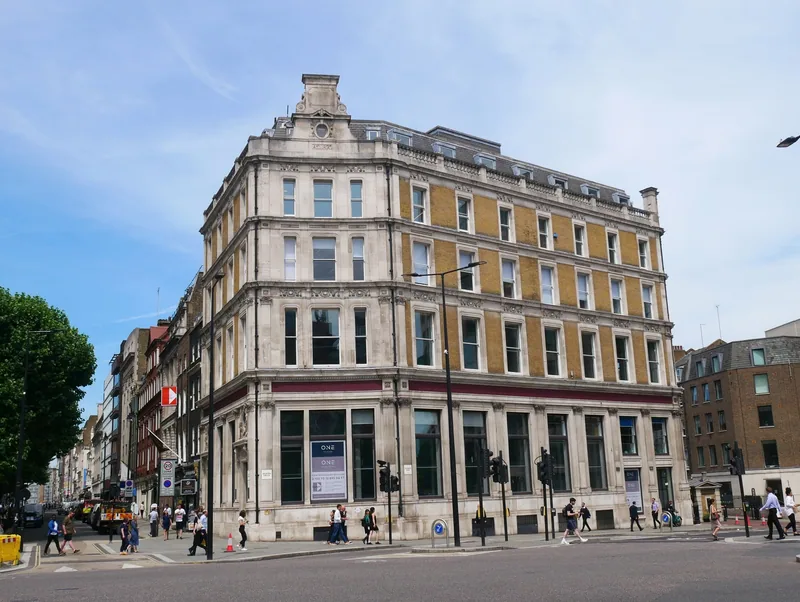
Photo: Doyle of London · CC BY-SA 4.0 · Wikimedia Commons · resized
What a British hallmark actually guarantees
This is law rather than custom. Under the Hallmarking Act 1973 it is a criminal offence for anyone in the course of a trade to describe an unhallmarked article as gold, silver, platinum or palladium, or to supply one. The hallmark is not a mark of quality or of age: it is an independently tested statement of how much precious metal is in the piece.
| Mark | Compulsory? | What it tells you |
|---|---|---|
| Sponsor's mark | Yes | Who submitted the article and is responsible for it. Often called a maker's mark, and often not the maker |
| Fineness number | Yes | Precious metal content in parts per thousand. Gold 375 to 999, silver 800 to 999, platinum 850 to 999, palladium 500 to 999 |
| Assay office mark | Yes | Which office tested it. London is a leopard's head |
| Traditional pictorial symbol | No | The old symbol for the metal, such as a crown or a lion. Applied as standard by the London office |
| Date letter | No | The year of marking |
So a ring with five marks is not better hallmarked than a ring with three. And where an article contains two or more precious metals, the piece is marked to the lowest standard present, which makes the fineness number a floor rather than an average.
A light piece may legally have no hallmark at all. The Act exempts articles below 1 gram of gold, 7.78 grams of silver, 0.5 gram of platinum or 1 gram of palladium. A thin chain or a pair of small studs can be perfectly genuine and unmarked. Ask, rather than assume the absence of a mark means anything either way.
The notice the shop must show you by law
Section 11 of the Act requires every dealer to keep a notice on display "at all times, in a conspicuous position in a part of his premises to which those with whom he deals are commonly admitted". Its wording and form are set by the British Hallmarking Council, it explains the approved hallmarks, and failure to display it is an offence.
That is the single most useful thing a visitor can know here. Every legitimate dealer on this street has a plain, standardised explanation of British hallmarks on the wall, and you are entitled to read it. If you cannot see one, ask. A shop that cannot produce it has a problem that has nothing to do with you.
What the hallmark does not cover: the stone
The Hallmarking Act is about metal. It says nothing about diamonds, sapphires or anything else set into the metal, and there is no equivalent statutory mark for a gemstone in Britain. That is the gap where money goes missing.
What protects you instead is general consumer law. A false description of fineness is treated as a misleading action under the unfair commercial practices provisions now in Part 4 of the Digital Markets, Competition and Consumers Act 2024, and the same framework covers false claims about a stone. That is a remedy after the event, not a check before it, so do the checking yourself:
- Ask for an independent grading report from a recognised laboratory, in the laboratory's name, and read the report rather than the shop's summary of it.
- Ask whether the stone is natural or laboratory-grown, and get the answer in writing on the receipt. The two are chemically the same and very different in price.
- Ask for the price including VAT, and take a written quotation to the next door. Competition between several dozen businesses within three hundred metres is the actual reason to shop here, and there is nothing to reclaim afterwards: our guide to tax-free shopping in the UK explains that the visitor refund scheme ended in 2021.
- Pay by card rather than cash where you can, for the paper trail. Our page on card payments in Britain covers surcharges and limits.
Shops, wholesalers and the assay office counter
Telling the two apart is simple. A retail jeweller has a window display and a street door you can push. A wholesaler has an entryphone, a brass plate or a printed list of company names, often with a camera. Nobody minds you looking at either, but walking into the second without an appointment wastes everyone's afternoon.
One door on the edge of the quarter is neither. The Goldsmiths' Company Assay Office, the statutory body behind the leopard's head, keeps a counter at 17 Greville Street, EC1N 8SQ, one street south, open 09:00 to 17:00 Monday to Friday with an hour's closure from 12:00 to 13:00. It takes work from the trade and does not accept items for valuation; consumer valuations go to Goldsmiths' Hall in the City instead. All its offices may close early on the day before a bank holiday.
Two listed buildings show what the street looked like when it was gentler. Number 5, a mid-eighteenth-century terraced house, was the home of the Italian nationalist Giuseppe Mazzini and carries a plaque at first-floor level. Numbers 19 to 21, Treasure House, were built around 1905 by David Niven and Herbert Wigglesworth for the jewellers Stewart Dawson & Co: Portland stone, a tiled mansard roof, shopfronts separated by pilasters with carved figurative panels. Camden also records a former chapel of about 1670 at number 43 as the only original building of the seventeenth-century layout still standing.
What happened at 88 Hatton Garden in 2015
It is described everywhere as a robbery. It was not. The Court of Appeal judgment on the case records convictions for conspiracy to commit burglary, and the target was not a jeweller's shop but the basement vault of the Hatton Garden Safe Deposit Company at number 88.
The court's own summary of the facts is short. On the evening of 2 April 2015 a van parked in Hatton Garden, one man entered number 88 through the front door, and the others unloaded bags, tools, bins and equipment by the fire escape. They drilled through a concrete wall, could not reach the deposit boxes, and drove home at about eight the next morning. They came back the following evening and got into 73 of the 999 boxes in the vault. The stolen gold, bullion, jewellery, gems and cash were valued at "a little shy of £14 million".
Four men pleaded guilty to conspiracy to burgle and were sentenced at Woolwich Crown Court on 9 March 2016, three to seven years and one to six years and three months. Two more were convicted after trial, and a seventh received 21 months suspended for handling. In confiscation proceedings in January 2018 the judge assessed the benefit at just under £14 million and found about £5.75 million of it still hidden.
Do not go looking for the vault. Number 88 is an ordinary commercial building on a working street, there is nothing to see, there is no plaque and there is no tour. What the case is genuinely useful for is what it says about safe deposit boxes: the company was a private business, not a bank, and most of the value taken from it was never recovered.
Which days the street works, and getting here
The pattern here is the opposite of the one most visitors expect, and Camden's appraisal states it plainly: the small jewellery shops are "busy throughout the week, including at the weekend when the rest of the Area is quieter". So Saturday is a real shopping day on Hatton Garden even though the offices, the workshops and the Leather Lane market are shut. Individual shops keep their own hours, a number close on Saturday and most close on Sunday, so telephone before a special trip. The assay office counter and the wholesale trade are strictly Monday to Friday.
Chancery Lane on the Central line is the nearest station, measured by Transport for London at 399 metres and about 5 minutes to the middle of the street, but it has no lifts. Farringdon is 367 metres and about 7 minutes, and is step-free. Our guide to opening hours and Sunday trading explains the wider pattern.
A gateway at the southern end leads into Ely Place and the medieval church described in Ely Place and St Etheldreda's. Down an alley off it is the pub covered by Ye Olde Mitre, which is closed at weekends. Ten minutes north-east is Smithfield and the new London Museum, which opens on 28 November 2026.
If silver rather than gold is the point, the London Silver Vaults are eight minutes south on Chancery Lane and appear in our guide to London's antiques markets. Evening drinking is covered in the Jerusalem Tavern and the pubs of Clerkenwell, rooms in staying in Clerkenwell and Farringdon, and the streets immediately south by Holborn.
Frequently asked questions
Is Hatton Garden cheaper than a high-street jeweller?
Often, but for a structural reason rather than a bargain: several dozen businesses quote against each other within a few hundred metres, and many of them make or set on the premises rather than buying in finished stock. Get two or three written quotations including VAT for the same specification, and compare those rather than window prices.
What do the numbers on a British gold ring mean?
They are the fineness in parts per thousand, and the Hallmarking Act sets the permitted figures: 375 is 9 carat, 585 is 14 carat, 750 is 18 carat and 916 is 22 carat, with 990 and 999 above them. Next to the number you should find a sponsor's mark and an assay office mark, which for London is a leopard's head.
Is Hatton Garden open on Saturday and Sunday?
Many of the retail shops open on Saturday, and Camden's conservation appraisal notes that they stay busy at the weekend while the rest of the area goes quiet. Sunday is the day to avoid, and the wholesale trade and the assay office counter work Monday to Friday only. Ring ahead if you are travelling for one particular shop.
Was the Hatton Garden job a robbery?
No. The men were convicted of conspiracy to commit burglary, which in English law does not involve force or the threat of it against a person. It happened over the Easter weekend of 2015 at a private safe deposit company at 88 Hatton Garden, not at a jeweller's shop or a bank, and 73 of the 999 boxes in the basement vault were opened.
Can I get jewellery valued in Hatton Garden?
Not at the assay office counter on Greville Street, which handles trade submissions only. The Goldsmiths' Company Assay Office takes consumer valuations at Goldsmiths' Hall in the City instead and quotes seven to ten working days for one to seven items. Several private valuers work on and around Hatton Garden; ask what qualification the valuer holds before you hand anything over.
Sources
- Hallmarking Act 1973, Schedule 2 - assay office marks and standards of fineness (checked September 2026)
- Hallmarking Act 1973, Schedule 1 - exempted articles and weight thresholds (checked September 2026)
- Hallmarking Act 1973, section 11 - dealers to exhibit notices as to hallmarks (checked September 2026)
- GOV.UK - British Hallmarking Council (checked September 2026)
- Goldsmiths' Company Assay Office - What is a hallmark, and the Greville Street and Goldsmiths' Hall counters (checked September 2026)
- Historic England - 31 Hatton Garden, list entry 1466982 (checked September 2026)
- Camden Council - Hatton Garden Conservation Area Appraisal and Management Strategy, August 2017 (checked September 2026)
- Find Case Law, The National Archives - Doyle and others, R v [2017] EWCA Crim 340 (checked September 2026)