
Southall is a Punjabi town inside west London, fourteen minutes from Paddington on the Elizabeth line. Its main streets are lined with gold jewellers, cloth shops and sweet counters, its gurdwara is the largest Sikh temple in London and serves a free meal to anyone who walks in, and almost nothing about the place has been adjusted for visitors.
That last point is the whole character of it. Southall is not a heritage quarter or a themed street. It is a working town centre serving the people who live there, and a visitor is simply another customer. Nobody will explain anything unless you ask, and if you ask, most people will.
Our guide to Indian food in London covers what to order here and how the regional cooking differs, and our page on Ealing and west London sets Southall in its wider borough. This article is about the visit itself: the gurdwara, the shops, the practicalities, and what to do with the rest of the day.
Southall at a glance
- Best for
- Punjabi food, gold and cloth shopping, sweets, and a Sikh temple open to all
- Station
- Southall (Elizabeth line and Great Western, Zone 4)
- From central London
- 14 minutes from Paddington; about 21 to 23 minutes from Tottenham Court Road
- Main streets
- The Broadway, South Road, King Street, High Street
- Gurdwara
- Sri Guru Singh Sabha, Havelock Road: open to visitors 3am to 9pm daily, free
- Busiest
- Saturday and Sunday, and during Vaisakhi and Diwali
The train, and why the journey changed
Southall station is in Zone 4 and is served by the Elizabeth line, which runs through the middle of London without changing trains: Paddington in fourteen minutes, Tottenham Court Road in about twenty-two, and on to Farringdon, Liverpool Street and Canary Wharf. The whole journey falls under the same daily cap as everything else you do that day, so the trip costs very little on top of a day's travel.
One thing to watch: not every Elizabeth line train stops at Southall, because some services run fast towards Heathrow or Reading. Check the destination and the calling points on the platform indicator. Our explainer on how the Elizabeth line works covers the stopping patterns, which are the one genuinely confusing thing about the line.
Southall is also four stops from Heathrow on the same line. If you have a long layover or an early flight from Terminals 2, 3 or 5, this is a far better use of four hours than sitting in the terminal; see our Heathrow arrivals guide for how the transfers work.
Come out of the station and turn towards the bridge. Southall's centre is not immediately obvious from the platform. The Broadway and South Road form the main axis, with King Street and the High Street running off them, and everything in this article is within a fifteen-minute walk of the station entrance. Allow an hour just to walk the length of the shops.
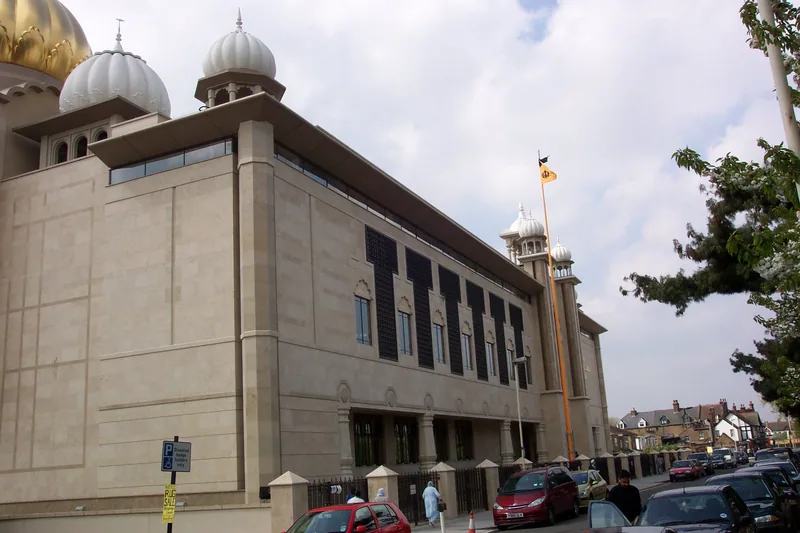
The gurdwara, and how to visit properly
Sri Guru Singh Sabha, which stands on Havelock Road, is the biggest Sikh place of worship in the city, and visitors of any faith or none are genuinely welcome. It is not an attraction with an admission desk. It is a working temple, and behaving well in it is straightforward once you know the rules.
The gurdwara's own information says it is open to visitors from 3am to 9pm every day, that it is particularly busy on Sundays and during the major Sikh festivals of Vaisakhi, Diwali and Guru Nanak Gurpurab, and that early arrival is advised on those days.
What to do, in order:
- Cover your head. This applies to everyone, of any gender. Scarves are usually available at the entrance if you do not have one; a clean handkerchief or a hood will do.
- Take off your shoes and leave them in the racks provided. Socks are fine.
- Wash your hands at the basins by the shoe racks.
- No alcohol or tobacco may be brought in, and you should not enter having been drinking.
- Dress modestly: legs and shoulders covered.
- In the prayer hall, walk quietly, sit on the floor at the side or the back, and do not point your feet at the scripture at the front. People will be coming and going constantly; you are not interrupting.
Photography inside is restricted and varies by area. Ask before you take a picture, and accept the answer. Our page on British etiquette for visitors covers the broader question of behaving in places of worship.
Langar: the free kitchen
Every gurdwara runs a langar, a communal kitchen that serves a free vegetarian meal to anyone who comes, of any religion, any background and any income. It is a central religious principle rather than a charity service, and it operates seven days a week. The gurdwara at Southall serves on a very large scale.
You sit on the floor in rows, everyone at the same level, and volunteers come along with buckets of dal, vegetable curry, rice and chapatis, serving onto a metal tray. You eat as much as you want; hold up a hand to decline more. There is no charge and no expectation of payment, though there is a donation box and leaving something is a reasonable thing to do.
Go in with the right attitude. This is not a free lunch for tourists; it is a religious practice that happens to include you. Eat properly, thank the people serving, and help clear your tray if that is what others are doing.
For a comparable building on the other side of west London, the BAPS Shri Swaminarayan Mandir at Neasden is a Hindu temple in carved marble and limestone with its own vegetarian dining hall and much stricter rules about dress and photography.
Gold, cloth and sweets: what the shops actually sell
Three trades dominate the streets, and each has its own conventions.
The jewellers sell gold at a much higher purity than British high-street jewellery, usually 22 carat, worked into heavy chains, bangles and wedding sets. Prices are largely driven by the weight and the daily gold price rather than by design, and the shops display that day's rate. This is a serious trade serving weddings, not a souvenir business, and the windows are worth looking at even if you buy nothing.
The cloth shops sell fabric by the metre and ready-made clothing: silks, cottons, embroidered and beaded material for wedding outfits, plus everyday salwar kameez and saris. Fabric is cut to order, and many shops have a tailor attached who will make something up in a few days. If you want a length of good cloth to take home, this is the cheapest place in London to buy it, and our page on London souvenirs worth buying is honest about what else is and is not worth the suitcase space.
The mithai counters sell Indian sweets by weight from glass cases. You point, you say how many grams, they box it. Everything is priced per kilo and is a fraction of what a dessert costs in the centre; our guide to desserts and chocolate in London puts them against the patisseries.
Bring cash for the small shops, and expect prices to be fixed. Most places take cards, but a few of the smallest sweet counters and market stalls prefer cash. Haggling is not the custom in the food shops or the sweet shops; the price is the price. Gold is different, because it is weighed and calculated in front of you.
Eating, and what "vegetarian" means here
Southall is one of the easiest places in London to eat as a strict vegetarian, because many kitchens are entirely vegetarian and always have been. No substitution is required and nobody will look puzzled. Our page on eating vegan and vegetarian in London explains the difference between a vegetarian kitchen and a restaurant with a vegetarian section, which matters more than most visitors realise.
Equally, most of the meat served here is halal, and Southall is one of the main centres for it in west London; see our guide to halal food in London. Alcohol is not served in many of the restaurants. Some are licensed, some are not, and a few allow you to bring your own; ask before you sit down if it matters to you.
The Three Bridges, which is the strangest thing here
Ten minutes' walk south of the centre, on Windmill Lane, is a piece of engineering that almost nobody visits. Isambard Kingdom Brunel needed to take a railway branch line from Southall to Brentford past an existing canal and an existing road, and rather than divert any of them he stacked all three: the road crosses on top, the Grand Union Canal runs in an iron trough beneath it, and the railway passes below that again.
He completed it in 1859, the year he died, which makes it among the last things he built. It is a scheduled ancient monument, and the road and canal bridges are cast iron with a weight limit as a result. There are entrances from Windmill Lane, and the whole thing takes fifteen minutes to look at and is free.
From there you can walk along the towpath of the Grand Union Canal, which runs through Southall towards Hanwell and the Brent valley. For the better-known canal walk in central London, see our page on Little Venice and the Regent's Canal.
Parks, and the rest of the town
Southall Park and Norwood Green are the local green spaces, ordinary rather than remarkable, and useful if you want somewhere to sit after eating too much. Southall Manor House, on The Green, is a timber-framed Tudor building that survives improbably in the middle of a modern town centre.
On the Broadway, look up at the frontage of the former Palace cinema, an interwar picture house given an elaborate Chinese-style facade, which later ran for years as a Bollywood cinema. It is no longer a cinema and its ground floor has been put to other uses, so look at it from the pavement rather than planning to go in.
When to come, and who it suits
Weekends are when Southall is fully itself: crowded, loud, with wedding shopping in full swing and the gurdwara at its busiest. A weekday is calmer, easier to walk and better if you want to talk to shopkeepers. Avoid arriving at two in the afternoon expecting an empty restaurant; the good ones are busy all day.
Go if you want
- The best-value food of its kind in London
- To visit a working Sikh temple properly, and eat in the langar
- Cloth, gold and sweets at trade prices
- A short, cheap trip on the Elizabeth line
- A piece of Brunel engineering nobody queues for
Skip it if you want
- Museums, galleries or historic architecture
- A street arranged for visitors, with menus in five languages
- A drink with dinner, which is not always possible
- Quiet: the Broadway is loud and the traffic is heavy
- To fit it into a three-day first visit to London
For the same idea at the other end of the city, Tooting does South Indian and Sri Lankan cooking on a similar scale, and Wembley, a short way north, is the centre of Gujarati London. Doing two of the three in one trip gives you a much better picture of Indian London than any single restaurant in the West End.
Frequently asked questions
How do you get to Southall from central London?
One train does it: the Elizabeth line. Reckon on about 14 minutes from Paddington and about 22 from Tottenham Court Road, with no change on the way. Southall is in Zone 4, so contactless and Oyster work and the fare counts towards your daily cap. Check the platform indicator, because some Elizabeth line services run fast and do not stop here.
Can anyone visit the gurdwara in Southall?
Yes. Anyone may visit Sri Guru Singh Sabha, on Havelock Road, which opens from 3am to 9pm daily and charges nothing. Cover your head, remove your shoes, wash your hands, dress modestly and bring no alcohol or tobacco. It is busiest on Sundays and during Vaisakhi, Diwali and Guru Nanak Gurpurab.
Is the free meal at the gurdwara really free?
Yes. The langar is a communal kitchen that serves a free vegetarian meal to anyone who comes, seven days a week, as a religious principle rather than as charity. You sit on the floor, volunteers serve onto a metal tray, and you take as much as you want. There is a donation box, and leaving something is courteous but not required.
What should I buy in Southall?
Fabric by the metre from the cloth shops, which is the cheapest good material in London; Indian sweets by weight from the mithai counters; and spices and groceries from the supermarkets. Gold here is usually 22 carat and priced by weight against the day's rate, which is a serious purchase rather than a souvenir.
What else is there to see in Southall besides food?
The Three Bridges on Windmill Lane, where Brunel stacked a road, the Grand Union Canal and a railway on three levels in 1859; it is a scheduled ancient monument and free to look at. There is also the Tudor Southall Manor House, the towpath walk along the canal, and the Chinese-style frontage of the former Palace cinema on the Broadway.
Sources
- Sri Guru Singh Sabha Southall - Visitor information and opening hours (checked September 2026)
- Historic England - Windmill Bridge, the Three Bridges, Southall (list entry 1002020) (checked September 2026)
- Ealing Council - The Three Bridges local history walk (checked September 2026)
- Transport for London - The Elizabeth line (checked September 2026)
- Transport for London - Journey Planner, times from Paddington and Tottenham Court Road (checked September 2026)