
Three things bring visitors to this corner of north-west London: a zebra crossing outside a recording studio, the oldest cricket ground in the world, and a canal basin full of narrowboats. They are within a mile of each other, all reachable on foot, and between them they make a good half-day that most three-day itineraries never touch.
St John's Wood and Maida Vale are otherwise residential: wide streets of white stucco villas and red-brick mansion blocks, expensive, quiet and not designed to be looked at. There is no high street of any scale, no market and very little nightlife. That is not a criticism, it is simply what the area is.
Each of the three attractions has its own page on this site, and they go into far more detail than a neighbourhood guide can: the Abbey Road crossing, cricket at Lord's and Little Venice and the Regent's Canal. This page is about fitting them together and about what else is here.
St John's Wood and Maida Vale at a glance
- Best for
- Abbey Road, Lord's, canal boats, a very large mosque, quiet streets
- Stations
- St John's Wood (Jubilee line, Zone 2); Maida Vale and Warwick Avenue (Bakerloo line, Zone 2)
- Walking distance
- Abbey Road to Lord's, about 10 minutes; Lord's to Little Venice, about 20
- Free
- The crossing, the canal basin, the mosque, the park
- Ticketed
- The Lord's guided tour, £32.95 for 100 minutes
- Time needed
- Half a day on foot
The walk that joins the three
The reason to treat this as a neighbourhood rather than three separate trips is that they line up. Start at St John's Wood station on the Jubilee line, which is also the nearest station to the crossing and is a few minutes from Lord's.
- Abbey Road is a short walk north-west of the station, on buses 139 and 189 if you would rather ride. Do the photograph, look at the graffiti wall, and go.
- Lord's is about ten minutes back the other way, on St John's Wood Road. Tours run most days when there is no cricket.
- Little Venice is twenty minutes south-west from there, either through the streets or, better, down onto the canal towpath at Lisson Grove and along the water.
- Finish at Warwick Avenue station on the Bakerloo line, which is directly beside the basin, or take the waterbus east to Camden.
That is about three miles in total with two long stops in it, and it is flat. Doing it in the other direction works equally well and puts you on the Jubilee line at the end, which is the faster of the two lines back into the centre.
Two Tube lines serve this area and they behave very differently. The Jubilee line at St John's Wood is fast, frequent and goes to Bond Street in one stop. The Bakerloo line at Maida Vale and Warwick Avenue is an older, slower line with narrower trains. For getting back to a central hotel in a hurry, walk to St John's Wood. Our guide to the Underground explains the difference between the deep tube lines.
Abbey Road: the practical bits a neighbourhood page can add
The crossing is on a working public road with real traffic on it, in a residential street where people live and are extremely tired of the whole business. Our dedicated page on the crossing, linked above, covers how to take the photograph safely and how to get a good one.
Two things worth knowing from a neighbourhood point of view. First, there is very little here besides the crossing: no café with a view of it, no visitor centre, and the studios are a working business that does not admit the public. Second, the residents' patience is finite and the road is busy, so treat it as five minutes rather than an hour.
Abbey Road Studios runs an official webcam on its own website pointing at the crossing, which is genuinely useful: you can look at it before you travel and see how busy it is, and friends at home can watch you cross.
Lord's, and what you can see without a match ticket
Lord's, on St John's Wood Road, is the home of the Marylebone Cricket Club and the most important cricket ground in the world. It has a Victorian pavilion, a media centre that looks like a spacecraft, a slope across the pitch of about two and a half metres, and a museum holding the Ashes urn.
The guided tour costs £32.95 and lasts 100 minutes (September 2026). It operates on most non-match days, takes you into the Long Room and the dressing rooms, and is among the better sports tours in the city even for someone who has never watched a game. Check availability on the MCC's own site, because tours do not run on major match days.
Our cricket page, linked at the top, explains the formats, how the ballots work and what tickets cost, which matters because international days here sell out long in advance. For the other grounds that run tours, see our stadium tours page.
The mosque at the edge of Regent's Park
The London Central Mosque, at 146 Park Road, is one of the largest mosques in Britain, with a golden dome and a minaret visible across Regent's Park. It is run by the Islamic Cultural Centre and it welcomes visitors.
The rules are clear and are worth reading before you go. Dress decently, with no tight-fitting clothing; women are asked to cover their heads with a scarf anywhere in public on the premises, and scarves are available at the security desk. No alcohol, music, dancing or smoking on the premises. As with any working place of worship, prayer times are when the building is busiest and least suitable for sightseeing; our page on British etiquette for visitors covers the general principle.
From the mosque it is a two-minute walk into Regent's Park, which is the obvious way to extend the day.
Little Venice, and what makes it different from the rest of the canal
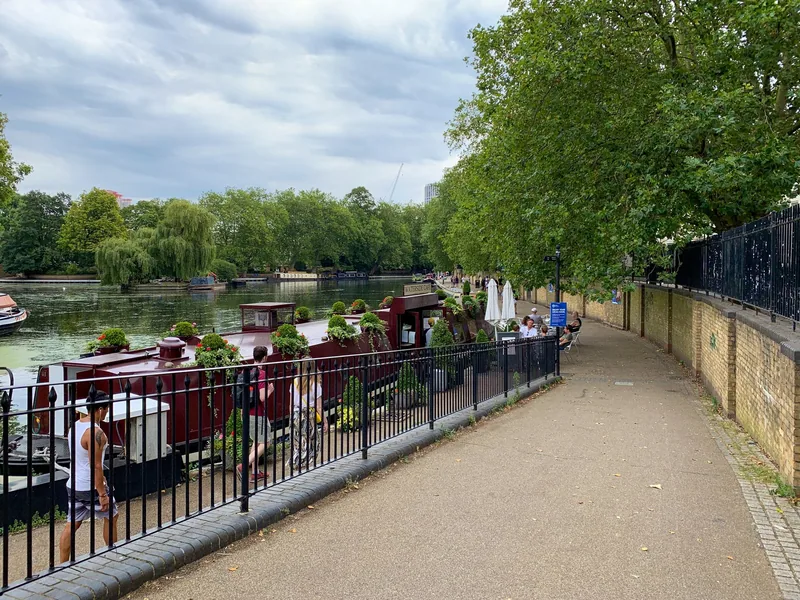
Little Venice is the triangular basin where the Regent's Canal meets the Paddington Arm of the Grand Union, with willows, moored narrowboats, a small island in the middle and white stucco houses all around. Our full page on Little Venice and the canal, linked above, covers the boat companies, the trip to Camden and the towpath walk.
Two things that belong on a neighbourhood page. There is a puppet theatre on a barge moored here, which runs shows for children and adults in the winter months and moves away in summer, and which is one of the odder small venues in London: check its schedule before promising anything to a six-year-old. And Rembrandt Gardens, the small public garden beside the basin, is free, has benches and is the right place to sit and eat something.
Warwick Avenue station is directly beside the basin, which makes this the easiest arrival of the three stops in this article.
Maida Vale station, and eight women in 1915
Maida Vale station opened on 6 June 1915, on the Bakerloo line extension from Paddington to Queen's Park, and it was the first station on the Underground to be staffed entirely by women: a team of eight who did every job in the building. Britain was at war, men were away, and the Underground became one of the first transport operators in the country to put women into operational roles.
The building was put up in 1914 and 1915, probably by Stanley Heaps in the style established by his predecessor Leslie Green, with the oxblood-red glazed terracotta frontage that marks the pre-war deep tube stations. It is listed at Grade II.
It takes two minutes to look at and it is free, and knowing what happened in it makes an ordinary Tube entrance worth stopping for.
The streets themselves
St John's Wood was one of the first parts of London built as detached and semi-detached villas with gardens rather than terraces, which is why it looks the way it does. St John's Wood High Street is a short, expensive parade of cafés, delicatessens, a bookshop and a few restaurants, and it is pleasant for half an hour.
Maida Vale, to the west, is dominated by large red-brick mansion blocks from around 1900, built as flats for the professional middle classes. The streets between them are wide, quiet and lined with plane trees, and the area running north from Little Venice is sometimes called Maida Hill.
There is no real nightlife in either place. Pubs close at ordinary times, restaurants are neighbourhood restaurants, and for an evening out you go elsewhere. Our page on Marylebone covers the nearest area with a proper high street, and Paddington and Bayswater the nearest one with hotels.
Staying here
There are hotels, they are quiet, and the Jubilee line reaches Bond Street in a single stop and Westminster in four. For a family that values a quiet night over a central address, that is a reasonable trade. It is also an expensive area, so the saving against central London is smaller than you might expect.
Our guide to staying near King's Cross, St Pancras and Paddington covers the nearest concentration of rooms, and Paddington is fifteen minutes' walk from Little Venice along the canal.
Who this suits
Come for
- Abbey Road, Lord's and the canal in one flat walk
- A cricket tour that works even if you do not follow cricket
- Narrowboats and a puppet theatre on the water
- A very large mosque that welcomes visitors
- Quiet streets ten minutes from Regent's Park
Not for you if
- You want shops, markets or nightlife
- You expected Abbey Road to be an attraction rather than a road
- You are visiting Lord's on a major match day without a ticket
- You want to eat cheaply: this is an expensive part of London
- It is raining, since most of this walk is outdoors
If you are working your way outwards from the centre, Wembley is further along the Jubilee line and Angel and Finsbury Park are the equivalent on the other side of north London, with far more going on in the evening.
Frequently asked questions
Which Tube station is nearest to Abbey Road?
St John's Wood, on the Jubilee line, a few minutes' walk away. Buses 139 and 189 also stop nearby. Beware the Docklands Light Railway stop that shares the name: it is out east, several miles away, and no record was ever made near it. People get this wrong often enough that it is worth saying twice.
How much is the Lord's tour?
The Lord's Guided Tour costs £32.95 and lasts 100 minutes as of September 2026. It runs on most days without play and includes the Long Room, the dressing rooms and the museum with the Ashes urn. Tours do not operate on major match days, so check availability on the MCC's website before travelling.
Can visitors go inside the London Central Mosque?
Yes. The mosque at 146 Park Road welcomes visitors of any background. Dress decently with no tight-fitting clothing, and women are asked to cover their heads with a scarf, which can be obtained at the security desk. Alcohol, music, dancing and smoking are not permitted on the premises. Avoid prayer times if you are there to look around.
Can you walk from Abbey Road to Little Venice?
Yes, in about half an hour, and it is flat the whole way. A good route takes in Abbey Road, then Lord's on St John's Wood Road, then down to the canal towpath near Lisson Grove and west along the water to the basin at Little Venice, finishing at Warwick Avenue station on the Bakerloo line.
What is special about Maida Vale Tube station?
It opened on 6 June 1915 and was the first station on the London Underground staffed entirely by women, a team of eight doing every job in the building while men were away at war. The Grade II listed building, in oxblood glazed terracotta, was put up in 1914 and 1915 in the style established by Leslie Green.
Sources
- Transport for London - Maida Vale station centenary and its all-female staff (checked September 2026)
- Historic England - Maida Vale Underground Station (list entry 1066834) (checked September 2026)
- Lord's - Guided tour price and duration (checked September 2026)
- London Central Mosque and the Islamic Cultural Centre - Visitor conditions (checked September 2026)
- Abbey Road Studios - The crossing webcam (checked September 2026)