
The best South Asian cooking in London is not in the centre. It is in Southall, Tooting, Wembley and East Ham, where restaurants cook for the families who live around them, and where a Sunday lunchtime queue outside a plain-looking room tells you more than any review. This page is about getting to those streets and knowing what to ask for when you arrive.
The cooking of Sri Lanka, Bangladesh, Pakistan and India is not one cuisine, and London is one of the few cities outside South Asia where you can eat across all of them in a weekend. A Gujarati thali in Wembley, a Tamil dosa in Tooting, a Punjabi tandoor in Southall and a Hyderabadi biryani in Whitechapel have almost nothing in common except the spice cupboard.
Our separate page on Brick Lane and the British curry house explains how that trade grew, how to read a menu of kormas and madras, and what to do about the touts on the pavement. Start there if you are new to it. This page starts where that one stops: the outer neighbourhoods, the regional dishes and the practicalities of an afternoon spent eating in them.
Four streets and what they are for
- The Broadway, Southall
- Punjabi tandoor cooking, sweet shops, sugar cane juice. Southall station, Zone 4, Elizabeth line
- Upper Tooting Road
- Sri Lankan Tamil and South Indian, plus Pakistani grills. Tooting Broadway, Zone 3, Northern line
- Ealing Road, Wembley
- Gujarati vegetarian, chaat, mithai by the kilo. Alperton, Zone 4, Piccadilly line
- Green Street, East Ham and Upton Park
- South Indian, Sri Lankan and Kerala Muslim cooking. East Ham, Zones 3 and 4, District line
- Transport cost
- All four sit inside the Zones 1-4 daily cap of £12.80 (September 2026)
- Best day
- Sunday lunchtime for atmosphere; a weekday evening for a table
Southall: the Punjab at the end of the Elizabeth line
Southall changed for visitors when the Elizabeth line opened. Trains from Paddington, Bond Street, Tottenham Court Road, Farringdon and Liverpool Street run straight there, the journey feels like a Tube ride rather than an expedition, and the fare falls under the same ceiling that covers everything else you do that day. Our guide to how the Elizabeth line works covers the stopping pattern, which matters because not every train calls at every station.
Come out of the station, turn left, and The Broadway runs west for well over a kilometre. Jewellers, fabric shops and grocers take up most of the frontage; the food is in between, and a good deal of it is not in restaurants at all.
What to order. Southall's kitchens are Punjabi, which means the tandoor and the karahi. Ask for lamb chops marinated and charred in the clay oven, a karahi of chicken or paneer brought to the table in its own iron pan, black lentils cooked overnight until they taste of cream, and a stack of hot roti. Ask for lassi, salted rather than sweet, if the day is warm.
What to buy. The mithai shops sell sweets by weight from glass counters: squares of barfi in cashew, pistachio or coconut, orange coils of jalebi fried to order, milky gulab jamun in syrup. Point at what you want and say how many grams. Half a kilo feeds a family and costs less than a dessert in the West End. Many shops also have a savoury counter selling samosas and pakoras hot from the fryer, which is the cheapest lunch on the street.
Southall pairs naturally with the temple at Neasden. Both sit in west and north-west London, both are free to look at from the outside, and the BAPS Shri Swaminarayan Mandir has a vegetarian dining hall of its own. Doing the two in one afternoon gives you a side of London that no central itinerary includes.
Tooting: where to find a dosa done properly
Tooting is the easiest of these areas to reach from the centre, being on the Northern line, and the most densely packed. Between Tooting Bec and Tooting Broadway stations the road carries Sri Lankan Tamil cafes, South Indian vegetarian rooms, Pakistani grill houses and at least two covered markets.
A dosa is a crisp, paper-thin crepe made from rice and lentil batter left to ferment overnight. It arrives rolled or folded and longer than the plate, with a bowl of thin lentil broth and small dishes of chutney. Order a plain one first, or a masala dosa with a spiced potato filling inside it. Eat with your right hand, tearing pieces and dipping.
Sri Lankan menus add two dishes that are worth crossing London for. Hoppers are bowl-shaped, lacy pancakes cooked in a curved pan, lace-thin at the rim and spongy in the middle, sometimes with an egg set into the base. Kothu is flatbread chopped on a hot griddle with egg, vegetables and meat, and you can hear the metal blades from the pavement before you see the kitchen. Order kothu for one person and it will feed two.
Tooting is also where a strict vegetarian eats best in London. Whole menus contain no meat at all and were not designed as a substitute for it. Our page about eating vegan and vegetarian covers the wider picture, but the South Indian rooms on this road need no special arrangements.
Wembley and Ealing Road: Gujarati food and the art of the thali
Ealing Road runs south from Wembley towards Alperton, and it is the centre of London's Gujarati community. The cooking is vegetarian, sweeter and gentler than Punjabi food, built on lentils, chickpea flour, yoghurt and a light hand with chilli.
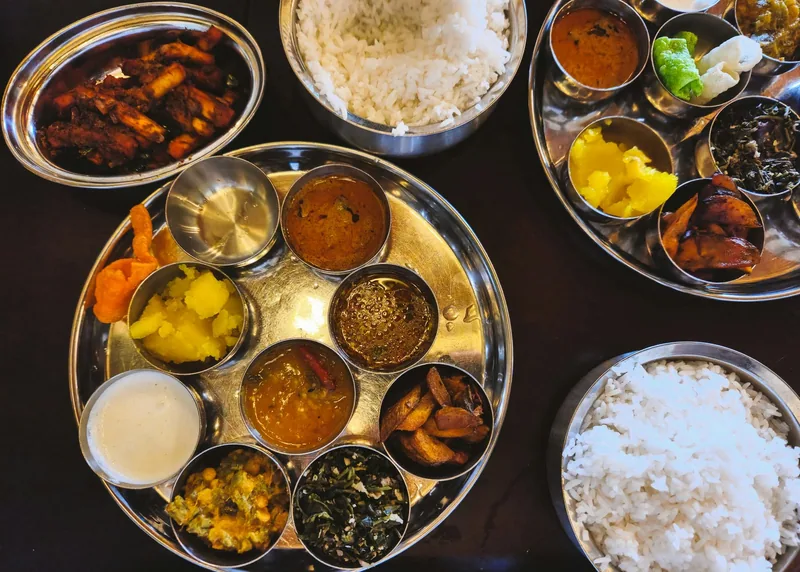
The dish to understand here is the thali. A thali is a round metal tray with a rim, carrying six or eight small bowls: two or three vegetable dishes, a lentil dal, a thin soupy kadhi, rice, pickles, a sweet, and bread brought hot to the table a piece at a time. In many places it is unlimited, and the staff will refill the bowls until you stop them. It is the best value meal in the city for a hungry person, and the most bewildering if nobody explains the etiquette.
- Say yes to a refill by leaving the bowl where it is, and no by covering it briefly with your hand.
- Bread keeps arriving. Two or three pieces is normal; six is a challenge.
- Mix a spoonful of each curry into a little rice rather than eating them one after another.
- The sweet is part of the meal, not a dessert, and often arrives at the start.
Ealing Road's other speciality is chaat, the family of savoury snacks built on crisp fried dough, yoghurt, tamarind and coriander. Pani puri are hollow spheres you fill with spiced water and eat in one go, immediately, before they collapse. They are messy, cheap and the single most fun thing to eat on this list.
Green Street, East Ham and the Kerala kitchens
Green Street runs north from Upton Park, and the surrounding streets in East Ham hold the largest concentration of South Indian and Sri Lankan shops in east London. Cooking from Kerala, on India's south-western coast, is the distinctive thing here: coconut, curry leaves, mustard seed, black pepper and a lot of fish.
Ask for a Kerala fish curry, sour with tamarind or with the smoked fruit called kudampuli, and appam, a soft fermented rice pancake, to soak it up. Look also for beef fry, slow-cooked with coconut slivers and black pepper, which surprises visitors who assume beef is never on an Indian menu. It is common in Kerala, where a large Christian and Muslim population eats it.
East Ham sits in Zones 3 and 4, served by the Hammersmith & City and District lines, and the walk from the station along High Street North to Green Street takes about fifteen minutes. Our page about finding halal food covers this corridor in more detail, because many of the butchers and restaurants here are Muslim-run.
Where to eat regionally without leaving Zone 1
You will not always have an afternoon to spare. Three central clusters do a version of the same thing.
| Where | Nearest station | What it does |
|---|---|---|
| Drummond Street, Euston | Euston or Euston Square | South Indian vegetarian cafes and sweet shops, useful before a train |
| Whitechapel Road and Fieldgate Street | Whitechapel, Zone 2 | Punjabi and Pakistani grill houses, several unlicensed with bring-your-own |
| Mayfair and St James's | Green Park, Zone 1 | Tasting menus and regional cooking at the top of the price range |
The West End rooms are a different proposition altogether, and several hold stars. Our guide to Michelin-starred restaurants covers that end. Book their set lunch rather than dinner if you want the cooking without the evening bill.
Drinking, paying and the things that catch visitors out
Several of the best restaurants in Southall, Tooting and East Ham do not serve alcohol, for religious reasons. Some of those are happy for you to arrive with a bottle and charge a small fee for opening it; others forbid it outright. Ask when you book, not when you arrive with a bottle. Our notes on alcohol rules in London explain where you may and may not drink in public on the way.
Payment is nearly always by card now, but sweet shops and snack counters are the last holdouts and a few still prefer cash. Carry a small amount. Our page about paying for things in London covers contactless limits and foreign card charges.
Two more practical points. Many of these restaurants do not take bookings at all, and the queue on a Sunday between 13:00 and 15:00 can run to forty minutes. And portion sizes in family restaurants are built for sharing: three dishes, one rice and one bread between two people is usually too much food.
A day of eating across four boroughs can cost you nothing extra in fares. Southall, Wembley and East Ham all sit inside Zone 4, where an adult using contactless is charged no more than £12.80 in a day. If you were already going to use the Tube for a full day, the travel to any of these streets is effectively free once you hit the cap. Check the current figure on TfL's capping page.
When the streets are at their best
Two festivals transform these neighbourhoods. Vaisakhi, the Punjabi harvest and Sikh new year festival in April, fills Southall with processions and free food served from stalls by the gurdwaras. Diwali, in the autumn, brings queues at every sweet shop in Wembley and Southall for boxes of mithai, and Trafalgar Square holds its own celebration. The dates move each year, so check before you plan around them, and see what else is on in October if you are here in autumn.
Outside those weeks, Sunday is the day these streets are busiest and most enjoyable, and Monday is the day some family restaurants close. Ramadan changes opening hours across Whitechapel and East Ham, with kitchens quiet by day and very busy after sunset.
Building a food day around one area
A single street is enough for an afternoon if you treat it as several small meals rather than one large one. In Southall: samosas from a sweet-shop counter, then a plate of chaat, then grilled lamb chops in a restaurant two hours later, then half a kilo of barfi to take away. In Tooting: a dosa at midday, a walk through the covered markets, kothu in the late afternoon.
If you would rather have someone else do the planning, several operators run guided eating walks in these areas. See our page on food tours in London for how they work and what they cost, and London's food markets for the central alternative on a day when you have less time.
For cheaper eating across the whole city, including the supermarket and canteen tricks Londoners use on weekdays, see our page about eating well on little money. For the other communities whose food is worth the same journey, start with the charcoal grills of Green Lanes and Dalston.
Frequently asked questions
Where is the best Indian food in London?
There is no single answer, because the cooking is regional. For Punjabi tandoor food go to Southall, for South Indian and Sri Lankan go to Tooting or East Ham, for Gujarati vegetarian go to Ealing Road in Wembley, and for refined regional tasting menus go to Mayfair. Brick Lane is the most famous street but not the widest choice.
How do I get to Southall from central London?
Take the Elizabeth line from Paddington, Bond Street, Tottenham Court Road, Farringdon or Liverpool Street directly to Southall, which is in Zone 4. Not every Elizabeth line train calls there, so check the destination on the platform display. The journey sits inside the Zones 1-4 daily cap of £12.80.
What is a thali and how much food is it?
A thali is a metal tray holding several small bowls of vegetable curries, lentils, rice, pickles and a sweet, with bread brought hot to the table. In many Gujarati restaurants the refills are unlimited until you say stop. One thali is a full meal for one hungry adult, and no side dishes are needed.
Do Southall and Tooting restaurants let you bring wine?
Only where the restaurant says so. A number of restaurants in Southall, Tooting, Whitechapel and East Ham do not sell alcohol at all, and some of those welcome customers bringing their own, occasionally for a small charge. Others are licensed and will not allow it. Confirm before you travel.
Is Indian food in London good for vegetarians?
Yes, and unusually so. Gujarati and South Indian restaurants serve entirely vegetarian menus that were never designed around meat, so the vegetarian dishes are the main event rather than an afterthought. Ask about ghee, cream and yoghurt if you avoid dairy, and about ground nuts in creamy sauces if nuts are a problem for you.
Sources
- Transport for London - Daily and weekly fare capping (checked September 2026)
- Transport for London - The Elizabeth line (checked September 2026)
- Transport for London StopPoint data - fare zones for Southall, Tooting Broadway, Alperton and East Ham (checked September 2026)
- Food Standards Agency - Food hygiene ratings search (checked September 2026)
- Food Standards Agency - Food allergy and intolerance advice for consumers (checked September 2026)