
Wembley is two places with one name. Wembley Park, in the north, is a new district built around the national stadium and a 12,500-seat arena, with an outlet mall and thousands of new flats. Wembley Central, fifteen minutes' walk south, is an older high street, and beyond it Ealing Road is the centre of Gujarati London, with a hand-carved stone temple on it.
Almost everyone who comes here comes for an event, and the difference between an event day and an ordinary day is enormous. On a Tuesday in February, Wembley Park is a quiet modern plaza. On a cup final Saturday, ninety thousand people walk up the same street.
This page is about the area rather than the venues. Our guides to outlet shopping near London and to stadium tours cover the shops and the tour in detail, and our page on London's big arenas covers what it is like to see a concert here.
Wembley at a glance
- Best for
- Football, concerts, outlet shopping, Gujarati food and two remarkable temples
- Stations
- Wembley Park (Jubilee and Metropolitan lines, Zone 4); Wembley Central (Bakerloo line, Overground and National Rail, Zone 4); Wembley Stadium (Chiltern from Marylebone)
- From central London
- 13 minutes from Baker Street to Wembley Park on the Metropolitan line
- Stadium
- 90,000 seats, England's national stadium and the second largest in Europe
- Arena
- OVO Arena Wembley, 12,500 seats
- Avoid
- Visiting for the shops on a stadium event day
Three stations, and which one to use
The three stations are not interchangeable, and choosing the wrong one adds a twenty-minute walk.
- Wembley Park (Jubilee and Metropolitan lines, Zone 4) is the main one. Baker Street to Wembley Park takes about 13 minutes on a Metropolitan line train, and the station exit puts you at the bottom of Olympic Way with the stadium arch straight ahead. This is the station for the stadium, the arena and the outlet centre.
- Wembley Central (Bakerloo line, the Overground's Lioness line and London Northwestern trains, also Zone 4) serves the older town centre and is the right station for Ealing Road. It is about fifteen minutes' walk south of the stadium.
- Wembley Stadium (Chiltern Railways from Marylebone) is a separate station on the far side of the stadium, useful on event days because it spreads the crowd across a different route.
All three take contactless and Oyster. On event days the Underground runs extra trains and the stations use queuing systems in both directions; our page on avoiding rush hour in London applies equally to a stadium exit, which is a rush hour of its own.
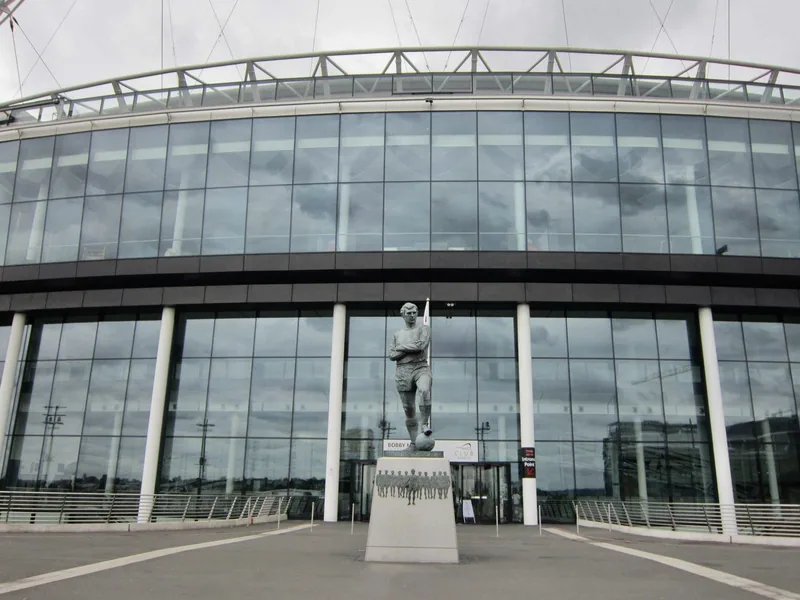
Photo: Ank Kumar · CC BY-SA 4.0 · Wikimedia Commons · resized
Olympic Way, and what an event day is actually like
Olympic Way is the wide pedestrian avenue from Wembley Park station to the stadium steps, universally called Wembley Way. Walking up it towards the arch with a crowd is the part of a Wembley visit people remember, and it takes about eight minutes at a normal pace and considerably longer in a crowd.
Three practical things decide whether an event day goes smoothly.
- The bag rule is strict and is enforced. Wembley Stadium allows one small bag per person, and it must be smaller than A4: 297mm high, 210mm wide and 210mm deep. A handbag counts as your one bag. A large bag folded over to make it look smaller will be refused, and there is no bag drop at the stadium for ordinary ticket holders, so anything oversized becomes a problem you have to solve yourself before you arrive.
- You cannot drink in the street. Brent Council has a Public Spaces Protection Order covering Olympic Way and the surrounding area which prohibits street drinking for all events at the stadium. Police and council officers can require you to stop and hand over alcohol, and refusing without a reasonable excuse is an offence. Our page on alcohol laws and drinking in public explains how these orders work across London.
- Getting out takes longer than getting in. Ninety thousand people leave at once through three stations. Either accept a slow thirty to forty minutes, or plan to stay in the area for an hour afterwards, which the bars and restaurants around the square are set up for.
Check the stadium's event calendar before planning a shopping trip. The outlet centre, the arena and the stadium share the same square and the same stations. On a big stadium day the shops are crowded, the restaurants are full, and parking is charged at an event-day rate many times the usual one. If you are coming for the shops, come on a day with nothing on.
Wembley Park when there is no event
What has been built around the stadium over the past fifteen years is a new district rather than a retail park: thousands of flats, a public square, a theatre, hotels, restaurants and a street-food and bar complex, arranged along Olympic Way and around the arena.
It is clean, modern and completely unhistoric, and how much you enjoy it depends on what you wanted. As somewhere to eat before a concert, it works very well. As a destination on a day with no event, it is thin: an hour in the outlet centre and a coffee in the square, and you have seen it.
The one genuinely striking thing is the arch. It rises over the stadium and is visible from high ground right across north and west London, including from Hampstead Heath and Alexandra Palace, and it is lit at night. Standing under it is worth the journey once.
The OVO Arena Wembley, on the edge of the same square, holds 12,500 and is the indoor venue that sits between the theatres and the very large arenas. It was built for the 1934 Empire Games as a swimming pool, which explains its shape.
Ealing Road: the other Wembley
South of Wembley Central, Ealing Road heads down towards Alperton through the heart of Gujarati London. Vegetarian dining rooms, sweet counters, spice merchants, fabric and sari shops and gold jewellers fill the frontages, and the street stays busy from morning until late.
Our guide to Indian food in London covers what to eat here in detail, including how a thali works, and is the page to read before you come. What that page does not cover is the temple.
The Shree Sanatan Hindu Mandir, at 240b Ealing Road, opened in 2010 after fourteen years of carving. It is built of Indian limestone, cut and carved by hand into thousands of panels and figures, and it is one of the most remarkable buildings in this part of London. Entry is free, volunteers manage the shoe storage and the security check, and guided explanations of the carvings are usually available. Opening times vary through the day and by festival, so check before travelling.
If you are visiting temples, the other one within reach is the BAPS Shri Swaminarayan Mandir at Neasden, which has stricter rules about dress and photography and its own vegetarian dining hall. Doing both in an afternoon is entirely possible and is a better day than the outlet centre.
Football, rugby, American football and everything else
Wembley is England's national football stadium and hosts the FA Cup final, the League Cup final, England internationals, play-off finals and a long list of other occasions. It also hosts rugby league, National Football League games from the United States, and stadium concerts through the summer.
Tickets for almost none of this reach general sale in the ordinary way. Our pages on Premier League football in London and NFL games in London explain how each is actually sold, which matters because Wembley finals are allocated through the competing clubs and through the Football Association's own membership scheme rather than through a public box office.
If you want to see inside the stadium without a ticket to an event, the guided tour costs £28 for an adult, with a discount for booking in advance. Our stadium tours page compares it with Arsenal, Chelsea, Tottenham and Lord's.
Staying near Wembley
There are a lot of hotel rooms here, they are cheaper than central London, and the Jubilee line puts you at Bond Street in about twenty minutes. That is a real option for a family on a budget, and it is a bad one on the night of a big event, when prices in the area rise sharply and the whole district is full.
Our guide to the best areas to stay in London sets it against the other outer options. The honest summary: Wembley works if you are going to an event or if you value cost over character, and not otherwise.
Who this suits
Come for
- An event at the stadium or the arena
- Gujarati food and a hand-carved stone temple on Ealing Road
- Outlet shopping inside the Tube network
- Cheaper hotel rooms twenty minutes from Bond Street
- Standing under the arch, once
Do not come for
- History or architecture around the stadium: the old ground and its twin towers came down in the early 2000s
- A shopping trip on an event day
- Atmosphere on a day with nothing on
- A short walk between Wembley Park and Ealing Road, which it is not
- Anything at all if you have only three days in London
For the other great immigrant high streets of west and north-west London, see Southall, which is Punjabi rather than Gujarati and is a larger and busier version of the same thing. For a north London contrast with a park and a very different night out, our page on Angel and Finsbury Park covers the other end of the Piccadilly and Victoria lines.
Frequently asked questions
What size bag can you take into Wembley Stadium?
One small bag per person, smaller than A4: 297mm high, 210mm wide and 210mm deep. A handbag counts as that one bag, and a larger bag folded over to look smaller will be refused. Check the stadium's own restricted bag policy before you travel, because there is nowhere convenient to leave an oversized bag once you arrive.
Which station is best for Wembley Stadium?
Wembley Park, on the Jubilee and Metropolitan lines, which is about 13 minutes from Baker Street and puts you at the foot of Olympic Way. The third option, Wembley Stadium station on the Chiltern line out of Marylebone, sits on the far side of the ground and is useful when there is a crowd to spread. Wembley Central is for the older town centre and Ealing Road, not the stadium.
Can you drink alcohol on Olympic Way before a match?
No. Brent Council operates a Public Spaces Protection Order covering Olympic Way and the streets around the stadium that prohibits street drinking for all stadium events. Officers can require you to stop and hand over any alcohol, and refusing without a reasonable excuse is an offence. Licensed bars in the area are unaffected.
Is the temple on Ealing Road open to visitors?
Yes. The Shree Sanatan Hindu Mandir at 240b Ealing Road is free to enter and welcomes visitors, with volunteers handling shoe storage and security and explanations of the carvings usually available. It opened in 2010 after fourteen years of hand-carving in Indian limestone. Opening times vary by day and festival, so check before making a special trip.
Is Wembley worth visiting if there is no event on?
Only for the outlet centre, the stadium tour or Ealing Road. Wembley Park itself is a modern residential and retail district with little to look at once you have stood under the arch. Ealing Road, fifteen minutes south of Wembley Central, is the more interesting half of the area and has nothing to do with the stadium.
Sources
- Wembley Stadium - Restricted bag policy (checked September 2026)
- Wembley Stadium - Capacity and event calendar (checked September 2026)
- OVO Arena Wembley - About the venue (checked September 2026)
- Brent Council - Shree Sanatan Hindu Mandir (checked September 2026)
- Anti-social Behaviour, Crime and Policing Act 2014, section 63 - alcohol in public places (checked September 2026)
- Transport for London - Journey Planner, times from Baker Street (checked September 2026)