
The stretch of Thames between Hammersmith and Barnes carries the best riverside pub walk in London: about two and a half miles of towpath, six or seven pubs facing the water, a Victorian suspension bridge closed to cars, and a wetland nature reserve at the far end. It starts at a Tube station and finishes at a station, and it takes an afternoon.
Hammersmith is a big, noisy transport interchange with a quiet eighteenth-century riverside hidden two minutes behind it. Barnes, across the water, is a village with a pond, a high street and the London Wetland Centre. The two are connected by Hammersmith Bridge, which no car has crossed since 2019.
Our guide to riverside pubs on the Thames covers which pubs face the water across the whole of London. This page is the walk itself: where to start, which side to be on, and what you pass.
The Hammersmith to Barnes walk at a glance
- Distance
- About 2.5 miles from Hammersmith to Barnes Bridge, flat the whole way
- Time
- An hour at walking pace; three or four hours if you stop
- Start
- Hammersmith station (Piccadilly, District, Circle, Hammersmith & City)
- Finish
- Barnes Bridge or Barnes station, National Rail to Waterloo
- Hammersmith Bridge
- Open to people on foot and to river traffic; closed to all motor traffic
- Best time
- Late afternoon in summer; the north bank gets the evening sun
Hammersmith has two Tube stations, which catches people out
There are two stations called Hammersmith, on opposite sides of the Broadway, and they are not connected underground. One serves the Piccadilly and District lines and sits above the bus station inside the shopping centre; the other serves the Circle and Hammersmith & City lines and is across the road. Both are a short walk from the river, but if someone tells you to meet them at Hammersmith station, ask which one.
Hammersmith is also a major bus interchange, and it used to be the place where buses crossed the river to Barnes. They no longer do: bus routes that once used Hammersmith Bridge now take long diversions via Putney or Chiswick. If you are trying to get from one bank to the other, walking across the bridge is faster than any bus. Our Underground guide explains how the western branches of the District and Piccadilly lines interleave here.
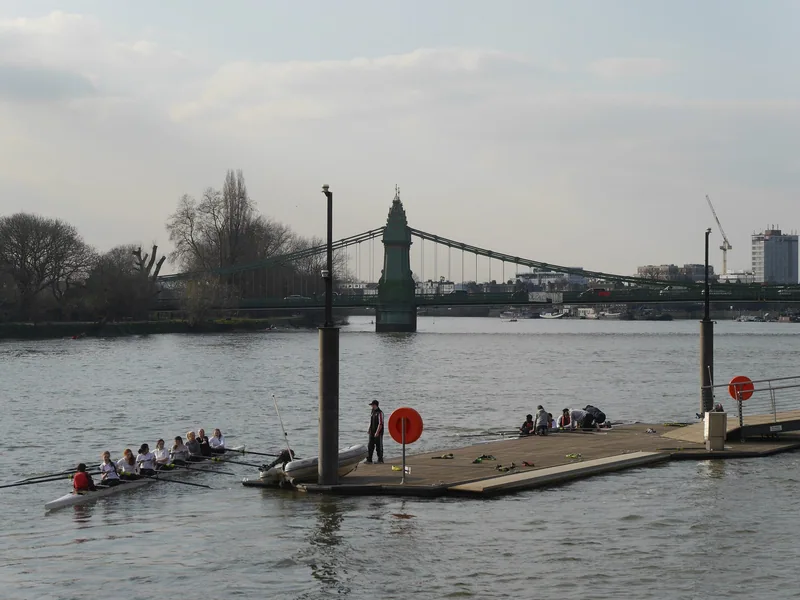
Photo: Edwardx · CC BY-SA 4.0 · Wikimedia Commons · resized
The bridge, and what you can and cannot do on it
Hammersmith Bridge is a Victorian suspension bridge in green and gold, and it has been in trouble for years. Transport for London's position in September 2026 is clear: the bridge is open to people walking and cycling and to river traffic underneath, and closed to all motor traffic. It shut to motor vehicles in 2019 and to everything in 2020 after cracks were found, and reopened to foot, cycle and river traffic in July 2021.
The detail that matters on the day: while stabilisation work continues, people cycling and riding electric scooters must dismount and walk across. The main carriageway reopened in 2025 with separate lanes, which makes it a comfortable crossing on foot and a very good place to stand and look at the river. Hammersmith and Fulham Council owns the bridge and TfL publishes the current status, so check before relying on it.
A road bridge with no cars on it is a rare thing to walk across. Stand in the middle of Hammersmith Bridge on a weekday afternoon and you will hear the river rather than the traffic. It is the only major Thames crossing in London where that is true, and it is worth ten minutes on its own.
The walk, step by step
Start at Hammersmith station and walk south towards the river, under the flyover, into Furnivall Gardens. Then follow the water.
- Lower Mall comes first: a narrow riverside lane with rowing clubs, boathouses and the first pubs, their tables set out on the pavement facing the water. This is where the crowds are on a sunny evening.
- Upper Mall continues past eighteenth-century houses. Somewhere along here is the famously cramped pub with the tiny terrace that everybody has heard of, and several less famous ones with more room.
- Kelmscott House, at 26 Upper Mall, is where William Morris lived. The basement and coach house are now the William Morris Society's museum: open Thursday to Sunday, 10am to 4pm with last entry at 3.30pm, £5 admission, free for under-16s and Hammersmith and Fulham residents, cashless, and worth booking online to be sure of a place.
- Hammersmith Bridge. Cross it. From this point the good walking is on the Barnes side.
- The south bank towpath runs west from the bridge with trees on one side and the river on the other, past the boathouses and Barn Elms. It is unpaved in places and floods on big tides.
- Barnes Bridge is where you come off, up onto the road, with the station directly above the river.
Do it in that direction and you finish at a station with a train to Waterloo. Do it the other way and you finish at a Tube station with more onward options; both work. Our page on the Thames Path and London's walking routes has the sections upstream and downstream.
Parts of this towpath flood at high tide, and the water comes up fast. The path below Hammersmith Bridge and sections on the Barnes side go under on big spring tides, which happen around the new and full moon. Check the day's tide times before you set out, especially if you are walking with children or a pushchair, and do not try to wade a flooded towpath.
Barnes: a village with a pond in it
Barnes sits inside a great loop of the Thames, which is why it feels cut off from the rest of London. Barnes High Street runs up from the river to Barnes Pond, an actual duck pond with a green around it, and the shops between are the sort a village has: a butcher, a fishmonger, a bookshop, several cafés, a cinema in a converted building, and a Saturday farmers' market.
There is nothing to tick off. The point of Barnes is that it does not feel like a city, twenty minutes from Waterloo, and that you can sit outside with a drink and watch people walking dogs. Our page on the Sunday roast explains how pub booking works, which matters here because the riverside pubs fill up for Sunday lunch.
The London Wetland Centre
On the Barnes side, in what used to be reservoirs, the Wildfowl and Wetlands Trust runs the London Wetland Centre: a large area of lakes, reeds and grazing marsh with hides, boardwalks and a great many birds, twenty minutes from Hammersmith.
It is ticketed and it opens almost every day of the year, with the last admission an hour before closing. Booking ahead online is cheaper than paying at the gate. Our dedicated page on the WWT London Wetland Centre has the prices, the hides and what you are likely to see in each season, and is the page to read before you go.
From this walk, the practical point is that the reserve is a short bus ride or a twenty-minute walk from the Barnes end of the towpath, so it slots into the afternoon rather than replacing it. Allow two hours inside if you want to use the hides properly.
The Boat Race, and what this stretch is like on the day
The Oxford and Cambridge Boat Race is rowed from Putney to Mortlake, and both banks in this article are on the course. On race day the towpath is packed, the pubs fill from mid-morning, and the bridge carries a constant stream of people moving between the banks.
There is no point repeating the detail here: our guide to the Boat Race covers where to stand, when to arrive and what you will actually see, and is honest about how little of the race is visible from any one point. The relevant thing for this page is that if you want a quiet riverside walk, the day of the Boat Race is the one day of the year to avoid.
Hammersmith away from the river
Behind the Broadway, Hammersmith is a working west London town centre: a large shopping centre over the bus station, office blocks, and three things worth knowing about.
- The Eventim Apollo on Queen Caroline Street is a 1930s cinema turned concert hall and one of the best mid-sized music venues in London. Our page on London's arenas covers how it fits between the small clubs and the big venues.
- The Lyric Hammersmith, on Lyric Square, is a producing theatre with a Victorian auditorium reconstructed inside a modern building, and is one of the better places in London to see new work at a reasonable price.
- The Polish community. Hammersmith has been a centre of Polish London since the Second World War, and the delicatessens, bakeries and the Polish cultural centre on King Street reflect it. Our guide to Polish and eastern European food in London explains what to buy and how to order in a Polish deli.
Where to go next along the river
Upstream on the north bank the walk continues into Chiswick Mall and on to Strand-on-the-Green, which is the prettiest short riverside stretch in London and has three more pubs on it. That is covered on our page about Chiswick and Kew, and it makes a natural second half if you have the legs for it.
Further upstream still, past Mortlake and Kew, the river reaches Twickenham and the Richmond riverside. Downstream, on the other side of Putney Bridge, is Fulham Palace, which is free and has a walled garden. For the bridges themselves, see our guide to walking London's bridges.
Who this suits
Come for
- The best concentration of riverside pubs in London
- A flat, easy walk with a station at each end
- A road bridge with no cars on it
- Birdwatching twenty minutes from Hammersmith
- A village with a duck pond inside Zone 3
Think again if
- You want museums or major sights: there is one small museum
- You are here on Boat Race day and wanted peace
- The tide is high and the towpath is under water
- You need buses between the two banks, because there are none
- It is raining: this is entirely an outdoor afternoon
Frequently asked questions
Is Hammersmith Bridge open?
It is open to people walking and cycling and to river traffic underneath, and closed to all motor traffic. It closed to vehicles in 2019 and to everything in 2020 after cracking was found, and reopened to foot, cycle and river traffic in July 2021. While stabilisation work continues, cyclists and e-scooter riders must dismount and walk across. Check TfL's status page before relying on it.
How long is the walk from Hammersmith to Barnes?
About two and a half miles, flat the whole way, which takes roughly an hour at a steady pace. With stops at the pubs and the William Morris Society museum it becomes a comfortable afternoon. Start at Hammersmith station and finish at Barnes Bridge, from where trains run to Waterloo.
Can you get a bus from Hammersmith to Barnes?
Not across Hammersmith Bridge. Buses that once used it now divert via Putney or Chiswick, which takes far longer than walking. If you want to get from one bank to the other here, cross the bridge on foot: it takes a few minutes.
What is there to do in Barnes?
The London Wetland Centre, a village high street around a duck pond, a cinema, a Saturday market and several riverside pubs. The reserve is ticketed, opens almost every day of the year and is cheaper booked online; see our dedicated page on it for the current prices and the best hides.
Which Hammersmith Tube station should I use?
Either works for the river. There are two separate stations on opposite sides of the Broadway: one for the Piccadilly and District lines, inside the shopping centre above the bus station, and one for the Circle and Hammersmith & City lines across the road. They are not connected underground, so agree which one if you are meeting someone.
Sources
- Transport for London - Hammersmith Bridge status (checked September 2026)
- Hammersmith & Fulham Council - Hammersmith Bridge (checked September 2026)
- The William Morris Society - Visit our museum at Kelmscott House (checked September 2026)
- WWT London Wetland Centre - Opening times (checked September 2026)
- WWT London Wetland Centre - Directions (checked September 2026)