
The Twickenham bank of the Thames holds two Palladian houses, a free art gallery in an octagonal Baroque room, a Gothic fantasy villa, an island you cannot normally visit, and the national rugby stadium. Across the water, the view from Richmond Hill is the only view in England protected by its own Act of Parliament. All of it sits within about three miles of river.
Most visitors to this corner of London go to Richmond, which is covered on our Richmond page, or to the rugby, which has its own page on this site. This article is about the Middlesex bank and what you can actually get into, most of which is free.
The important practical point is that the two banks are barely connected. Between Richmond Bridge and Teddington there is one road bridge, one lock footbridge and a small seasonal ferry. Decide which side you are walking before you start.
Twickenham and the riverside at a glance
- Best for
- Georgian riverside houses, free galleries and parkland, rugby, the protected view
- Stations
- Twickenham (South Western Railway, Zone 5); St Margarets; Strawberry Hill; Richmond for the far bank
- Free
- Marble Hill house and park, Orleans House Gallery, York House Gardens, Strawberry Hill garden
- Ticketed
- Strawberry Hill House from £16.50 online; the stadium tour and rugby museum
- Crossing the river
- Richmond Bridge, Teddington Lock footbridge, and Hammerton's Ferry in season
- Time needed
- A full day, or half a day and a long lunch
The view from Richmond Hill, and the law that protects it
From the terrace at the top of Richmond Hill you look west and south over a bend in the Thames, with Petersham Meadows below and woods and water beyond, and hardly a building in sight. It is the view Turner and Reynolds painted, and it is the reason the hill is famous.
What is unusual is the legal position. In 1902 Parliament passed the Richmond, Petersham and Ham Open Spaces Act, which vested Petersham Meadows and the land below the hill as public open space and stopped it being built on. Richmond Council describes it as the only view in England protected by an Act of Parliament, and it came about because developers had proposed building on the Twickenham bank.
That is why the foreground of the view is still fields. It is also why walking along the Twickenham side, looking back up at the hill, is the other half of the experience: you are standing on the land the Act was passed to save. Our round-up of the best free viewpoints in London covers the rest, none of which has its own statute.
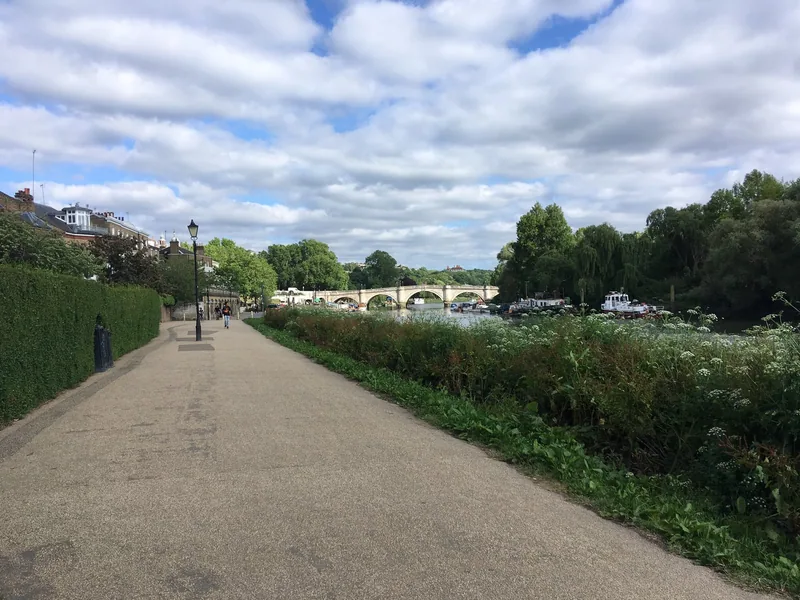
Photo: Xander11012 · CC BY-SA 4.0 · Wikimedia Commons · resized
Marble Hill: a free Palladian villa in a free park
Marble Hill, on Richmond Road, is a white Palladian villa built in the 1720s for Henrietta Howard, mistress of George II and a considerable figure in her own right, who commissioned it as an independent house of her own. It is small, symmetrical and deliberately restrained, and it sits in a large riverside park.
Both are free. English Heritage opens the house Wednesday to Sunday and on bank holidays, 10am to 5pm in the main season, and walk-in tickets are available though you can book online to be sure. The park is open every day from 7am until sunset. Our page on Ham House and Marble Hill compares it with the seventeenth-century house directly across the water.
Hammerton's Ferry links Marble Hill to Ham House across the river. It is a small passenger boat, it runs seasonally for a modest fare, and it turns two separate visits into one walk. Check whether it is running before you rely on it: outside the summer months and in bad weather it does not operate, and the alternative is a long detour to Richmond Bridge.
Orleans House Gallery, and the Octagon Room
A few minutes downstream from Marble Hill, Orleans House Gallery sits in woodland gardens facing the river. The gallery is free, run by Richmond's arts service, and shows changing exhibitions alongside a collection of paintings of the local landscape.
The reason to go is the Octagon Room: a small, intensely decorated Baroque garden pavilion from the 1720s, all plasterwork and gilding, which survived when the house it belonged to was demolished. It is one of the best interiors of its date in London and almost nobody has heard of it.
The gardens and woodland are open at all times and free, and there is a café in the stables. Check current gallery opening hours on its own site before travelling, as they are shorter than the garden's.
York House Gardens and the Twickenham riverside
York House, now the borough's council offices, has gardens that are free and open to the public, running down to the river and linked to the riverside lawn by a footbridge over the road.
In the gardens stands a group of white marble statues of naked sea nymphs and horses climbing out of a waterfall, installed by a previous owner in the early twentieth century and known locally by an unprintable nickname. They are completely unexpected in a municipal garden in suburban Middlesex, and they alone are worth the detour.
The Twickenham riverside itself is short: an embankment with a few pubs, boats moored along it, and a view across to Eel Pie Island. Our guide to riverside pubs on the Thames explains which stretches flood and when, which matters here because the embankment goes under on big tides.
Eel Pie Island, which you mostly cannot visit
Eel Pie Island sits in the Thames at Twickenham, reached by a humpbacked footbridge, and is mostly private: houses, boatyards and artists' studios, with residents who are not running a tourist attraction. In the 1960s the hotel on the island was a significant rhythm and blues venue, and that is why the name is familiar to people interested in British music history.
The hotel is long gone. The bridge is public as far as the island, but the island itself is private except for a small number of open studio weekends each year, which are announced locally. Walk over the bridge, look, and do not wander into people's gardens.
Strawberry Hill House
Horace Walpole spent decades from 1749 turning a modest house at Twickenham into a white Gothic castle with battlements, pinnacles, painted glass and vaulted ceilings copied from medieval tombs. Strawberry Hill invented the Gothic revival in domestic architecture and, indirectly, the Gothic novel: Walpole wrote The Castle of Otranto here.
The house and shop open Wednesday to Sunday, 10am to 5pm with last entry at 4pm. The garden and café open Wednesday to Friday from 9.30am and at weekends from 9am, and the garden is free. House tickets start at £16.50 booked online, which is also the way to guarantee entry; check the current price on the house's own site. It is at 268 Waldegrave Road, a few minutes from Strawberry Hill station.
See it if you have any interest in architecture at all. The interiors are white, gilded and theatrical, and the effect is nothing like a real medieval building, which was entirely the point. Our page on Strawberry Hill House goes into the rooms in detail.
The stadium, and the rugby museum
The national rugby ground at Twickenham is now called Allianz Stadium, having taken a sponsor's name in 2024. It holds international matches, cup finals and a small number of concerts, and on a Six Nations Saturday the entire area is given over to it.
Outside match days you can take a guided tour of the stadium, which goes behind the scenes to the changing rooms, the tunnel and pitchside, and includes the World Rugby Museum. Prices and tour types vary, and premium tours with former players cost a great deal more than the standard one, so check the museum's own booking page for the current options. Our guide to stadium tours in London compares the grounds that run them.
On a match day, read our page on rugby at Twickenham before you make any other plans for the area. Trains are crowded in both directions, the walk from the station takes longer than the map suggests, and the pubs fill from late morning.
Walking the two banks
The best day here is a loop, and it works like this.
- Train to Twickenham, walk down to the embankment and along the river past Orleans House to Marble Hill.
- Cross on Hammerton's Ferry if it is running, or continue to Richmond Bridge if it is not.
- On the Surrey bank, walk up through Petersham Meadows to the terrace at the top of Richmond Hill for the view.
- Come down through Terrace Gardens into Richmond for food, and take the train or the District line home.
That is about five miles with two house visits in it, and it is flat except for the hill at the end. Our page on the Thames Path and London's walking routes has the sections upstream towards Kingston and downstream towards Kew.
Twickenham is in Zone 5 and there is no Underground here. Trains run from Waterloo to Twickenham, St Margarets and Strawberry Hill, and contactless and Oyster work normally. Richmond, on the far bank, has both the District line and the Overground's Mildmay line, so if you want the Tube, finish your walk there rather than starting from it.
Eating, and what else is nearby
Twickenham has a short high street with cafés and a few restaurants, and a handful of riverside pubs on the embankment and at St Margarets. It is pleasant and unambitious. Richmond, across the bridge, has far more choice and higher prices.
Upstream, the river continues past Teddington to Kingston and Surbiton, and Bushy Park, which is enormous and full of deer, sits between Teddington and Hampton Court. Downstream, past Kew, our pages on Chiswick and Kew and Hammersmith and Barnes take the same Thames back towards central London.
Who will enjoy this
Come for
- Two Palladian houses and a Gothic revival villa in one walk
- A free Baroque interior almost nobody visits
- The only view in England with its own Act of Parliament
- A flat riverside walk with a ferry in the middle of it
- Rugby, if you have a ticket
Think twice if
- There is a match on and you are not going to it
- You want an Underground station: there is not one on this bank
- The ferry is not running and you did not check
- It is Monday or Tuesday, when several of the houses are shut
- You are short of time: this is a full day, not an hour
Frequently asked questions
Is the view from Richmond Hill really protected by law?
Yes. The Richmond, Petersham and Ham Open Spaces Act 1902 vested the meadows and land below the hill as public open space to stop development on the Twickenham bank, and Richmond Council describes it as the only view in England protected by an Act of Parliament. That is why the foreground is still fields rather than houses.
Is Marble Hill free to visit?
Yes. English Heritage charges nothing to enter Marble Hill house, which opens Wednesday to Sunday and on bank holidays, 10am to 5pm in the main season, with walk-in tickets available and online booking if you want to be certain. The surrounding park is open every day from 7am until sunset and is also free.
How much does Strawberry Hill House cost?
Tickets start at £16.50 when booked online, which is the cheapest way and guarantees entry. The house opens Wednesday to Sunday, 10am to 5pm with last entry at 4pm. The garden is free and opens from 9.30am on weekdays and 9am at weekends. Check the house's own site for the current price before you travel.
Can you visit Eel Pie Island?
Not usually. The island is reached by a footbridge from the Twickenham embankment but is almost entirely private: homes, boatyards and studios. A small number of open studio weekends each year let the public in, announced locally. At other times, walk over the bridge, look, and go back.
How do you get from Twickenham to Richmond?
On foot along the river to Richmond Bridge, which takes about 40 minutes, or by train in a few minutes. In season the small Hammerton's Ferry crosses between Marble Hill and Ham House and cuts the walk considerably. There is no other crossing between Richmond Bridge and the footbridge at Teddington Lock.
Sources
- Richmond, Petersham and Ham Open Spaces Act 1902 (checked September 2026)
- London Borough of Richmond upon Thames - Preserving the view from Richmond Hill (checked September 2026)
- English Heritage - Marble Hill prices and opening times (checked September 2026)
- Strawberry Hill House & Garden - Planning your visit (checked September 2026)
- Orleans House Gallery - Your visit (checked September 2026)
- World Rugby Museum and Allianz Stadium tours - Plan your visit (checked September 2026)