
London has two rush hours that do not quite overlap: the crowded one, which is worst between about 08:00 and 09:00 and again from 17:00, and the expensive one, which TfL defines as 06:30 to 09:30 and 16:00 to 19:00 on weekdays. Knowing that they are different is what lets you dodge one without paying for the other.
For most visitors the crowding matters more than the money, because the daily cap flattens the fare difference anyway. What ruins a morning is standing on a platform at Oxford Circus while three full trains go past, not the thirty pence.
Our guide to the Underground explains how the network works. This page is about one thing only: timing your day so you are not in the worst of it.
The hours that matter
- Fare peak (weekdays, not public holidays)
- 06:30 to 09:30 and 16:00 to 19:00
- Quieter on Tube and rail
- Weekdays 09:00 to 16:30 and after 18:45; weekends before 13:00 and after 18:30
- Quieter on buses
- Weekdays 08:30 to 15:00 and after 18:00; weekends before 12:00 and after 17:30
- The easiest single change
- Travel 07:30 to 08:00 instead of 08:00 to 08:30: around 20% fewer people
- Bus fares
- No peak or off-peak. £1.75 flat, rising to £1.85 on 1 November 2026
The crowded rush hour and the expensive one are not the same
TfL charges a peak fare from 06:30, but at 06:45 the Tube is pleasant. It charges a peak fare until 19:00, but by 18:45 the trains have thinned out considerably. The fare bands are blunt instruments; the crowds follow a sharper curve.
TfL's own advice is that Tube and rail journeys are generally quieter between 09:00 and 16:30 and after 18:45 on weekdays. Buses calm down earlier, from about 08:30, and stay quiet until roughly 15:00, when the school run begins.
So there is a window between 09:00 and 09:30 that is quiet but still charged at the peak rate, and a window between 18:45 and 19:00 that is the same. If crowding is your problem, use them. If money is your problem, wait the extra fifteen minutes.
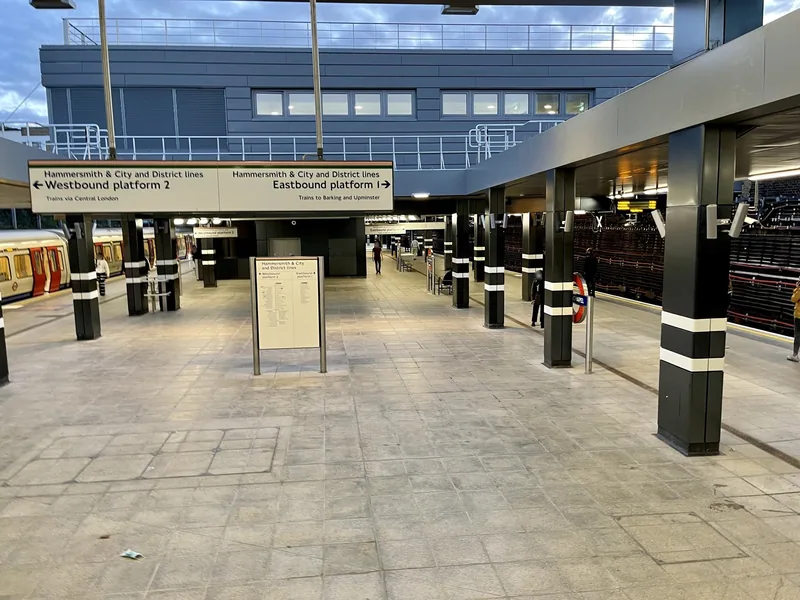
Half an hour earlier removes a fifth of the crowd
The most useful number TfL publishes is this: travelling between 07:30 and 08:00 means sharing the network with around 20% fewer people than between 08:00 and 08:30.
Thirty minutes is a small sacrifice for a one-in-five reduction in the crush, and for visitors it often costs nothing at all, because you are not tied to an office start time. If you have an early attraction booking, a flight connection or luggage to carry on the Tube, this is the single change that helps most.
The same logic works in reverse in the evening. Leaving a museum at 16:45 rather than 17:30 is the difference between a seat and a scrum.
Monday and Friday are already quieter
Working patterns have changed the shape of the London week. TfL reports 14% fewer morning peak travellers on Mondays and 28% fewer on Fridays than on a Tuesday, Wednesday or Thursday.
That is a bigger effect than any time-shifting you can do, and it is worth knowing when you plan which day to do the long museum trek across town and which day to stay in one neighbourhood. If your trip covers a Tuesday to Thursday, those are the three days to be gentle with your itinerary.
Friday morning is the best weekday to cross London. With more than a quarter of the usual peak traffic gone, a Friday 08:30 journey feels like a Tuesday at 10:00. Save your most transport-heavy day for it.
What peak travel actually costs you
Here is where most advice goes wrong. The saving from travelling off-peak depends entirely on how far you go, and for central journeys it is close to nothing.
| Journey | Peak | Off-peak | You save |
|---|---|---|---|
| Oxford Circus to Piccadilly Circus (Zone 1) | £3.10 | £3.00 | 10p |
| Oxford Circus to Brixton (Zones 1-2) | £3.60 | £3.10 | 50p |
| Oxford Circus to Uxbridge (Zones 1-6) | £5.90 | £4.00 | £1.90 |
| Victoria to Gatwick Airport by Southern or Thameslink | £19.20 | £10.70 | £8.50 |
Fares are from TfL data, September 2026; check a specific journey on TfL's Single Fare Finder, because Zone 1-2 fares are not all the same and Camden Town is priced differently from Brixton.
The pattern is clear. Inside Zone 1 the peak surcharge is trivial. On long journeys out to the edge of the network, and above all on the airport lines, it is large enough to reshape your morning. Anyone flying from Gatwick should read our comparison of Gatwick Express, Thameslink and Southern with that £8.50 in mind.
If you hit the daily cap, peak travel is free
This is the part almost nobody tells visitors. For Zones 1 to 6, the daily contactless and Oyster cap is the same whether you travel at peak times or not: £8.90 for Zones 1-2, £16.30 for Zones 1-6.
So if you are going to make four or more journeys and reach the cap anyway, travelling in the rush hour costs you nothing extra. The only reason to avoid it is comfort. Our page on how contactless and Oyster capping works explains the mechanics, and the zones explained page shows which cap applies to your day.
Two exceptions are worth knowing. Journeys in Zones 1 to 9, which reach out past Watford and beyond, do have a separate off-peak cap of £16.30 against a peak cap of £23.30. And if you have loaded a railcard onto an Oyster card, your off-peak cap drops to £5.90 for Zones 1-2, while your peak cap stays at the full adult rate. Railcard holders genuinely do save by waiting until 09:30, which our guide to railcards worth buying as a visitor covers in detail.
Heathrow is charged at the peak rate at any hour. Any Tube or Elizabeth line journey to or from Heathrow that starts, ends or passes through Zone 1 pays the peak fare all day, including Sundays. Waiting until 10:00 saves you nothing on the way to the airport.
Which parts of the network are worst
The crush is directional. In the morning, trains running into Zone 1 from every direction fill up; trains running outwards are comparatively empty. In the evening it reverses. A visitor heading from a central hotel out to Greenwich at 08:30 is going the easy way, while the same trip at 17:30 is the hard way.
The pinch points are the big interchanges rather than whole lines. Oxford Circus, Bank, King's Cross St Pancras, Waterloo, Victoria and Liverpool Street are where people change trains, and changing trains is where the platforms back up. Stations are sometimes closed briefly for crowd control at these points, which is normal and usually lasts a few minutes.
The Elizabeth line is the great exception. Its trains are long, its stations are enormous, and even at peak times it usually feels civilised compared with the deep tube lines. If your journey can be made on it, make it on it.
TfL Go and the online Journey Planner will tell you how busy any individual station is at any time of day, which is more reliable than any general rule. Check the station you are actually using rather than trusting a reputation.
Answers that are not about timing
Shifting your hours is not the only way out.
Buses have no peak fare at all: £1.75 for any journey, any distance, any hour, with the Hopper fare allowing unlimited changes within an hour. They are slower in traffic but never as compressed as a rush-hour Tube, and you can see out. Our guide to London buses and the Hopper fare explains which routes are useful for sightseeing.
Walking beats the Tube over surprising distances in central London, and at 08:30 it beats it by a wider margin than the map suggests. See when walking is faster than the Tube for the routes where this is reliably true.
The river is the calmest option of all and runs a full commuter service, though it costs more and sits outside your cap, as our comparison of the river bus and sightseeing cruises sets out.
And if you are travelling with small children, the rush hour is not just uncomfortable but genuinely difficult, because lifts and wide gates get congested. Our page on getting around with a pushchair deals with that directly.
Weekends have their own pattern
Saturday afternoon in the West End is busier than Tuesday morning on the same platforms, and it lasts longer. TfL gives the quieter weekend windows as before 13:00 and after 18:30 for the Tube, and before 12:00 and after 17:30 for buses.
Saturday mornings before noon are the best-kept secret in London travel: the trains are nearly empty, the shops are open from 09:00 or 10:00, and the museums have not filled up. Sundays add engineering works, which close sections of line with little warning to visitors, so check the status page before you set out.
Late evenings are easy every night, and on Friday and Saturday the Night Tube keeps several lines running right through.
Building a day that avoids both peaks
A shape that works for most visitors: leave the hotel before 08:00 or after 09:30, do your longest cross-city journey in the middle of the day, and be somewhere you can stay put between 17:00 and 18:30.
The middle of that day is also when the free national museums are open and reasonably quiet, which makes them a natural place to sit out the afternoon. An early dinner at 18:00 near where you already are, followed by a journey home at 19:30, avoids the evening peak entirely.
If you are fitting a lot into a short stay, our realistic one-day itinerary is built around these timings rather than against them. And when you do end up on a packed train, the conventions that keep it bearable are in our guide to Tube etiquette.
Frequently asked questions
What time is rush hour on the London Underground?
For fares, peak is 06:30 to 09:30 and 16:00 to 19:00 on weekdays, excluding public holidays. For crowding, the worst of it is roughly 08:00 to 09:00 and 17:00 to 18:30. TfL says the Tube is generally quieter between 09:00 and 16:30 and after 18:45.
Do I save money by avoiding peak hours?
Usually very little. Inside Zone 1 the difference is 10p, and the daily cap is identical peak and off-peak for Zones 1 to 6, so anyone making four or more journeys saves nothing. You save real money on long outer-zone journeys, on airport routes, and if you have a railcard loaded onto an Oyster card.
Which day of the week is the Tube quietest?
Friday, by a clear margin: TfL reports 28% fewer morning peak travellers than on a Tuesday to Thursday. Monday is next, with 14% fewer. Tuesday, Wednesday and Thursday are the three busiest weekday mornings.
Is the bus cheaper in the rush hour than the Tube?
Buses cost £1.75 at all hours and all distances, which is less than almost any Tube fare, and the bus and tram daily cap is £5.25. From 1 November 2026 those rise to £1.85 and £5.55. Buses are slower in traffic but never charge a peak supplement.
How can I tell how busy a station will be before I go?
The TfL Go app and TfL's online Journey Planner both show how busy any station on the network is at any time of day, including the pattern for a typical weekday. Check the specific station rather than relying on a line's general reputation, because busyness varies enormously along the same line.
Sources
- Transport for London - Quieter times to travel (checked September 2026)
- Transport for London - Tube and rail fares and peak times (checked September 2026)
- Transport for London - Daily and weekly capping (checked September 2026)
- Transport for London - Single Fare Finder (checked September 2026)
- Transport for London - Bus and tram fares (checked September 2026)
- Mayor of London - MD3517, July 2026 fare changes (checked September 2026)