
A bespoke two-piece suit from a Savile Row house starts at around £7,500 and takes three fittings spread over weeks, not days. A ready-made shirt on Jermyn Street runs from about £37 at the chain shirtmakers to £495 at the old houses. Both streets are free to walk down, and the walk is the point for most visitors.
Savile Row and Jermyn Street sit five minutes apart on either side of Piccadilly, and between them they are the reason London is still associated with men's tailoring. Savile Row makes suits. Jermyn Street, one street south of Piccadilly, makes shirts, and sells shoes, hats, razors, cheese and perfume alongside them.
Neither street works like the shopping you will have done on Oxford Street. Very little is on open display, prices are often not shown, and the staff expect a conversation rather than a browse. That is intimidating the first time, and it should not be: nobody will stop you looking, and the shops are used to visitors who are not buying.
What tailoring costs in London (September 2026)
- Savile Row bespoke two-piece suit
- From £7,500 at Huntsman; most houses quote on request
- Hand work in a bespoke two-piece
- Typically at least 50 hours, under the Savile Row Bespoke Association rules
- Fittings
- Normally three for a first commission; fewer for later orders
- Ready-made shirt, old Jermyn Street houses
- £145 to £495 depending on the shop
- Ready-made shirt, chain shirtmakers
- From about £37 on a multi-buy offer, around £70 at full price
Prices checked on the shops' own websites in September 2026. Bespoke prices rise with the cloth you choose, so always confirm before ordering.
Bespoke, made to measure and off the peg
Three words do almost all the work in a tailor's shop, and the price gap between them is enormous.
- Off the peg (also called ready to wear) means a finished garment made to a standard size. You buy it, and a shop alterations tailor may shorten the sleeves or take in the waist. This is what almost every visitor actually buys.
- Made to measure means an existing block pattern adjusted to your measurements. The cutting is done by machine from that adjusted block, usually off the premises. It fits far better than a standard size and costs a fraction of bespoke.
- Bespoke, in the Savile Row sense, means a paper pattern cut individually for you by hand, from scratch, by a master cutter, and kept afterwards so future garments can be made from it.
The word "bespoke" is not legally protected in the way that, say, "Champagne" is, and it is used loosely by plenty of shops that are really doing made to measure. On Savile Row itself the distinction is taken seriously, and the Savile Row Bespoke Association exists largely to police it.
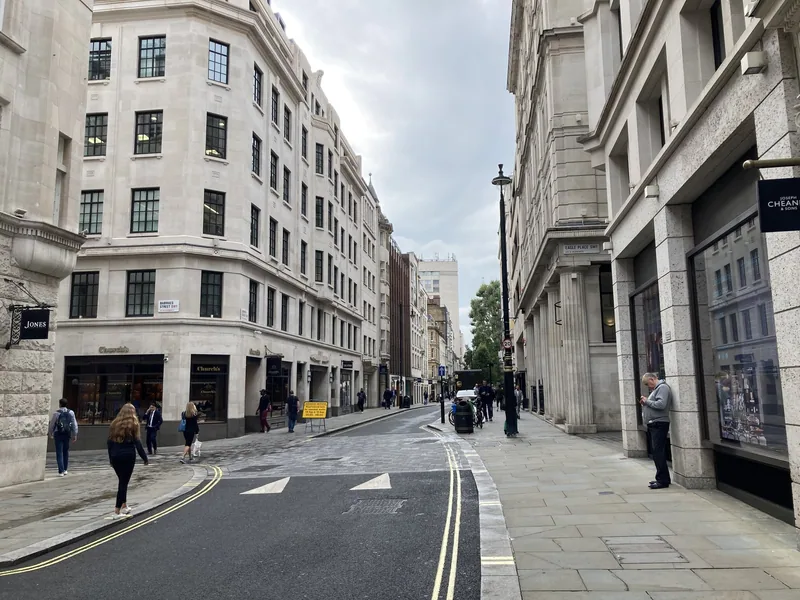
Photo: Nick-D · CC BY-SA 4.0 · Wikimedia Commons · resized
What "Savile Row Bespoke" commits a tailor to
The association publishes the rules its full members sign up to, and they are specific enough to be useful to a customer. A full member must:
- have its bespoke business on Savile Row or within 100 yards of it;
- create all, and make the majority of, its Savile Row bespoke garments on Savile Row and within the UK;
- cut every bespoke garment from an individually cut paper pattern made by a master cutter;
- have production supervised by a master cutter;
- employ at least one salaried apprentice cutter or tailor at any time;
- typically put at least 50 hours of hand work into a two-piece suit;
- keep an expert cloth consultant on the premises and offer a choice of at least 2,000 fabrics;
- retain full customer records, and provide aftercare including sponging, pressing, repairs and button matching.
Ten houses hold full membership: Gieves & Hawkes at No. 1 (founded 1771), Dege & Skinner at No. 10 (1865), H. Huntsman & Sons at No. 11 (1849), Chittleborough & Morgan at No. 12 (1969), Richard Anderson at No. 13 (2001), Hackett at No. 14 (1983), Henry Poole & Co at No. 15 (1806), Norton & Sons at No. 16 (1821), Edward Sexton at No. 35 (1975) and Richard James at No. 29 and 19 Clifford Street (1992).
Some very well-known tailors are not on that list, which does not mean their work is inferior. Anderson & Sheppard, for instance, has traded around the corner for a century without joining. Membership tells you what a house has promised, not who is best.
The aftercare is part of what you are paying for. A Savile Row house keeps your paper pattern and a record of the order, so a repair twenty years later can be matched to the original cloth and buttons, and a second suit needs fewer fittings than the first. If you commission something, keep the order number.
What a bespoke suit costs, and how long it takes
Most Savile Row houses do not publish prices, which is a deliberate choice rather than evasion: the cloth you pick moves the total significantly, and a lightweight worsted and a rare vicuña are not the same purchase at all. Huntsman is the clearest about it and states that bespoke starts from £7,500 (September 2026). Treat that as the realistic floor for the street as a whole, and expect a dinner suit or a heavily detailed commission to cost more.
The process is the reason for the price. Henry Poole sets out a nine-stage sequence that is broadly how all the houses work: a first appointment where cloth and style are chosen and measurements taken, then a personal paper pattern cut by the cutter; a first fitting in the "baste", a loosely tacked-together version, after which the garment is taken apart and re-cut; a second fitting where the fit is refined; and a final fitting before you take it away. Three visits is the normal minimum, which is the single most important practical fact for a visitor.
Unless you are coming back to London, a first bespoke commission is not something you can complete on a four-day trip. Many houses run trunk shows abroad and will do later fittings in other cities, so if you are serious, ask at the first appointment whether they visit yours.
Walking Savile Row when you are not buying
Savile Row is one short block, running parallel to Regent Street between Conduit Street and Vigo Street. Walking it end to end takes about four minutes. What makes it worth doing is the basements: several houses have their cutting and sewing rooms at street or lower-ground level with windows onto the pavement, so you can watch tailors working. Weekday mornings are best, because most of the workrooms are quiet or closed at weekends.
Almost every house is happy for you to step inside and look at the cloth books, and several have small ready-to-wear sections. If you want to go further, ask whether they offer a made-to-measure or ready-to-wear line; that is the polite way to signal that you are not commissioning a £7,500 suit today.
The street joins naturally onto Regent Street at one end and the galleries and shops of Bond Street and Mayfair at the other, and our guide to Mayfair and St James's covers the wider neighbourhood on both sides of Piccadilly.
Jermyn Street: shirts first, then everything else
Jermyn Street runs parallel to Piccadilly on its south side, from St James's Street to the edge of Piccadilly Circus. It is a five-minute walk from Savile Row and a completely different shopping experience: small shops at street level, windows full of folded shirts, and prices on the labels.
Shirtmakers dominate, and they come in two clear tiers. The old houses make their own shirts to their own patterns and cloths. Turnbull & Asser has had its flagship on the street since 1903; New & Lingwood and Emma Willis, which has been there since 1999 and works in Swiss and West Indian Sea Island cotton, sit in the same tradition. Budd, trading since 1910, is a few steps off the street in Piccadilly Arcade. The second tier is the modern shirt chains, which sell a great deal of very competent shirting at a quarter of the price and run permanent multi-buy offers.
Between and around them are a shoemaker or two, hatters, a barber, a cheesemonger and perfumers, including Floris at No. 89, which has been making scent as a family business since 1730. It is the mix that makes the street enjoyable to walk rather than any single shop.
What a shirt actually costs
| Shop | Ready-made shirts | Most shirts priced at |
|---|---|---|
| Turnbull & Asser | £315 to £495 | £315 to £325 |
| Budd, Piccadilly Arcade | £200 to £445 | £275 |
| New & Lingwood | £145 to £245 | £175 |
| Charles Tyrwhitt and the shirt chains | From about £37 on offer | Around £70 at full price |
Prices taken from the shops' own websites in September 2026. The gap is real but it is not entirely a gap in quality: the old houses use heavier two-fold cottons, cut fuller through the body, and finish collars and cuffs differently. Whether that is worth eight times the money is a judgement only you can make, and trying one on costs nothing.
Bespoke shirts are also made on the street, and here the number that matters is not the price of one shirt but the minimum order. Several houses will only start a bespoke pattern on an order of four or more shirts, because the first shirt is effectively a trial garment. Ask about the minimum before you ask about the price.
The January and July sales are when Jermyn Street becomes affordable. The shirtmakers run two main sale periods a year, and reductions on ready-made shirts and ties are substantial. Outside them, the chain shirtmakers' three-for-a-fixed-price offers run almost permanently, which is why the same shirt can be £37 or £70 depending on how many you buy.
Practical notes before you go
Both streets keep office-style hours. Expect most shops to open around 9.30am or 10am and to close between 5.30pm and 6.30pm, with shorter Saturday hours and many Savile Row houses closed on Sunday altogether. If you have only one day and want to see the workrooms, come on a weekday.
Alterations are usually included or cheap on a ready-made shirt or suit bought in the shop, but they take days rather than hours, so buy early in your trip rather than on the way to the airport. Ask about the turnaround before you pay.
Visitors from outside the UK can no longer reclaim VAT on goods they carry home themselves; our page on tax-free shopping in the UK sets out the current rules and the one route that still works, which is having the shop ship the goods abroad for you. On a trip where tailoring is the main purchase, that one decision can change the total by a fifth, so raise it before the transaction, not after. Our page on what a London trip costs puts the figures in context.
Finally, the two streets sit inside a small area full of other things worth seeing. Fortnum & Mason is a two-minute walk from the east end of Jermyn Street, the big department stores are a short bus ride north, and Carnaby Street and Soho lie on the other side of Regent Street. If you are shopping for gifts rather than clothes, our guide to souvenirs worth buying and our notes on shopping in London before Christmas may be more use. For the unwritten rules of dealing with British shop staff, see our guide to British etiquette.
Frequently asked questions
How much is a bespoke suit from Savile Row?
Huntsman states that bespoke starts from £7,500 for a suit (September 2026), and that is a fair guide to the street. Most houses quote individually because the cloth affects the price. A dinner suit, a three-piece or an unusual fabric will cost more, and prices are confirmed at the first appointment.
What is the difference between bespoke and made to measure?
Bespoke means a paper pattern cut individually for you by hand by a master cutter, with the garment largely hand made and several fittings. Made to measure adjusts an existing block pattern to your measurements, usually cut by machine elsewhere. Made to measure fits much better than a standard size and costs far less than bespoke.
How many fittings does a Savile Row suit need?
Three is the usual number for a first commission: a fitting in the loosely tacked baste, a second fitting after the garment has been taken apart and re-cut, and a final fitting. Later orders need fewer, because the house keeps your paper pattern on file.
Can I visit Savile Row shops as a tourist without buying?
Yes. The tailors are used to visitors and you are welcome to look at cloth books and ready-to-wear rails. Come on a weekday morning if you want to see the cutting and sewing rooms working, and say plainly that you are looking rather than commissioning.
Where can I buy a good English shirt in London without spending hundreds?
The shirt chains on Jermyn Street sell well-made cotton shirts from about £37 on a multi-buy offer and around £70 at full price. The old houses start at about £145 and run to £495. Both sit on the same street, so you can compare the cloth and the collar in ten minutes.
Sources
- Savile Row Bespoke Association - membership requirements (checked September 2026)
- Savile Row Bespoke Association - member houses (checked September 2026)
- Huntsman - bespoke tailoring prices (checked September 2026)
- Henry Poole & Co - the bespoke process (checked September 2026)
- Turnbull & Asser - ready-to-wear shirts (checked September 2026)
- New & Lingwood - shirts (checked September 2026)
- Budd Shirtmakers - business shirts (checked September 2026)
- Floris London - our story (checked September 2026)