
Go from Paddington. The average journey to Windsor & Eton Central is 28 minutes including the change at Slough, against 55 minutes on the direct train from Waterloo, and Central sits in the middle of the town a few minutes below the castle wall. Take Waterloo instead if you are staying south of the river, if you would rather not change trains, or if you want a seat on the way home.
Windsor is a small town in Berkshire, about twenty miles west of London, with two railway stations and no Underground. Our guide to visiting Windsor Castle covers the ticket prices, the opening days and what there is to see once you arrive. This page is about the journey: the two timetables, the change at Slough, the first and last trains, and the one rule that catches out almost every visitor, which is that your bank card will not work as a ticket.
The two routes side by side
- From Paddington
- Great Western Railway to Windsor & Eton Central, changing at Slough. Average 28 minutes, 19 miles
- From Waterloo
- South Western Railway direct to Windsor & Eton Riverside. Average 55 minutes, 21 miles, every 30 minutes
- Distance between the two Windsor stations
- A six-minute walk
- Walk to the castle
- Within ten minutes from either station, according to South Western Railway
- Oyster, contactless and Travelcards
- Not valid. Buy a National Rail ticket for the whole journey
- Castle closed
- Every Tuesday and Wednesday, so check the day before you buy anything
The Paddington route: a fast train and a six-minute shuttle
There is no through train from Paddington. What there is instead is a fast Great Western service to Slough, and then a two-carriage shuttle that runs the short branch line into Windsor & Eton Central in six minutes. The shuttle usually waits on its own platform, and the connection is designed to work.
The half-hourly pattern is worth understanding, because it is the difference between a good trip and a fidgety one. On a typical midday hour, one departure gets you to Windsor in 28 minutes and the next takes 38. Both change at Slough; the extra ten minutes is time standing on the Slough platform waiting for the shuttle. Great Western's own page quotes the trip at "around 35 minutes" and puts the fastest at 22.
Paddington is also on the Elizabeth line and the Bakerloo, Circle, District and Hammersmith & City lines, so getting to it is easy from most of central London; our guide to crossing between London's terminals has the times, and our overview of the main railway terminals explains which one each part of Britain uses.
Do not book the shuttle as a separate leg. Buy one ticket from London to Windsor & Eton Central and the branch line is included. Buying London to Slough and then a second ticket at Slough is more expensive and means queueing twice, and the shuttle platform is not where the ticket machines are.
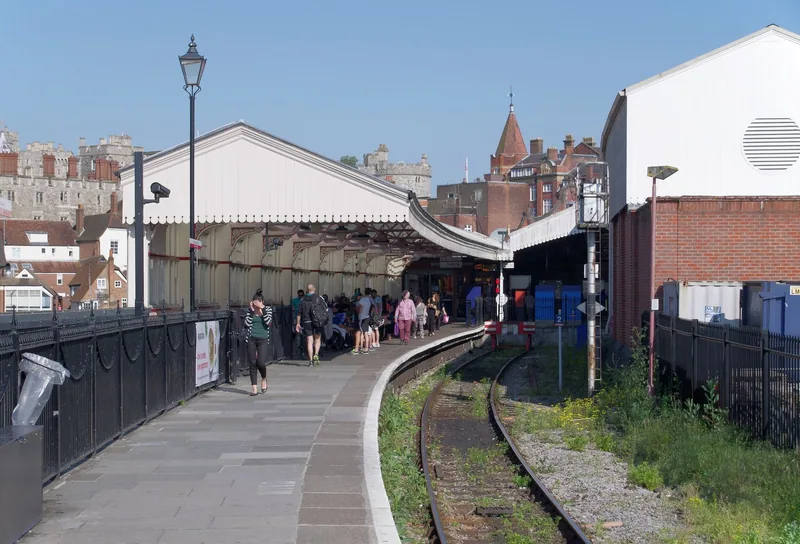
Photo: mattbuck (category) · CC BY-SA 4.0 · Wikimedia Commons · resized
The Waterloo route: one train, and half an hour more of it
South Western Railway runs directly from Waterloo to Windsor & Eton Riverside, usually every 30 minutes, with a scheduled time of 56 minutes and an average across the day of 55. Trains leave Waterloo at roughly three and thirty-three minutes past the hour, and come back from Windsor at twenty-one and fifty-one past.
It stops at Clapham Junction, Richmond, Twickenham and Feltham on the way, which is the route's real advantage. If you are staying in south-west London, joining at Clapham Junction or Richmond saves the trip into Waterloo and cuts a quarter of an hour off the journey. It also means you can break the return at Richmond for an hour by the river, which is a better end to a day than an hour on the Underground.
The other advantage is comfort. It is one train, so nobody has to shepherd children, cases or a pushchair across a platform at Slough, and outside the rush hour there are seats. The same line carries on past Twickenham and the rugby stadium, which is worth knowing if there is a match on: the trains will be full in both directions.
First and last trains, and the Saturday night cut-off
The published first and last departures from London differ sharply between the two routes, and the weekend numbers are the ones that matter for a day trip.
| Paddington to Windsor & Eton Central | Waterloo to Windsor & Eton Riverside | |
|---|---|---|
| First train, weekdays | 05:05 | 04:19 |
| Last train, weekdays | 23:22 | 00:03 |
| First train, weekends | 05:38 | 04:52 |
| Last train, weekends | 22:33 | 22:50 |
| Average journey | 28 minutes | 55 minutes |
| Distance | 19 miles (30 km) | 21 miles (34 km) |
The trap is the last weekend train. Both routes stop running out of London before 23:00 on a Saturday or Sunday, well before the equivalent weekday service. If you are going out to Windsor for the evening rather than the day, check the last train home on the operator's site for your actual date rather than assuming the timetable mirrors a weekday. Services are also often altered on Sundays for engineering work.
Which station leaves you nearer the castle
South Western Railway describes both Windsor stations as within a ten-minute walk of the castle, and the two are only six minutes apart from each other, so this is a smaller question than it first appears. The difference is what you walk through.
Windsor & Eton Central is in the town centre. You come out under the castle wall, into the shops and cafés, and the admission centre is a short climb from there. Windsor & Eton Riverside is on the edge of the centre by the Thames, which puts you closer to the bridge over to Eton and to the riverboats, and slightly further from the castle gate.
There is a tidy way to use both. Arrive at Central from Paddington, see the castle, walk down to the river and over to Eton in the afternoon, and come back from Riverside to Waterloo on the direct train. You pay for two separate journeys rather than a return, so price it before you commit, but it removes all the backtracking. Our guide to Windsor in half a day sets out what fits if you are short of time.
Why tapping in with your bank card will not work
Windsor sits beyond the outer edge of London's fare zones. The train operator says so plainly on its Windsor Castle travel page: Travelcards, Oyster and contactless are all invalid for the journey, and the same holds from Paddington. This is the single most common mistake visitors make on this trip, because contactless works on so much else that reaches well out of the centre.
What goes wrong in practice is that you can tap in at Waterloo. The gate opens, the journey begins, and nothing tells you that the tap stops being valid somewhere past Feltham. When the ticket is checked on the train you have no valid ticket, and the penalty on many routes is a £100 charge on top of the full single, cut to £50 plus the fare when it is settled inside 21 days. National Rail also applies a maximum fare of £30.40 where a contactless journey is left incomplete.
There is a second version of the same trap. Transport for London's Journey Planner will happily plan the trip to Windsor and show a fare next to it, because the planner covers National Rail; that figure is a London zonal fare and does not apply here. Name the Windsor station you want, Central or Riverside, and buy an ordinary rail ticket covering the whole trip. Our explainer on where Oyster and contactless stop working covers the boundary in more detail.
Contactless takes you to Gatwick but not to Windsor. The two destinations feel similar in distance and direction, and the rules are opposite. Gatwick is inside the pay-as-you-go area; Windsor is not. If you have used your card to reach the airport earlier in the trip, do not assume the same thing works on the way to the castle.
Buying the right ticket
The two routes are priced as separate journeys, from separate London terminals, so compare both on the day you book rather than assuming the faster one costs more. Which comes out cheaper depends on the date, the time and how far ahead you buy; check the fare for each on National Rail or with the operator before you choose a station.
The ticket types are the same on both routes:
- Advance. Cheapest, tied to one named train, and not refundable. South Western Railway sells them up to 30 minutes before departure on its own routes. Only worth it if you are certain of your times, which on a castle day you often are not.
- Off-Peak. The usual choice. Off-peak generally starts at 09:30 on weekdays in and around cities, and weekends are generally off-peak all day, which fits a castle that opens at 10:00 anyway.
- Anytime. Full flexibility, full price. Buy it only if you must travel out before 09:30.
Most railcards cost £35 for a year and cut a third from the fare. Visitors from abroad are allowed to buy two of them online in digital form: Two Together and 16-25. Two Together is also on sale at the stations serving Gatwick, Stansted and Luton Airport Parkway, but not at Heathrow. Children aged 5 to 15 get half off most fares, and under-5s travel free. Two adults making this trip plus one other day out will usually cover the cost of the railcard. Our guides to buying UK train tickets and which railcards a visitor can actually buy work through the arithmetic, and the cheapest day trips from London compares Windsor with the alternatives.
The verdict
Take the Paddington train if
- You are staying anywhere near Paddington, the Elizabeth line or the West End
- You want the shortest journey: 28 minutes on average against 55
- You want to arrive in the town centre rather than by the river
- You are going for the day and want the hours in Windsor rather than on a train
Take the Waterloo train if
- You are staying south or south-west, and can join at Clapham Junction or Richmond
- You are travelling with children, a pushchair or heavy bags and do not want a change
- You want a seat, which the direct train usually has outside the peaks
- You plan to stop at Richmond or Twickenham on the way back
For a first visit with no complications, Paddington. It is the faster route by a clear margin and it puts you where you want to be. The Waterloo train is the better one to be on, and that is a different thing.
With children, luggage or a wheelchair
The change at Slough is short and signposted, but it is still a change, and on a busy Saturday the shuttle fills. With a pushchair or a wheelchair, the direct train from Waterloo removes the variable entirely. If you want the Paddington route anyway, book Passenger Assist with the train company at least two hours ahead on 0343 222 2000 and staff will meet you at both ends and at the interchange; our guide to step-free travel and assistance explains how the scheme works.
Do not take suitcases to Windsor. The castle puts every visitor through airport-style screening, large backpacks and pushchairs are not allowed in the State Apartments, and the cloakroom is a ten-minute uphill walk from the admission centre. Leave them in town instead; our guide to left luggage at London's stations lists the staffed offices and their charges. If Windsor is your last stop before a flight, Heathrow is close by, and our Heathrow arrivals guide covers the connections.
Where you are staying makes more difference to this trip than most. A hotel near Paddington turns Windsor into a half-day; a hotel in Bloomsbury adds a Tube ride at each end. Our guides to staying near Paddington and King's Cross and choosing an area on a first visit weigh that up, and if you are deciding between royal palaces rather than routes, our comparison of Hampton Court and Windsor Castle may save you the journey.
Frequently asked questions
How long does the train from London to Windsor take?
From Paddington to Windsor & Eton Central the average is 28 minutes, changing at Slough, with some departures taking 38 because of a longer wait for the shuttle. From Waterloo to Windsor & Eton Riverside the direct train takes about 55 minutes.
Does contactless work on the train to Windsor?
No, and neither does Oyster or a Travelcard. The town lies beyond the edge of London's zones, so you need an ordinary rail ticket bought for the Windsor station by name. Boarding without one risks a penalty charge of £100 on top of the full single fare.
Which Windsor station is closer to the castle?
Windsor & Eton Central, which is in the town centre below the castle wall. South Western Railway puts both stations within ten minutes' walk of the castle, and the two are six minutes apart from each other, so the difference is small.
Is it better to go to Windsor from Paddington or Waterloo?
Paddington for speed, Waterloo for comfort. The Paddington route averages 28 minutes with one change at Slough; the Waterloo train takes about 55 minutes but runs direct, usually has seats, and stops at Clapham Junction, Richmond, Twickenham and Feltham on the way.
What time is the last train back from Windsor?
Check the return timetable for your date, because the weekend service ends earlier than the weekday one. Trains out of London stop before 23:00 at weekends on both routes, against 23:22 from Paddington and 00:03 from Waterloo on weekdays, and Sunday services are often altered for engineering work.
Sources
- South Western Railway - London Waterloo to Windsor & Eton Riverside: journey summary, first and last trains (checked September 2026)
- South Western Railway - London Paddington to Windsor & Eton Central: journey summary, first and last trains (checked September 2026)
- South Western Railway - Trains to Windsor Castle: the two stations and ticket validity (checked September 2026)
- Great Western Railway - London to Windsor (checked September 2026)
- National Rail - Off-Peak and Super Off-Peak tickets (checked September 2026)
- National Rail - Penalty fares (checked September 2026)
- National Rail - Railcards (checked September 2026)
- Royal Collection Trust - Windsor Castle opening days and admission (checked September 2026)