
Use Wembley Park if you want the short walk and the atmosphere, and Wembley Stadium station if you want to be back in central London first. Wembley Park is two stops from Baker Street and about thirteen minutes; Wembley Stadium station is one stop and nine minutes from Marylebone, on a Chiltern train that most of the crowd has never heard of.
Three stations sit within walking distance of the ground, they are on three different networks, and on an event night they behave nothing like each other. Our guide to the Wembley area describes what the district is like and what a stadium day feels like from the inside. This page is the travel half: the timings from each direction, what the journey costs, how to get home after 22:30, and what happens if you drive.
The three stations in brief
- Wembley Park
- Zone 4, on the Metropolitan and Jubilee lines. Closest to the ground, and the busiest afterwards
- Wembley Stadium
- Zone 4, Chiltern Railways out of Marylebone. Twice an hour off-peak, more on event days
- Wembley Central
- Zone 4, served by the Bakerloo line, the Lioness line and some Southern trains
- Daily fare cap
- £12.80 for a day covering Zones 1 to 4, paying with contactless or Oyster (September 2026)
- Night travel
- Jubilee line Night Tube on Friday and Saturday nights; night buses N18, N83 and N118 on other nights
- Driving
- Inside the Ultra Low Emission Zone, and official car parks must be booked ahead
Wembley Park, and why everyone uses it
Wembley Park is served by both the Metropolitan and the Jubilee lines, and the exit opens straight onto Olympic Way, with the arch directly ahead. The walk from the ticket gates to the turnstiles takes about eight minutes when nobody else is doing it.
The Metropolitan is the faster of the two lines because it runs non-stop for much of the way. From Baker Street it is two stops. From King's Cross St Pancras a Metropolitan train runs through without a change in 18 to 21 minutes. From Bond Street, where the Jubilee line starts to look convenient, the quicker move is to take the Jubilee only as far as Finchley Road and change there onto a Metropolitan train; the whole trip is then 17 to 19 minutes.
The flaw is what happens after the final whistle. Transport for London runs extra Metropolitan and Jubilee trains on event days, and the station uses a controlled queue in both directions, which is orderly and slow. Wembley Stadium holds 90,000 people and they all finish at the same moment.
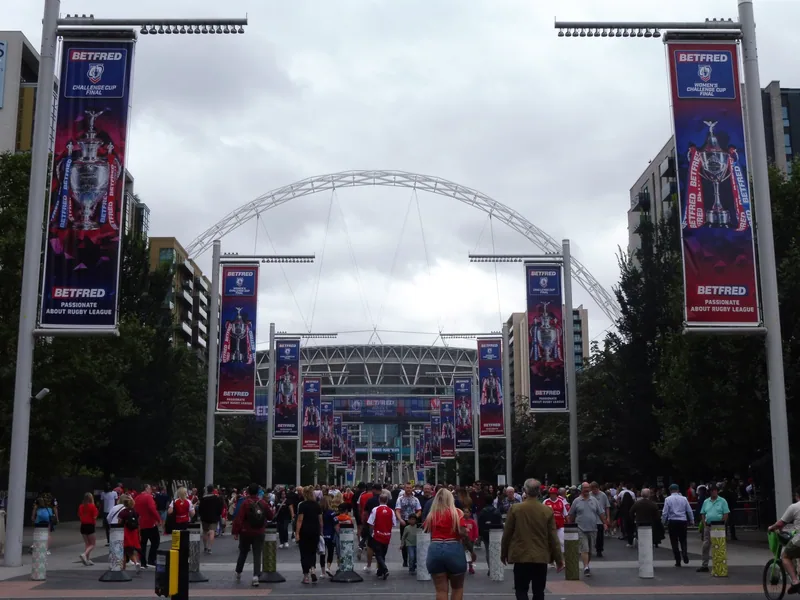
Photo: Hullian111 · CC BY-SA 4.0 · Wikimedia Commons · resized
Wembley Stadium station: nine minutes from Marylebone
The least-used of the three is the most interesting. Wembley Stadium station is a Chiltern Railways stop on the opposite side of the ground from Wembley Park, and the stadium's own travel page describes it as one stop out of London Marylebone. The journey takes nine minutes.
Off-peak the service is twice an hour, at roughly ten and forty minutes past, with extra trains laid on for events. Marylebone is the calmest of London's terminals, which makes this the easiest arrival if you are carrying anything, and the walk from the station to the turnstiles is roughly the same as from Wembley Park.
Two things to check. First, the service is much thinner late in the evening than the Underground, so look up the last departure before you rely on it for the journey home. Second, Marylebone is on the Bakerloo line and nothing else, so factor in the crossing from wherever you are staying; our guide to getting between London's main terminals has the times.
Split your group across two stations and you will all get home sooner. There is no rule that everyone must leave the way they came. If half of you walk to Wembley Stadium station or Wembley Central while the rest queue at Wembley Park, both halves move faster, because the crush at Wembley Park is caused by the number of people choosing it, not by the trains.
Wembley Central: the slow way in, the quick way out
Wembley Central is on the Bakerloo line, on the Overground's Lioness line to Watford Junction and on some Southern services. The walk from the stadium is longer than from Wembley Park, around 15 to 20 minutes down through the older town centre, and the trains are slower.
From Oxford Circus a Bakerloo train takes 29 to 31 minutes. From Euston, a Lioness line train covers it in 21 minutes. Neither is a reason to choose Wembley Central on the way in. On the way out it is a different calculation: an extra twenty minutes of walking against twenty to forty minutes standing in a queue, and the walk is more pleasant. It is also the station for Ealing Road, which is where the good food is.
How long it takes from where you are staying
| From | Best route | Time on the train |
|---|---|---|
| Baker Street | Metropolitan line to Wembley Park | 13 min |
| King's Cross St Pancras | Metropolitan line to Wembley Park | 18-21 min |
| Bond Street | Jubilee to Finchley Road, then Metropolitan | 17-19 min |
| Marylebone | Chiltern Railways to Wembley Stadium | 9 min |
| Euston | Lioness line to Wembley Central | 21 min |
| Oxford Circus | Bakerloo line to Wembley Central | 29-31 min |
| Stratford | Elizabeth line to Farringdon, then Metropolitan | about 40 min |
Buses reach all three stations but none of them is quick from central London. Routes 83, 182, 206, 223, 245 and 297 serve Wembley Park; Wembley Central has a wider set including the 18, 79, 92 and 483. They are useful for short hops within north-west London and for getting between the two halves of Wembley, not for crossing the city. Our guide to using London's buses covers the flat fare and how the Hopper works.
What the trip costs a family
All three stations are in Zone 4, so pay with a contactless card, a phone or an Oyster card and the day's travel from central London is capped at £12.80 (September 2026). That cap covers everything else you do on the Tube and buses that day, which matters if you are sightseeing before an evening kick-off.
Children aged 5 to 10 travel free on the Underground and the Overground with a fare-paying adult, up to four children per adult, and free on buses without any card at all. For 11 to 15-year-olds, staff at any Tube station can add a Young Visitor discount to an Oyster card, which halves fares and caps for up to 14 days; the child has to be there when it is done. There is no equivalent on contactless, because contactless carries no discounts of any kind. Our guides to children's fares and to how capping works on Oyster and contactless explain the rules, and the zone system shows what changes if you are staying further out.
So two adults and two children aged 8 and 12, travelling from Zone 1, pay two adult caps of £12.80 and a half-rate cap for the 12-year-old, with the 8-year-old free. Bus fares sit under a separate £5.25 daily cap.
Getting home after the final whistle
The Jubilee line runs all night on Fridays and Saturdays, which changes everything about a weekend concert. At two in the morning a Night Tube train leaves Wembley Park roughly every ten minutes and reaches Baker Street in 16 minutes and Bond Street in 19. The Metropolitan line does not run through the night, so the Jubilee is a few minutes slower than the daytime route, and worth every one of them.
On a Sunday-to-Thursday night the last trains matter. Check both the last Underground departure from Wembley Park and, if you are changing lines, the last train on your second line, which is often earlier. The night bus network fills the gap: the N18 runs between Trafalgar Square and Harrow Weald through Wembley, the N118 links Trafalgar Square with Ruislip, and the N83 crosses north-west London between Golders Green and Ealing Hospital. All three stop near Wembley Central.
Our pages on which lines run through Friday and Saturday nights, London's night buses and first and last Tube trains cover the detail, and there is separate advice on getting home late in London.
Coming by coach from the rest of Britain
National Express is the stadium's official coach partner and runs event-day services from more than 55 places around the United Kingdom, dropping passengers at the ground rather than at a station. Two details make this more attractive than it sounds for anyone travelling in from outside London: your seat home is reserved, and the operator states that the coaches wait if the event overruns, which no train will do.
Book through National Express directly. If you are arriving in London by coach rather than on a Wembley service, everything starts from Victoria Coach Station, which is a Tube ride away from all three Wembley stations.
Driving: three charges before you have parked
Wembley has been inside the Ultra Low Emission Zone since the zone was extended to all London boroughs in August 2023. A car that does not meet the emissions standard pays £12.50 for the day, and because the charging day runs from midnight to midnight, driving home after a late finish means two charges rather than one. Check the vehicle on Transport for London's ULEZ page before you set off, and remember that non-UK vehicles have to be registered with Transport for London even when they do comply.
Then there is parking. The stadium says to use only the official car parks and to book a space in advance, because they fill. Street parking around the ground is reserved for residents on event days under Brent Council's restrictions. The stadium also warns against the private car parks that appear on event days, on the grounds that they may not carry the right insurance, are not patrolled and are badly lit. Blue badge holders can book a space through the stadium.
A pop-up car park on a residential street is not a car park. The stadium's own advice is blunt about it: no insurance cover if something happens to your vehicle, nobody watching it, and poor lighting when you come back in the dark with 90,000 other people. Book an official space or leave the car at the hotel. Our guide to parking in London explains how the city's parking rules work.
Step-free access, and the catch at one station
All three stations have step-free access and low-level ticket machines, which is better than most parts of the Underground manages. There is one important qualification, and the stadium spells it out: Wembley Central is step-free from the street to the platform but not from the platform onto the train.
That makes Wembley Park and Wembley Stadium the better arrivals for a wheelchair, a mobility scooter or a pushchair. Staff on the Underground and the Overground offer turn-up-and-go assistance with no booking; for the Chiltern service, Passenger Assist can be booked at least two hours ahead. Our guides to step-free transport in London and travelling with a pushchair set out what staff can do.
A timetable for an evening kick-off
For a 19:45 kick-off, working backwards from the turnstiles rather than forwards from your hotel:
- 17:15 leave central London. Thirteen to twenty minutes on the train, eight on Olympic Way, and you are at the gates before the queue thickens.
- 18:00 to 18:30 at the turnstiles. Security is airport-style and the worst queues form in the last hour.
- Full time around 21:30. Allow twenty to forty minutes at Wembley Park, or start walking to one of the other two stations.
- On a train by 22:15. Comfortable on any night of the week for anywhere in Zone 1.
- Staying beyond Zone 4. Look up the last connection on your second line now, not at 22:30.
If you would rather eat before or after than fight for a table at the interval, our guide to eating near Wembley Stadium covers the options, the outlet centre is a two-minute walk from Wembley Park, and our page on stadium tours explains how to see inside on a day with nothing on. For arena nights on the other side of London, the same planning applies at The O2 on the Greenwich Peninsula.
Frequently asked questions
Which station is closest to Wembley Stadium?
Wembley Park is the closest, and it is where most of the crowd goes. Both the Metropolitan and the Jubilee call there, and it is roughly eight minutes on foot up Olympic Way to the turnstiles. Wembley Stadium station, served by Chiltern out of Marylebone, is a similar distance away on the opposite side of the ground and far quieter.
How do I get to Wembley Stadium from central London?
Take a Metropolitan line train from Baker Street or King's Cross St Pancras to Wembley Park: two stops and about thirteen minutes from Baker Street, 18 to 21 minutes from King's Cross. From Marylebone, a Chiltern train reaches Wembley Stadium station in nine minutes.
Does the Tube run late after a Wembley concert?
On Friday and Saturday nights the Jubilee line runs all night, with trains from Wembley Park roughly every ten minutes and Baker Street 16 minutes away. On other nights, check the last departure before you travel, or use the N18, N83 or N118 night buses, which all stop near Wembley Central.
How much does it cost to get to Wembley?
All three stations are in Zone 4, so a day's travel from central London with contactless or Oyster is capped at £12.80 (September 2026). Children aged 5 to 10 travel free with a fare-paying adult, and an 11 to 15-year-old can have a half-price Young Visitor discount added to an Oyster card at any Tube station.
Can I park at Wembley Stadium?
Only in the official car parks, and a space has to be booked before the day. Street parking near the ground is reserved for residents under Brent Council's event-day restrictions, and the stadium advises against the private car parks that appear on event days. Wembley is also inside the Ultra Low Emission Zone, at £12.50 a day for a non-compliant vehicle.
Sources
- Wembley Stadium - Getting to Wembley: the three stations, coach services and ULEZ (checked September 2026)
- Wembley Stadium - Parking at Wembley (checked September 2026)
- Transport for London - Journey Planner, sampled journeys for 23 and 26 September 2026 (checked September 2026)
- Transport for London - Daily and weekly fare caps (checked September 2026)
- Transport for London - The Night Tube (checked September 2026)
- Transport for London - Ultra Low Emission Zone (checked September 2026)
- Transport for London - Young Visitor discount and children's fares (checked September 2026)