
Almost every transfer between two London terminals is a Tube ride of 1 to 18 minutes. The problem is everything either side of it: allow 30 to 45 minutes door to door with a suitcase, and an hour if you are changing between two separate long-distance tickets.
London's terminals sit in a loose ring around the centre, so a journey from Manchester to Brighton, or from Edinburgh to Paris, means arriving at one and leaving from another. Our guide to London's main railway terminals sets out which one you need for each part of Britain. This page is about the gap in between: how many minutes each crossing actually takes, which line to use, where a walk beats the Tube, and when a taxi is the sensible answer.
Every time below was taken from Transport for London's own Journey Planner, sampled on a weekday at eleven in the morning. Each one covers the train or the walk and nothing else, so treat them as a floor rather than a total.
What a terminal-to-terminal transfer involves
- Tube or rail time
- 1 to 18 minutes between the main terminals
- Add for the walk inside both stations
- 10 to 20 minutes, more at Euston, Waterloo and Victoria
- Realistic door to door
- 30 to 45 minutes with luggage, outside the rush
- Cost
- £3.10 peak or £3.00 off-peak for a Zone 1 Tube journey with contactless or Oyster (September 2026)
- Same-day paper single
- £7.00, so tap rather than queue at a machine
- Peak hours
- Monday to Friday 06:30-09:30 and 16:00-19:00
How many minutes each crossing takes
The table gives the quickest sensible route for each pair and the time on the train. Where two routes are close, take whichever line is nearer the platform you arrive on; the difference is usually smaller than the walk to the escalator.
| From | To | Route | On the train |
|---|---|---|---|
| King's Cross / St Pancras | Euston | Victoria line, one stop | 1-2 min |
| King's Cross / St Pancras | Victoria | Victoria line, no change | 8 min |
| King's Cross / St Pancras | Liverpool Street | Metropolitan or Hammersmith & City | 8-9 min |
| King's Cross / St Pancras | Paddington | Circle or Hammersmith & City | 10 min |
| King's Cross / St Pancras | London Bridge | Northern line, Bank branch | 10 min |
| King's Cross / St Pancras | Waterloo | Victoria line to Oxford Circus, then Bakerloo | 12-14 min |
| St Pancras | London Bridge | Thameslink, direct, no Tube | 14 min |
| Euston | Victoria | Victoria line, direct | 7 min |
| Euston | Waterloo | Northern line by way of Charing Cross | 9 min |
| Euston | London Bridge | Northern line, Bank branch | 11 min |
| Euston | Paddington | Northern to Tottenham Court Road, then Elizabeth line | 13 min |
| Euston | Liverpool Street | Northern to Moorgate, then a five-minute walk | 13 min |
| Paddington | Marylebone | Bakerloo line | 3 min |
| Paddington | Liverpool Street | Elizabeth line, direct | 11-12 min |
| Paddington | Waterloo | Elizabeth line to Tottenham Court Road, then Northern | 13 min |
| Paddington | Victoria | Bakerloo to Oxford Circus, then Victoria line | 14-16 min |
| Victoria | Waterloo | Circle or District to Westminster, then Jubilee | 8 min |
| Victoria | London Bridge | Circle or District to Westminster, then Jubilee | 11 min |
| Victoria | Liverpool Street | Victoria line to Oxford Circus, then Central | 18 min |
| Waterloo | London Bridge | Jubilee line | 3 min |
| Waterloo | Liverpool Street | Waterloo & City to Bank, then Central | 11 min |
| Liverpool Street | London Bridge | Walk to Moorgate, then Northern line | 8-9 min |
| Charing Cross | Waterloo | Bakerloo or Northern, one stop | 3 min |
Two numbers in that table decide most itineraries. Waterloo to London Bridge in three minutes means a trip that combines the south-west and the south-east is easy. Victoria to Liverpool Street in eighteen minutes, with a change at Oxford Circus in the middle of the shopping crowd, means a Gatwick-to-Stansted connection through central London is not something to attempt with forty minutes in hand.
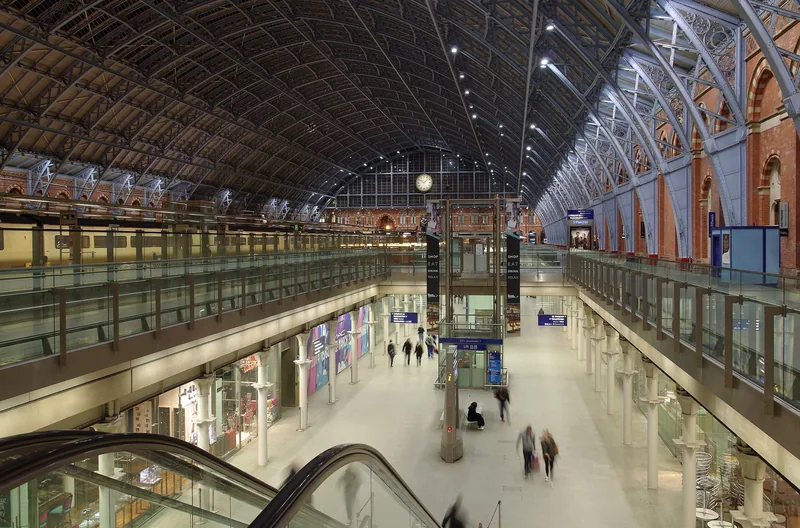
Photo: mattbuck (category) · CC BY-SA 4.0 · Wikimedia Commons · resized
Four transfers where you do not need the Tube at all
Buying a Tube ticket and queueing for an escalator is sometimes slower than simply walking, especially if your platform is at the front of the station and you have wheels on your bags.
- King's Cross to St Pancras. They face each other across a plaza. The walk is a couple of minutes between the concourses, longer if your Thameslink platform is on the lower level.
- King's Cross or St Pancras to Euston. A flat 13-minute walk west along Euston Road. Works out the same as the Tube once you have found the Victoria line platform, and you see daylight. Building work for the new high-speed railway has changed the pavement layout at the Euston end, so follow the signs rather than your memory.
- Charing Cross to Waterloo. Twelve minutes on foot over the Golden Jubilee footbridges, with the best free river view of any station transfer in London.
- Cannon Street to London Bridge. Eleven minutes across London Bridge itself.
Marylebone to Paddington is an 18-minute walk or a three-minute Bakerloo line ride, which is the one case where the Tube wins outright. Marylebone is also worth remembering for a different reason: Wembley Stadium station is one stop and nine minutes away on a Chiltern train, as our guide to reaching Wembley Stadium explains. Our page on when walking beats the Tube in central London covers the rest of the city, and there is a separate list of Tube stations it is quicker to walk between.
St Pancras to Gatwick and Brighton needs no Underground ticket. Thameslink runs from the lower level of St Pancras through Farringdon, City Thameslink, Blackfriars and London Bridge. Blackfriars is eight minutes away and London Bridge fourteen, on the same train, on the same ticket.
The three transfers that catch people out
Euston to Paddington. Euston has the Northern and Victoria lines, and neither goes to Paddington. The Journey Planner will send you on the Northern line to Tottenham Court Road and then the Elizabeth line, which takes about 13 minutes. The older route is to walk three minutes to Euston Square, a separate station on Euston Road, and take the Circle or Hammersmith & City line for eight minutes. Both land you in the same place. Euston Square is not part of Euston, and nobody will tell you that if you are following a sign for "Underground".
Liverpool Street to London Bridge. There is no single line between two of the busiest stations in the City. The quickest route involves walking about five minutes to Moorgate and then taking the Northern line, which is fine unless you are carrying two suitcases through the lunchtime pavement traffic.
Anything involving Fenchurch Street. The smallest of the terminals has no Underground station of its own. Tower Hill on the Circle and District lines and Tower Gateway on the Docklands Light Railway are both a short walk away, and Fenchurch Street is the one terminal where it pays to look at a map before you arrive rather than after.
What the transfer costs, and the mistake that doubles it
Tap in and out using one contactless card, phone or Oyster card. In September 2026 a Zone 1 journey on the Underground is charged at £3.10 in the peaks and £3.00 outside them; the same trip bought as a paper single at a machine is £7.00. Every crossing in the table above sits inside Zone 1.
The mistake is splitting your payments. Caps and the correct fare only work if the same card or device is used all day; an iPhone in the morning and the plastic card it is linked to in the afternoon count as two separate travellers. The Zones 1-2 daily cap is £8.90, so two transfers plus some sightseeing will reach it. Our explainer on how Oyster and contactless fares and caps work sets out the rules, and the zone system explains what happens once you leave the centre.
One thing contactless will not do is give a discount. There is no child, railcard or concession rate on a contactless tap. Children aged 5 to 10 travel free on the Tube with a fare-paying adult, up to four children per adult, so a family transfer usually costs two adult fares and nothing more. For 11 to 15-year-olds, staff at any Tube station can add a Young Visitor discount to an Oyster card, giving half-price fares and caps for up to 14 days; our guide to children's fares on London transport has the detail.
With heavy bags: the case for a black cab
Most of these crossings are between one and three miles. Transport for London's published taxi tariffs put a one-mile weekday daytime trip at £8.40 to £13.00, two miles at £12.60 to £20.20 and four miles at £21 to £31, with a minimum fare of £4.40. There is no extra charge for luggage, and every licensed taxi must take contactless without a surcharge.
For one person that is poor value. For three or four travellers with cases, a cab from Paddington to King's Cross or Euston to Victoria often costs less than the Tube fares would, and it saves two flights of stairs at each end. Black cabs are also exempt from the Congestion Charge, so the driver will not add one. Our guide to black cabs, minicabs and ride-hailing apps explains the tariffs and how to find a rank.
Leave the cases and travel across town with empty hands. Several terminals have staffed left-luggage offices, and Transport for London runs its own luggage room at Victoria Coach Station, from £2 for an hour to £10 for 24 hours per item. If you have six hours between trains, storing the bags and crossing London unencumbered beats dragging them to a café and back. Our guides to left luggage at London's stations and to Victoria Coach Station list the options and hours.
Step-free transfers and travelling with wheels
Step-free coverage is uneven, and it is the single biggest reason a transfer takes longer than the table suggests. Every one of the 41 Elizabeth line stations has level access from the street down to the platform, which is why Paddington, Farringdon and Liverpool Street are the easy ones. Every station on the Docklands Light Railway is step-free too. On the Underground, 95 stations out of more than 270 are step-free, and some of the busiest interchanges are not among them.
Staff on the Tube, the Overground and the Elizabeth line operate a turn-up-and-go service: no booking, ask at the gateline, and they will take you to the platform, arrange a ramp and meet you at the other end. If no step-free route exists, Transport for London pays for an accessible taxi. For a long-distance train, book Passenger Assist with the train company at least two hours ahead on 0343 222 2000. Our guides to step-free travel in London and to crossing London with a pushchair go into the practical detail.
How much time to leave between two trains
If both trains are on one through ticket, the railway owns the problem and will put you on a later service. If you bought them separately, the risk is yours.
- Two flexible Off-Peak tickets. Forty-five minutes is comfortable outside the rush. Nothing is lost if you miss a connection.
- An Advance ticket on the second leg. Leave 90 minutes. Advance fares tie you to one named departure; miss it and you buy a fresh ticket at the walk-up price.
- Eurostar out of St Pancras. Add the check-in on top. Eurostar asks Standard and Plus passengers to arrive 75 minutes before departure, and the gates shut 30 minutes before.
- Travelling at 08:00 or 17:30. Add 15 minutes to everything. Interchanges at Oxford Circus, Bank and Victoria move at a shuffle in the peaks.
Our guide to buying UK train tickets explains the difference between Advance, Off-Peak and Anytime fares and what a change costs, and the Eurostar guide covers check-in and luggage rules. If you are planning a day trip out of London rather than a through journey, our page on getting to Windsor by train shows how the two-terminal question works in practice.
When the Underground is not running
Strikes, engineering work and late-night closures all break the table above. The Elizabeth line and Thameslink are the two routes most likely to keep going, because they are not part of the Underground; between them they link Paddington, Liverpool Street, St Pancras, Blackfriars and London Bridge without touching a Tube train.
On a Friday or Saturday night, the Night Tube runs on the Central, Jubilee, Northern, Piccadilly and Victoria lines and on the Overground's Windrush line, which covers most terminal transfers. On other nights, check the last departure on both legs of your route, not just the first. Our pages on first and last Tube trains and on getting around during a Tube strike cover both situations. Check the live status on Transport for London's status page before you set off for a connection you cannot afford to miss.
Frequently asked questions
How long does it take to get from Euston to Paddington?
About 13 minutes on the train, using the Northern line to Tottenham Court Road and then the Elizabeth line, or roughly the same by walking three minutes to Euston Square and taking the Circle or Hammersmith & City line for eight minutes. Allow 30 minutes door to door with luggage.
Is King's Cross far from St Pancras?
No. The two stations face each other across a plaza on Euston Road and the walk between the concourses takes a couple of minutes. Allow longer if you are heading for the Thameslink platforms, which are on a lower level, or for the Eurostar gates, which have their own check-in.
Which London stations are connected without changing lines?
Victoria and Euston share the Victoria line with King's Cross St Pancras. Paddington and Liverpool Street are linked directly by the Elizabeth line. Waterloo and London Bridge are three minutes apart on the Jubilee line, and St Pancras reaches London Bridge and Blackfriars on a Thameslink train with no Underground ticket at all.
How much time should I leave to change stations in London?
Forty-five minutes is enough if both tickets are flexible. Leave 90 minutes if the second leg is an Advance ticket tied to one train, and add the Eurostar check-in on top for trains to Paris and Brussels. In the morning and evening peaks, add another 15 minutes.
Is it cheaper to take a taxi between London stations?
For one traveller, no. For three or four people with suitcases it often is: a one-mile weekday daytime fare is £8.40 to £13.00 and there is no extra charge for luggage, so a short cab ride can cost about the same as four Tube fares while saving the stairs.
Sources
- Transport for London - Journey Planner, station-to-station times sampled for Wednesday 23 September 2026 (checked September 2026)
- Transport for London - Tube and rail fares and peak times (checked September 2026)
- Transport for London - Daily and weekly capping (checked September 2026)
- Transport for London - Taxi fares and extra charges (checked September 2026)
- Transport for London - Step-free access (checked September 2026)
- Transport for London - Turn up and go and Passenger Assist (checked September 2026)
- Transport for London - The Night Tube (checked September 2026)
- Eurostar - Check-in times at London St Pancras (checked September 2026)