
On most weekends some part of London's rail network is shut for engineering work: a stretch of a Tube line, an Overground route, the DLR or a main-line railway. The closures are planned months ahead, TfL publishes them six months in advance, and both TfL's and National Rail's journey planners route around them, so the trick is simply to check before Saturday and again on the morning you travel.
Weekends are chosen because fewer people travel, and the work that keeps an old railway running, such as track renewal, signalling and station rebuilding, needs whole days without trains. Where a line closes, there is usually a replacement bus, another line that covers the same ground, or both. Neither is as quick as the train.
Our guide to the Underground explains the network itself, and each of our line guides, for example the District and Circle lines, describes the detours that work for that particular line. This page covers what is the same everywhere: where to look, how to read a closure notice, what a replacement bus is like, and the holidays when closures get longer.
Weekend closures: where to check
- TfL, six months ahead
- "Planned track closures 6-month look ahead" PDF, linked from TfL's planned line closures page. The edition we read was dated 9 November 2026
- TfL, this week
- The status page for Tube, DLR, Overground and Elizabeth line, with the week's planned works
- Main-line trains
- National Rail's planned engineering works page and Journey Planner
- On the day
- TfL Go app, or TfL Journey Planner
- Tickets on replacement buses
- National Rail: you need a valid train ticket
- Delay refunds for planned works
- Not payable on TfL services
- Christmas Day
- No Tube, bus or National Rail services; TfL says only taxis, private hire and Santander Cycles run
How often weekends are affected
Very often. In the six-month look-ahead TfL published on 9 November 2026, which ran week by week from that date to May 2027, all but one of the 27 weeks listed at least one closure on a Saturday or Sunday. Many were partial: one section of one line, or a morning only. But a visitor in London for a long weekend should expect at least one line on their list to be affected.
Weekends are not the only time. National Rail's list of planned works in the same week was dominated by late-night and early-morning closures on weekdays, with buses replacing the last trains on several routes out of London. If you are coming back late from a day trip, check the evening as carefully as the weekend. Our page on the last train back to London covers that journey.
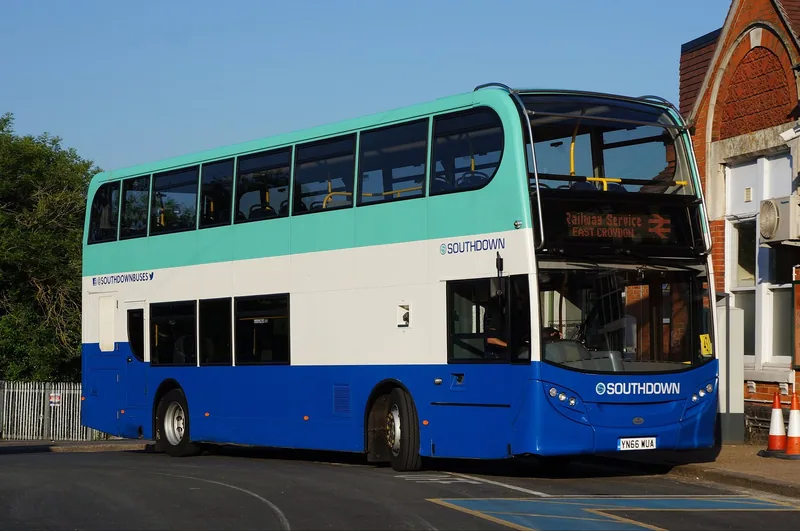
Photo: CharlieGizmo · CC BY-SA 4.0 · Wikimedia Commons · resized
Where TfL publishes its closures
TfL's page "Planned line closures and service changes" links to a PDF called "Planned track closures 6-month look ahead". It is organised week by week, Monday to Sunday, and lists each line, the days, the section closed and any time limits. It is revised often: the copy we read was marked "correct at date of publication Monday 9 November 2026", and the file had been replaced that morning.
Nearer the date, TfL's status page for the Tube, DLR, Overground and Elizabeth line shows the same work with the detail added: which replacement buses run, which tickets are accepted on other railways, and which stations are closed rather than just passed through. The status page also has a section for station, lift and escalator closures, which is where step-free problems appear; our page on what to do when a lift is out of order covers that side.
Check twice: once when you plan, once on the morning. The six-month list is a plan, and plans change. Work is sometimes added at short notice or cancelled because it finished early. A closure you read about in October may not be the one that happens in December.
Reading a closure notice
The wording is compact and every word matters. Phrases from TfL's November 2026 look-ahead show the range:
- "No service between A and B". The whole section is shut, including the stations in between, unless the notice says a station is served by another line.
- "During daytime hours only". The line reopens in the evening, often for the Night Tube.
- "During Saturday Night Tube only". The day service runs normally; only the overnight trains are affected. Our page on the Night Tube explains which lines run at night.
- "Until 10:15" or "between 10:00 and 18:00". A partial-day closure. An early start is the one most likely to catch someone heading for an airport.
- "Reduced service". Trains run, but fewer of them, or not to every branch.
- "Tickets will be accepted on…". Another operator is taking your ticket on a parallel route. This is often quicker than the replacement bus.
The section named is the section closed, not the trip you want to make. A closure "between Plaistow and Barking" on the District line does not stop you reaching Westminster from Earl's Court; a closure "between Paddington and Liverpool Street" on the Elizabeth line removes the fastest way across the centre.
What a rail replacement bus is like
National Rail's own description is honest about it. A rail replacement service is a bus or coach run by the train company instead of the train. The general rules it publishes:
- You need a valid train ticket before you get on.
- Non-folding bicycles are not allowed; a folded one may be carried at the driver's discretion.
- You may not drink alcohol on board.
- Vehicles show the destination, the train company's name and the words RAIL REPLACEMENT.
- A different timetable applies and journeys may take longer than usual.
- If the replacement service is significantly late against that temporary timetable, you can still claim delay compensation in the usual way.
Two practical points are less obvious. Replacement buses do not always stop at the station itself: where a double-decker cannot reach the entrance, they use a nearby bus stop or meeting point, and National Rail says there will be no railway staff there. Signs and the onward travel map at the station show where to go. And buses are used for short hops with many stops, while coaches, with luggage space underneath, tend to appear on longer runs.
TfL's own replacement buses are numbered or lettered services that follow the closed line from station to station. TfL's notices often also suggest an ordinary bus route or a parallel railway instead, which is usually the faster choice. How fares work on a TfL replacement bus is stated on the closure notice for that work; read it rather than assuming.
Allow double the time, and more with luggage. A replacement bus follows the roads, not the railway, and calls at every station on the closed section. Add queueing at the bus stop and the walk from the platform. For a flight or a Eurostar, look for a parallel railway first.
Replacement buses and step-free travel
A replacement bus is not automatically accessible. The rail regulator's guidance tells train companies to write accessible vehicles into their contracts with bus and coach suppliers, and to assess the need at least 12 weeks before major planned works. Where the substitute still cannot carry you, the company has to find another way to get you to a station you can use, and may not charge you extra for it. National Rail says that passengers with a disability will be asked about the best options, which may include a taxi, a minibus, a bus, a coach or a diverted journey.
If you use a wheelchair, book Passenger Assist and mention the engineering works, or speak to staff when you arrive. Our guide to step-free transport in London covers the rest of the network.
Routing round it yourself
The journey planners do most of the work. National Rail says its Journey Planner shows where a replacement service runs for all or part of a journey, and TfL's closure notices tell you to check its own Journey Planner nearer the time. When planning several days ahead, put in the actual date and time, not "now".
Beyond the planners, a few rules of thumb from London's geography help:
- In the centre, the next station is rarely far. Many central Tube stations are a ten- or fifteen-minute walk apart; our page on walking in London shows when walking wins.
- Most lines have a shadow. The Elizabeth line shadows the Central line across the centre; main-line trains shadow the District line to Richmond and Wimbledon; Thameslink crosses the centre north to south.
- Buses keep running. They are slower in traffic but go almost everywhere; see London's buses.
- The river is unaffected. The Uber Boat river service links the West End, the City, Canary Wharf and Greenwich and is not affected by rail engineering work.
- Watch the time limit. A long detour still has to fit inside the maximum journey time, and walking between stations counts as one journey only at the pairs TfL lists, explained on our page about changing trains without paying twice.
Christmas, New Year and Easter
Bank holiday weekends are when the railway does its biggest jobs, because more days are available in a row. TfL and National Rail publish separate holiday travel pages, and the pattern is the same every year: nothing runs on Christmas Day, very little on Boxing Day, and longer closures run across Easter.
| Day | What was published for 2026/27 (checked November 2026) |
|---|---|
| Christmas Eve | TfL and National Rail services finish earlier than normal |
| Christmas Day | No Tube, DLR, Overground, Elizabeth line, bus or National Rail services. TfL says only taxis, private hire and Santander Cycles run |
| Boxing Day | Most train companies run no service; National Rail expected a limited service from a few operators, including London Overground, Southern and Stansted Express, on some routes only |
| Substitute bank holiday | Monday 28 December 2026; National Rail says trains run |
| New Year's Eve | TfL said most of its services would run through the night, with normal fares, and some central stations exit-only or closed at short notice |
| Easter weekend | The look-ahead of 9 November 2026 already listed Good Friday to Easter Monday closures on several lines, including part of a route to Heathrow |
If you fly in or out over a holiday weekend, check the airport line specifically. Our page on getting from Heathrow to central London compares the alternatives, and what to do if your airport train is cancelled covers the day itself.
Refunds when planned work slows you down
TfL's Conditions of Carriage are clear that you cannot get a service delay refund if your journey was delayed by planned service changes and engineering works, and that if you take an alternative route because of planned or advertised changes, you are not entitled to the difference in fare. The logic is that the work was published in advance.
National Rail is slightly different: the replacement timetable becomes the timetable, and if the replacement service is significantly late against it, delay compensation can be claimed as usual. Our page on service delay refunds explains both systems.
Frequently asked questions
How do I find out about Tube closures this weekend?
Check TfL's status page for the Tube, DLR, Overground and Elizabeth line, which shows planned works, or the TfL Go app. For further ahead, TfL publishes a six-month look-ahead of planned track closures as a PDF. Check again on the morning you travel.
Do I need a ticket for a rail replacement bus?
On National Rail, yes: you need a valid train ticket before you board. On TfL closures, the notice for that work says how fares are handled, and it often points you to ordinary buses or another railway that accepts your ticket instead.
Are rail replacement buses wheelchair accessible?
Not always. Train companies are expected to hire accessible vehicles, and if the replacement still cannot take you, they must arrange something that can, such as a taxi or minibus, at no extra cost to you. Tell staff or book Passenger Assist and mention the works.
Does the Tube run on Christmas Day?
No. There are no Tube, DLR, Overground, Elizabeth line, bus or National Rail services on Christmas Day. TfL says only taxis, private hire vehicles and Santander Cycles operate, so plan a walk or book a car in advance.
Can I get a refund if a weekend closure made me late?
Not from TfL: its Conditions of Carriage exclude delays caused by planned engineering works. On National Rail, compensation can be claimed if the replacement service runs significantly late against its own temporary timetable.
Sources
- Transport for London - Planned line closures and service changes (checked November 2026)
- Transport for London - Planned track closures 6-month look ahead, 9 November 2026 (checked November 2026)
- Transport for London - Christmas and New Year travel (checked November 2026)
- National Rail - Rail replacement services (checked November 2026)
- National Rail - Planned engineering works (checked November 2026)
- National Rail - Christmas and New Year 2026/27 (checked November 2026)
- Transport for London - Conditions of Carriage, 24 September 2026 (checked November 2026)
- Office of Rail and Road - Accessible Travel Policy guidance, October 2025 (checked November 2026)