
Pride in London is a parade through the West End followed by free stages in six squares and streets across Soho and Westminster. It is free to watch, it takes over the centre of the city for a day in early summer, and it is a protest march as well as a party. The 2027 date had not been announced when we checked in September 2026.
The parade begins at Hyde Park Corner and moves along Piccadilly, down Haymarket, past Trafalgar Square and ends on Whitehall. It takes several hours to pass, because there are hundreds of groups in it. Around it, stages in Trafalgar Square, Leicester Square, Soho Square, Golden Square and on Dean Street run free programmes through the afternoon and evening.
Our guide to LGBTQ+ London covers the city's bars, venues and neighbourhoods all year round, and London in July places Pride among the summer's other events. This page is about the day itself: who runs it, what each part is for, and how to see it without spending eight hours unable to move.
Pride in London at a glance
- Organiser
- London LGBT Community Pride C.I.C., a community interest company (no. 08321669)
- 2026 (held)
- Saturday 4 July 2026, parade from Hyde Park Corner at 12:00
- 2027
- The organisers say Pride will return in 2027. No date announced as of September 2026
- Cost
- Free to watch the parade and to attend all the stages
- Marching
- By application only, with a wristband. Organisations apply in the spring
Who runs Pride in London, and why it is not just a party
Pride in London is produced by London LGBT Community Pride C.I.C., a community interest company rather than a council department or a commercial promoter. A community interest company is a form of British organisation that trades but is legally required to use its assets and profits for a stated community purpose.
The organisers describe Pride as a historic celebration and, in the same sentence, as a platform for protest and progress. Their stated values are visibility, unity and equality. That double character is not decoration. The first Gay Pride Rally in the United Kingdom was held in London in 1972, on the Saturday nearest the anniversary of the Stonewall uprising in New York, and it was a demonstration at a time when being openly gay carried real legal and social risk.
The modern event keeps the march at its centre. If you attend only the stages and the street parties, you have seen half of it.
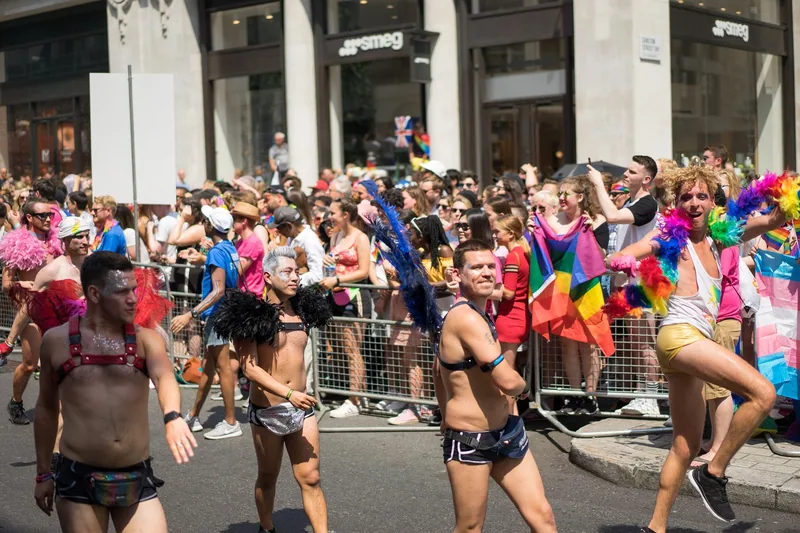
Photo: Camerawalker · CC BY-SA 4.0 · Wikimedia Commons · resized
The argument over who gets to march
Pride in London has become large enough that space in the parade is rationed, and the way it is rationed tells you what the organisers are trying to protect.
Groups apply in categories: Community Group, Non-Profit, Business, Company Entry and Sponsoring Partner. Every participant needs a wristband, and allocations run from around 25 to 75 per organisation depending on type. Student societies and employee networks cannot enter separately; they march under their parent institution's entry.
Companies whose main purpose is not LGBTQIA+ work are directed to join the organisers' business network, Pride in the City, before they can apply for a place. In practice this means corporate participation is filtered and paid for, while grassroots groups are given priority as Community Groups.
This structure exists because the balance between community groups and corporate floats has been the most argued-over question at Pride in London for years. Whatever you think of the answer, it is worth knowing that the parade you are watching is curated, not open.
When the 2027 date will be known
As of September 2026, the organisers' site said only that Pride will return in 2027, without a date. We will not guess one. Recent editions have fallen on a Saturday at the end of June or the beginning of July, but that is a pattern rather than a rule, and it has moved before.
Two places publish the confirmed date when it exists: the organisers' own site, prideinlondon.org, and the Mayor of London's events listings at london.gov.uk. Organisations wanting to march usually need to apply months ahead, with results announced around the end of March, so the date is normally settled well before the general public hears about it.
Do not book a hotel around an unconfirmed Pride date. Central London rooms are expensive on Pride weekend and sell out early, which creates pressure to book on a guess. Wait for the organisers to confirm. Our page on when to book a London hotel explains how far ahead is far enough.
The parade: where to stand and when
The route used in 2026 ran from Hyde Park Corner along Piccadilly, through Piccadilly Circus, down Haymarket, past Trafalgar Square and on to Whitehall, setting off at midday. The route is confirmed each year and can change.
Piccadilly is the widest part of the route and the easiest place to see something. The pavements near Piccadilly Circus are the most crowded, because that is where the parade turns. Whitehall, at the end, is the least crowded and also the least fun, because by the time groups reach it they have been walking for two hours.
Arrive by 11:00 for a position on Piccadilly with a view. By 12:30 the front rows are gone along the whole central section and you will be watching over heads.
The parade does not pass any one point in ten minutes. Expect it to take two to three hours to go by, which means you can arrive late and still see a great deal, just not from the front.
The stages, and which one to choose
The free programme is spread deliberately, so that different parts of the community have their own space rather than competing for one stage.
| Stage | Where | What it is for |
|---|---|---|
| Main Stage | Trafalgar Square | Headline performers, drag, and speeches from community leaders. The largest and busiest |
| Women's Stage | Leicester Square | LGBTQIA+ women performers and artists, with community stalls |
| Trans and Non-Binary Stage | Soho Square | Trans and non-binary performers and speakers, grassroots organisations |
| Cabaret Stage | Dean Street, Soho | Queer cabaret, burlesque and lip-sync |
| Global Majority Stage | Golden Square | Music, dance and spoken word from global majority communities, with international food |
| Family Area | Victoria Embankment Gardens | Storytelling, music and activities for children |
All of them are free and none needs a ticket. Trafalgar Square reaches capacity in the afternoon and entry is then controlled, so if a particular act matters to you, be there early. The smaller squares in Soho are more pleasant and easier to get into.
The Family Area in Victoria Embankment Gardens is worth knowing about if you are travelling with children. It is set apart from the drinking and the noise, and it is the one part of the day where there is space to sit down.
How busy it gets
Very. Soho is closed to traffic, the pavements are full, and the streets between the squares move at walking pace with frequent stops. Getting from Soho Square to Trafalgar Square, normally a ten-minute walk, can take three times that.
Bars across Soho put barrels on the pavement and sell outside. Queues for toilets are long everywhere. Mobile signal becomes unreliable when the crowd is at its densest, so agree a meeting point with anyone you are with rather than relying on your phone.
The atmosphere is overwhelmingly good-natured, but any crowd of that size attracts pickpockets. Our page on staying safe in London covers the ordinary precautions, and they apply here more than usual.
The quietest hour is between 11:00 and 12:00. The stages have started, the streets are still passable and the parade has not yet arrived. If you want photographs of Soho decorated for Pride without a wall of people in them, that is the window.
Marching in the parade yourself
You cannot simply join the parade on the day. Every participant needs a valid wristband and no one is admitted without one.
Organisations apply through an online portal in the spring, choosing a category and saying whether they will walk or bring a vehicle, and outcomes are announced around the end of March, with payment due within 14 days of acceptance.
Individuals who are not part of a group can apply separately when individual and flag-bearer applications open, which in 2026 was in mid-May. Those places are limited and they go quickly. Check the organisers' Join the Parade page from April onwards.
Getting there and getting home
Tube stations in the centre are exceptionally busy on Pride day, and several may be exit-only, entry-only or closed for short periods for crowd control. Green Park, Piccadilly Circus, Leicester Square and Charing Cross are the ones most likely to be affected.
Walk in from a station further out. Oxford Circus, Tottenham Court Road, Embankment and Waterloo all put you within fifteen minutes of the action and are considerably calmer.
Buses are diverted away from the whole area for most of the day, so do not plan a bus journey across the centre. Our page on London buses explains how diversions are signposted.
Going home late is straightforward on a Saturday: the Night Tube runs on several lines through Friday and Saturday nights. Around midnight the stations are still busy, so give yourself time, and remember that late-night food in London is easy to find in Soho and Chinatown if you need to wait out a queue.
Accessibility
The parade route is on flat central streets with wide pavements on Piccadilly, which is the most manageable section for wheelchair users. The squares have accessible viewing arrangements, and the organisers publish access information on their site each year, including how to request a place in an accessible viewing area.
Crowd density is the real barrier rather than physical access. Arriving early is the single most effective adjustment. Our guide to step-free transport covers which central stations have lifts, and Embankment and Westminster are usually the easiest approaches from the south.
Pride is not the only day
London's LGBTQ+ calendar runs well beyond one Saturday. Black Pride, Trans Pride and a number of borough-level Prides take place across the summer, each with its own organisers and character, and several are considerably easier to attend than the main parade.
The city's venues, bars and clubs are open all year, and our guides to London nightlife and free things to do in London are better starting points for an ordinary weekend. If you enjoy a large free street event, Notting Hill Carnival in August and St Patrick's Day in March work in a similar way, and both are run by or with the communities they celebrate.
Frequently asked questions
When is Pride in London 2027?
Not yet announced. As of September 2026 the organisers' site said only that Pride will return in 2027. The date is confirmed on prideinlondon.org and on the Mayor of London's events pages, usually well before the summer, because groups applying to march need to know by the spring.
Is Pride in London free?
Yes. Watching the parade and attending all the stages is free and no ticket is required. Taking part in the parade is different: participants need a wristband, and organisations pay an entry fee that varies by category.
Where does the parade go?
In 2026 it set off from Hyde Park Corner at midday and ran along Piccadilly, through Piccadilly Circus, down Haymarket, past Trafalgar Square and finished on Whitehall. The route is confirmed each year and can change, so check before you choose a spot.
Can I join the parade on the day?
No. Every participant needs a wristband issued in advance, and no one is allowed to march without one. Organisations apply in the spring and individual applications open later, usually in May. Anyone can watch from the pavement without any registration.
Is Pride suitable for children?
The parade is, and there is a dedicated Family Area in Victoria Embankment Gardens with storytelling and activities. The Soho streets in the afternoon and evening are crowded, loud and centred on drinking, and are less suitable. Watching the parade from Piccadilly in the morning and then going to the Family Area works well.
Sources
- Pride in London - official site (checked September 2026)
- Pride in London - Stages and squares (checked September 2026)
- Pride in London - Join the parade (checked September 2026)
- Greater London Authority - Pride parade 2026 (checked September 2026)
- Transport for London - Busiest times to travel (checked September 2026)