
On the second Saturday of November, a gold state coach, a few thousand marchers and about a hundred floats fill the streets of the City of London. It is free, nobody needs a ticket, and in 2026 it happens on Saturday 14 November, setting off from Mansion House at 11am.
The Lord Mayor's Show is a procession with a legal purpose. Each autumn the City of London elects a new Lord Mayor, who must travel from the City to the courts in Westminster to swear loyalty to the Crown. The Show is that journey, and it has been made in some form since the thirteenth century.
The Lord Mayor of the City of London is not the same person as the Mayor of London. One runs the Square Mile and its ancient institutions for a single year; the other is elected by the whole capital. Our guide to the City of London explains the difference and the strange constitutional world the Show belongs to, and London in November sets the day in the context of the month.
What follows is the practical part: exactly when the procession reaches each point, where to stand, and the two things that go wrong for visitors.
The Lord Mayor's Show 2026
- Date
- Saturday 14 November 2026
- Start
- 11am from Mansion House
- Cost
- Free. No tickets, no grandstands in recent years
- Outward route
- Mansion House, St Paul's, Ludgate Hill, Fleet Street, Royal Courts of Justice
- Return route
- Temple Place, Victoria Embankment, Queen Victoria Street, Mansion House
- Ends
- About 2:30pm, with the Pikemen's display outside Mansion House
The timetable, point by point
The procession never stops moving, which means the question is not "what time does it start" but "what time does it reach me". The organisers publish these timings, and they are reliable.
| Time | What happens |
|---|---|
| 11:00 | The leading band turns from Princes Street past Mansion House, where the new Lord Mayor watches from the balcony |
| 11:13 | The bands reach St Paul's Cathedral |
| 11:26 | The bands reach the Royal Courts of Justice at the Aldwych end |
| About 12:00 | The procession is still passing Mansion House. The Lord Mayor comes down and boards the State Coach |
| 12:11 | The State Coach reaches St Paul's, where the Lord Mayor receives a blessing |
| 12:31 | The State Coach arrives at the Royal Courts of Justice |
| 12:35 | The last vehicle, a City ash cart, reaches the Royal Courts. The outward leg is over |
| 13:10 | The bands set off again from Temple Place for the return |
| 13:18 | The return procession reaches the top of Blackfriars Bridge |
| 13:33 | The head of the procession is back at Mansion House |
| About 14:30 | The Lord Mayor returns, with a display by the Pikemen of the Honourable Artillery Company |
Note what those numbers mean. When the first bands arrive at the Royal Courts at 11:26, most of the procession has not left Mansion House yet, and the coach itself is still standing at Guildhall. There are around a hundred floats waiting to join. So from about 11:30 onwards it genuinely does not matter where on the route you stand: something is always passing.
Where to stand: three plans that work
For the fullest version of the Show, take the stretch between Bank and St Paul's between 11:00 and 12:00. This is where the crowd is liveliest, where the BBC cameras are, and where the streets are narrow enough to feel like a medieval procession. It is also where it is hardest to see over shoulders, so be early. Grandstand seating at St Paul's, which existed in past years, is no longer set up; the space is left open.
For space and comfort, take the return leg between Temple and Blackfriars, from about 13:15. The roads are wider, the pavements are wider, and the organisers themselves say there is room for wheelchairs, folding chairs, luggage and families. You see the same procession in reverse order, and you can actually move.
For the best ending, be outside Mansion House at around 14:30, when the Lord Mayor arrives back and the Pikemen present arms. This is the ceremonial high point and far fewer people stay for it than turn out at eleven.
Watch the outward leg, eat, then watch the return. Between about 12:40 and 13:10 the streets are briefly clear while the procession reforms at Temple. That is your window for lunch, and it is the reason the Show is a whole morning rather than twenty minutes.
Getting there, and the mistake nearly everyone makes
Bank and St Paul's stations are the closest to the action and are packed from mid-morning. The organisers suggest Mansion House, Cannon Street or Blackfriars instead if you do not mind a short walk, and Farringdon on the Elizabeth line or City Thameslink for the outward leg.
Roads across the City close from about 7am, from 5am around Bank and from midnight on Princes Street. The closed area runs roughly from Kingsway to Bishopsgate and from the river up to Holborn. Blackfriars Bridge is shut all day. Buses are diverted and taxis cannot reach the route, so arriving by car is not an option.
Now the mistake. Once the procession is moving, you cannot cross the road at all. Not at a gap, not at a crossing, not anywhere. If the side you want is on the other side, you must use an underpass, and there are four: Bank, City Thameslink, Mansion House and Blackfriars. Work out which side of the street you want before 10:45, because after that you are committed for an hour.
Coming from the south, the walk in over the Millennium Bridge from Bankside is pleasant and avoids the worst of the crush, and the river bus pier at Blackfriars is well placed for the return leg. Our page on the river bus has the timetable and fares.
Wheelchair users, Blue Badge holders and anyone wary of crowds
The Show is free and open, but the crowd around St Paul's and Mansion House is dense and slow-moving, and the organisers advise anyone unsteady on their feet to avoid those two areas.
Fleet Street, Victoria Embankment and Queen Victoria Street are the places to head for instead, and the organisers specifically suggest that wheelchair users come to Victoria Embankment for about 1pm for the return leg.
City Thameslink and Farringdon are both step-free and close enough to the route while being much quieter than Bank or St Paul's. Our guide to step-free transport in London explains how to plan a route that avoids stairs.
Blue Badge holders can watch the outward leg from a reserved area at the junction of Ludgate Street and Old Bailey, just past St Paul's, which requires a pass applied for in advance through the official site. A limited amount of parking is available at the Old Bailey, and space is set aside on Queen Victoria Street for coaches bringing disabled or elderly visitors, also by advance pass.
Accessible toilets are provided at several points along the route, including near Blackfriars Bridge, the Old Bailey, New Change and the Queen Victoria Street junction with Cannon Street, and they are marked on the official one-page map. Our guide to public toilets in London covers the rest of the City, where facilities are sparse at weekends.
There is no longer a fireworks display. For nearly forty years the Show ended with fireworks fired from barges between Blackfriars and Waterloo bridges. The last display was in 2017, and the fireworks have not been part of the day since. Older guidebooks and listings still mention them; the official site does not.
How big it actually is
The 2025 procession had more than 7,000 participants, and the organisers note that lined up end to end they would stretch over three miles. That is the source of the "three miles of procession" description: it is the length of the parade, not the length of the route, which is closer to two and a half miles there and back.
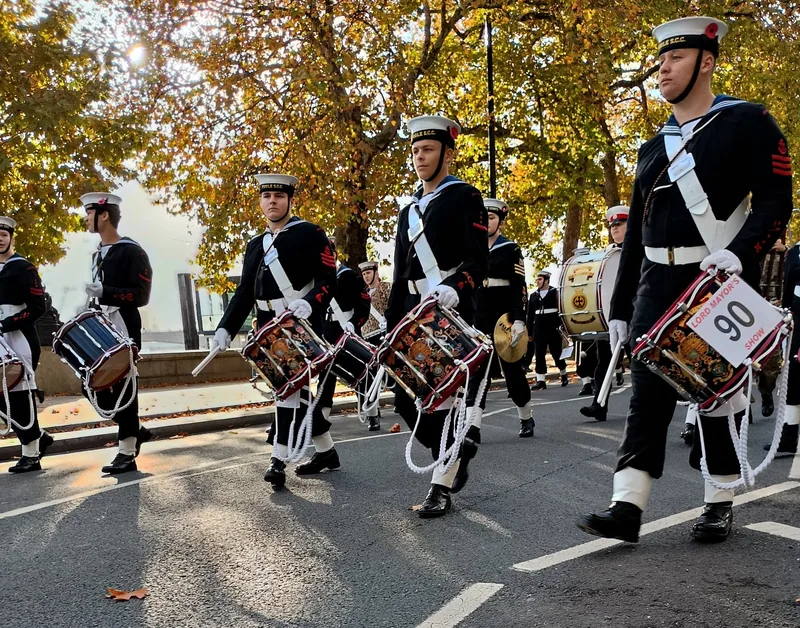
What passes is more varied than a military parade. There are City livery companies in their gowns, the Household Cavalry, the Pikemen and Musketeers of the Honourable Artillery Company in seventeenth-century dress, military bands, charities, schools, vintage vehicles, and floats built by companies and community groups. Then, at the end of the outward leg, the City's street cleaners, who get one of the day's biggest cheers.
The State Coach itself dates from 1757 and is kept at the Museum of London's collection for the rest of the year. It is drawn by six horses and is the thing most people come to see.
What to do afterwards
You are in the City on a Saturday, which is the one day of the week when the Square Mile empties out. That is either a problem or the point, depending on what you want.
At 3pm the City of London Guides lead free guided walks from No 1 Poultry, opposite Mansion House. It is an unusually good way to use the hour after the Show, and our overview of walking tours in London explains how the City's guiding scheme works.
Within a short walk are the Barbican Centre, Guildhall and the Roman amphitheatre beneath it, and the Tower of London. Note that the London Museum is in the middle of its move; its new West Smithfield home opens on 28 November 2026, a fortnight after the Show.
Many City cafés and sandwich shops close at weekends, so do not assume you will find lunch on the spot. Bring something, or walk towards St Paul's and One New Change, where the shops and restaurants stay open.
Frequently asked questions
When is the Lord Mayor's Show in 2026?
Saturday 14 November 2026, setting off from Mansion House at 11am. The Show is always held on the second Saturday in November. Full details of each year's procession, including the new Lord Mayor, are published around the beginning of October, once the election has taken place.
Do I need a ticket for the Lord Mayor's Show?
No. The procession is free to watch from the pavement along the whole route, and there are no grandstands to book. Blue Badge holders can apply in advance for a pass to a reserved viewing area near the Old Bailey.
Are there still fireworks after the Lord Mayor's Show?
No. The evening fireworks on the Thames were last held in 2017 and were subsequently discontinued on cost and crowd-safety grounds. The Show now ends in the early afternoon with the Lord Mayor's return to Mansion House.
How long does the procession take to pass?
From any one point, around an hour and a quarter on the outward leg. The first bands pass, then roughly a hundred floats and several thousand marchers, and the State Coach comes near the end. The whole day, outward and return, runs from 11am to about 2:30pm.
Is the Lord Mayor's Show good for children?
Yes, but choose the return leg on the Embankment rather than the crush at Bank. There is room to sit, bands and floats to look at, and space to move about between them. Bring warm clothes: mid-November in the City is cold, and you will be standing still.
Sources
- The Lord Mayor's Show - official site (checked September 2026)
- The Lord Mayor's Show - Timetable (checked September 2026)
- The Lord Mayor's Show - Where to go (checked September 2026)
- The Lord Mayor's Show - Getting to the Show (checked September 2026)
- The Lord Mayor's Show - Access (checked September 2026)
- The Lord Mayor's Show - Road closures (checked September 2026)