
The great majority of London hotel rooms hold two people and cannot be made to hold three. Beds for a third and fourth person exist in modern chain hotels, in purpose-built blocks beyond the centre and in the top-floor rooms of Victorian guest houses, but there are not many of them and they go months before ordinary doubles do. Search on the number of beds rather than the number of guests, and price one room against two before you commit.
The phrase "family room" has no fixed meaning in Britain. It is a marketing word, not a category, and the same words on two booking pages can mean a double bed with a folding bed squeezed beside it, a double plus a bunk, two double beds, or a genuine two-room suite. What you are buying is a bed count and a floor area, and everything else is decoration.
This page is about finding those rooms and choosing between the alternatives once you have. Which district to base a family in is a separate question, dealt with in our guide to family bases in London, and the days themselves are planned in London with kids.
Rooms for three or more: what to know first
- The standard room
- Two people. A booking form that accepts three does not prove three will fit
- "Triple"
- Usually a double bed plus one single, sometimes three singles
- "Family room"
- No standard definition. Ask for the bed configuration in writing
- "Quad"
- Four beds, most often two bunks or a double plus a bunk
- Extra bed
- Called a Z-bed, rollaway, put-up or sofa bed. Usually charged per night
- Cot
- Often free for a baby, must be requested, and takes up floor space you may not have
- Book by
- Three to six months ahead for school holidays; these are the first rooms to go
- Children on transport
- A paying adult can bring up to four under-11s free on the Tube and the buses
Why so few London rooms sleep more than two
Three things combine. Most central hotels occupy terraced houses whose bedrooms were divided once to add bathrooms and sometimes divided again; what is left is a rectangle that a double bed nearly fills. New hotels in central London are built on expensive land, and the commercial logic pushes towards more small rooms rather than fewer large ones. And a hotel's stated maximum occupancy for a room is not a suggestion: it follows from the fire risk assessment the operator is required to carry out for sleeping accommodation, which covers escape routes, alarms and how many people can leave the building safely.
That last point is the one to take seriously. If a hotel says a room takes two, it takes two, whatever the booking form lets you select and whatever the children's ages. Turning up as three for a room booked for two is not a negotiation you will win at 22:00, and the hotel is within its rights to charge for a second room if one is free.
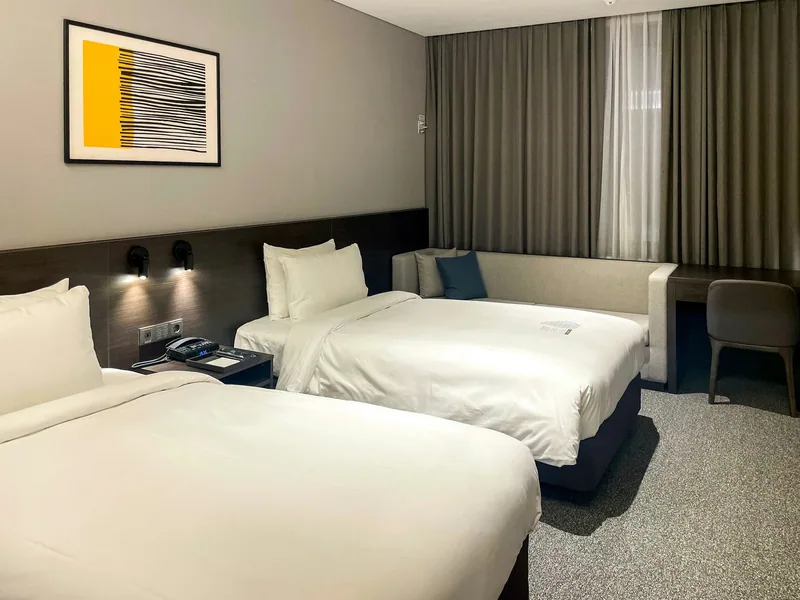
The words on the booking page, and what they hide
Search results are built around the number of guests, which is the wrong question. Two adults and two children can be shown a double room whose small print says nothing about a third person. Filter by room type and read the bed list.
| What it says | What it usually is | What to ask |
|---|---|---|
| Triple room | A double bed plus a single along the wall | Is the third bed a proper single or a folding one? |
| Family room | Anything from a double plus a sofa bed to two double beds | How many beds, of what width, and what is the floor area? |
| Quadruple / quad | Two bunk beds, or a double plus a bunk | Is there an upper age or weight limit on the top bunk? |
| Twin with extra bed | Two singles plus a rollaway wheeled in at night | Is there floor space for it with the cases in the room? |
| Studio or apartment | One room with a kitchen, and a sofa bed for the children | Is the sofa bed made up for you, and is bedding included? |
| Suite | Two connected rooms, one with a door that closes | Is the second room a bedroom or a sitting room with a sofa? |
| Interconnecting rooms | Two rooms with a private door between them | Are they guaranteed, or allocated on the day? |
Bed widths decide whether the room is comfortable or grim, and they are not fixed by anything: the National Bed Federation notes that even size tolerances have no legal standard here. A "double" is commonly around 135 cm, which two adults will put up with and an adult sharing with a restless eight-year-old will not. The whole range of names and widths is in our description of the standard London room.
The extra bed, and what it is called here
Britain has a small vocabulary for the third bed, and the words matter because they describe very different objects.
- Z-bed or rollaway. A folding frame on castors, wheeled in and made up in the evening. Fine for a child, thin and narrow for an adult, and it needs about a metre of clear floor.
- Put-up or sofa bed. A sofa that opens out. Comfortable versions exist; many are not. Ask whether it is made up before you arrive or whether you are expected to do it.
- Trundle or truckle bed. A low bed stored under another one and pulled out at night. Common in purpose-built family rooms.
- Bunk beds. Usual in quad rooms and hostels, and normally subject to a minimum age for the top bunk.
- Travel cot. A folding cot for a baby, supplied by the hotel on request. Often free, sometimes charged, and always finite in number.
None of these appears automatically. Each one is requested when you book, confirmed by the hotel, and billed if it carries a charge. Which charges are ordinary and which are not is set out in our page on what a rate leaves out.
A cot in a small double room leaves no room to open a suitcase. A travel cot is roughly a metre by 70 cm and has to stand away from the radiator, the window and the door. In a room of twelve or thirteen square metres, that is most of the clear floor. Travelling with a baby, ask how large the room is in square metres and place the cot in it mentally before you pay.
One room or two: the sum that actually decides it
Families reach for the family room because it sounds cheaper, and often it is not. Work it out with the numbers in front of you rather than assuming.
Here is an illustrative three-night stay for a couple with a seven-year-old and a ten-year-old. Say the family room is quoted at £260 a night and an ordinary double at £170. Three nights in the family room come to £780; three nights in two doubles come to £1,020. The single room wins by £240, and for three nights in four beds most families would take that.
Change one figure and it moves. Add £40 a night for the extra bed, then breakfast at £18 an adult and £9 a child, and the gap closes fast. Past four nights, two rooms with two bathrooms begin to look like the better bargain. The numbers to put in the sum are the extra-bed charge, breakfast for the children, whether the cot is free, and whether one of the options is far enough out to need a taxi home at midnight.
| Option | Works best when | What goes wrong |
|---|---|---|
| One family room | Two or three nights; children under about ten; a tight budget | One bathroom, one light switch, and everyone goes to bed at the same time |
| Two doubles | Four nights or more; teenagers; two adults who want an evening | Rarely adjacent unless requested early; two of everything to pay for |
| A one-bedroom apartment | Five nights or more; babies who nap; anyone who wants to cook | Often no daily housekeeping, and check-in may not be staffed |
| A hostel family room | Older children; a central address on a small budget | Bathrooms may be shared; the building is busy and young |
On the last of those, several London hostels sell private four-bed rooms that are larger than the equivalent hotel family room. On the third, the aparthotel category sets out the point at which a kitchen and a washing machine repay their cost, while renting a flat comes with rules of its own, among them the London limit of 90 nights in a calendar year before planning permission is required.
Connecting, adjoining and "we'll try": three different promises
These words are used loosely and mean different things.
- Interconnecting or connecting rooms share a private door, so you can move between them without going into the corridor. This is what most parents of young children actually want, and it is the rarest of the three.
- Adjoining or adjacent means next door with no connecting door. Useful, but a child cannot reach you without leaving their room.
- On the same floor is what you will usually be offered, and it is allocated on the day.
If a connecting pair matters to you, book it as a specific room type where the hotel sells one, get the confirmation in writing, and ring the hotel a week before arrival to have it noted again. A request stored on a booking site does not always reach the front desk. Many hotels also require an adult in each room where children are under a stated age, so ask that question too if you were planning to put two teenagers next door.
Ages: the number that changes the price
Enter each child's exact age in the search, not simply the number of people. Where a hotel draws the line between child and adult varies: 12, 16 and 18 are all used, and the line decides whether a child sleeps free, sleeps free but is charged for breakfast, or counts as a third adult.
Ask three things before you book. Do children stay free in a bed that is already in the room? Does a rate that includes breakfast include it for them as well? And is there a minimum age for the top bunk? Nothing about any of the three is standard across the city, and over four nights for a party of four they move the total by a noticeable amount.
Transport, by contrast, is generous, and it should change where you look. Up to four children aged under 11 ride free with one paying adult on the Tube, on the DLR, on Overground and Elizabeth line trains, and they need no card whatever to travel free on a bus or a tram. Between 11 and 15 there is the Young Visitor discount, added to an Oyster card by staff at a station, which halves the adult fares and the adult caps for a fortnight. The full rules are in our page on children's fares, and they are the reason a family base two or three stops out often works out better: looking beyond the boundary does that sum in detail.
Where the bigger rooms actually are
The pattern is consistent enough to plan around. Rooms for three and four cluster in newer buildings and away from the oldest streets.
- Purpose-built chain hotels, especially those put up since about 2000, hold most of London's family rooms. They are plainer than a townhouse hotel and far easier with children in tow. The main brands are described in our guide to the budget chains.
- Zone 2 station districts give you more floor for the same money, and because a day's capped travel across Zones 1 and 2 costs what Zone 1 alone costs, the extra distance is free.
- Guest houses in Victorian terraces usually keep one or two family rooms, generally at the top of the house and generally up several flights: see B&Bs and guest houses.
- Kensington, Bloomsbury and the South Bank put the free museums and the river within walking distance, which does more for a family day than a central postcode does. Weigh them up in our district comparison and in the South Bank guide.
What to avoid is the compact-room end of the market. Two is the hard limit in those rooms, there is no floor for a cot and no wall to put a third bed against, as our guide to pod and compact rooms explains.
Beds three and four disappear first in every school holiday. The February and late-October half-terms and the Easter fortnight empty London of anything that sleeps four long before doubles run short. Put a refundable four-bed room on hold the moment your dates are firm, then keep watching the price, which is the method set out in our page on cancellable rates.
Six questions to put in the booking message
- How many beds does the room contain, and how wide is each of them?
- How many square metres is it, bathroom included?
- Is the third or fourth bed a permanent bed or a folding one, and is it charged?
- Can you add a travel cot, is it free, and will it still leave floor space?
- Is breakfast included for children at the same terms as for adults?
- Which floor is the room on, and is there a lift?
Send those six lines as one email and keep the reply. It takes five minutes and settles almost everything that goes wrong with a family booking. The last question matters more than it sounds: a family room on the fourth floor of a house with no lift, reached with two suitcases and a pushchair, is a different holiday from the same room on the first floor.
Frequently asked questions
What is a family room in a London hotel?
There is no standard definition. In practice it usually means one room with a double bed and one or two extra beds, sleeping three or four. The bed configuration varies from hotel to hotel, so ask how many beds there are and how wide each one is rather than relying on the name.
Can three adults share a room in London?
Sometimes, in a triple room or a family room, but not in a standard double. Many central hotels have no rooms at all that take three, and the third bed, where it exists, is often a folding one. Check the stated maximum occupancy for the room type before booking, because it follows from the hotel's fire risk assessment.
Is one family room cheaper than two double rooms in London?
Often, but not always. Compare the total for the whole stay including the extra-bed charge and breakfast for children. For two or three nights the family room usually wins; from about four nights, two rooms with two bathrooms can cost little more and are considerably easier.
Do London hotels provide cots for babies?
Most will supply a travel cot on request, often free of charge, but numbers are limited and it must be arranged when you book rather than on arrival. Remember that a cot takes up a large share of the free floor in a small London room, so ask for the room's floor area at the same time.
How far ahead should I book a family room in London?
Three to six months for any school holiday, and at the earliest opportunity for Easter, the summer weeks and December. Four-bed rooms are a thin slice of London's stock, so on those dates they run out altogether rather than merely becoming dear.
Sources
- GOV.UK - Fire safety risk assessment: sleeping accommodation (checked September 2026)
- National Bed Federation - Regulations and standards (checked September 2026)
- Transport for London - Free and discounted travel (checked September 2026)
- Transport for London - Visitor Oyster card and the Young Visitor discount (checked September 2026)
- Transport for London - Fare capping (checked September 2026)
- Deregulation Act 2015, section 44 - short-term use of London residential premises (checked September 2026)
- GOV.UK - School term and holiday dates (checked September 2026)