
Very few London hotels have a swimming pool, and most of the ones that do have a small rectangle of warm water in a basement, ten to fifteen metres long, with no lifeguard, restricted hours for children and sometimes a charge. If what you want is a proper swim, the public pools are better and far cheaper: an adult swim at the Oasis centre in Covent Garden, which has a heated outdoor pool open all year, cost £5.80 in September 2026.
That is not a complaint about London hotels so much as a description of London buildings. A pool needs a large, structurally independent, waterproof volume with plant rooms attached, and almost nothing in central London was built with one. Where a hotel does have a pool it is usually because the building went up after about 1970, or because the hotel is expensive enough to have dug one out.
This page sets out what a hotel pool in London is actually like, which kinds of hotel and which parts of the city have them, the rules you will meet at the poolside and why they exist, and the public alternatives with their prices. For the rest of what a London hotel room does and does not contain, see our guide to what a London hotel room is like.
Hotel pools in London: the honest summary
- Typical length
- 10 to 15 metres, which is a third to a half of a public pool
- Typical location
- The basement, with no natural light
- Lifeguard
- Usually none. A trained member of staff is on call instead
- Children
- Often restricted to set hours, and always required to be accompanied
- Cost
- Free to guests at most chain hotels; charged at hotels where the pool is inside a health club
- Public alternative
- £5.80 for an adult swim at Oasis, Covent Garden, in September 2026, including its heated outdoor pool
What a London hotel pool is actually like
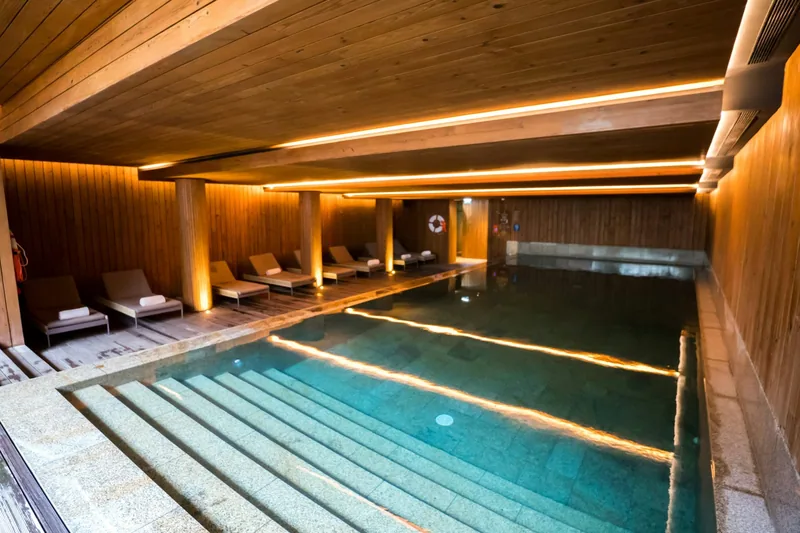
Picture a room rather than a facility. The water is warm, usually somewhere in the upper twenties Celsius, because the operators know most guests are there to soak rather than to train. It is between ten and fifteen metres long, so a length takes a few strokes and lane swimming is impossible if more than three people are in it. There is tiling, some downlighting, a row of loungers and often a sauna or a steam room in a cubicle beside it.
The hours are shorter than you expect: many open at six or seven in the morning and close at nine or ten at night, and some close for an hour in the middle of the day for cleaning. There is rarely a separate shallow pool, so a family with a small child shares the same water as everyone else. Towels are provided at the poolside in most hotels that have one, and the changing room is often just the bedroom.
None of that makes it worthless. A quarter of an hour in warm water after a day of walking is one of the better things a hotel can offer, and on a wet February afternoon with children it can rescue the day. Judge it as a warm bath you can swim three strokes in, not as a leisure centre, and you will not be disappointed.
Why there are so few, and why the star rating does not help
The national quality scheme is the clearest evidence here. VisitEngland's own standards for hotel accommodation describe a pool as the kind of facility hotels "often" have, but no star level from three to five requires one. What the criteria actually specify at five stars is air conditioning or mechanical ventilation, individually controlled heating, spacious bedrooms and a luxury suite. Nothing about water.
The practical consequence is that the star rating tells you nothing at all about whether there is a pool. A five-star townhouse hotel in Mayfair may have none, while a 1990s chain hotel beside a dual carriageway in Zone 3 may have a perfectly decent one. Filter for the pool itself, and ignore the stars while you are doing it.
Which parts of London actually have them
There are four broad groups, and they are geographically distinct.
| Where | Why the pool exists | What to expect |
|---|---|---|
| Docklands, Canary Wharf and around ExCeL | Purpose-built hotels from the 1990s onwards, designed for business guests who expect a gym | The best chance of a pool at a mid-range price, and often a gym worth using |
| Around Heathrow and the western approach | Large hotels built on cheap land for airline crews and conferences | Pools and gyms are common; the trade is being a long way from anything |
| Mayfair, Knightsbridge, Belgravia and the Strand | Hotels expensive enough to excavate a spa under the building | The best hotel pools in London, at the highest prices in the city |
| New blocks in Zones 2 and 3 | Recent towers and mixed-use developments with a residents' gym attached | Modern, small, sometimes shared with residents, sometimes charged for |
Our district guides cover what it is like to sleep in the first three of those: Canary Wharf, near ExCeL and Stratford, and near Heathrow. The fourth group is covered in our guide to London's grand hotels.
Aparthotels, otherwise the sensible choice for a longer stay, almost never have pools. Our guide to aparthotels and serviced apartments explains what they have instead.
The rules at the poolside, and where they come from
Visitors are often surprised that a hotel pool has no lifeguard, and sometimes assume the hotel is cutting corners. It usually is not. The Health and Safety Executive is explicit that there are no specific health and safety laws for swimming pools: operators work to their general duties under the Health and Safety at Work etc. Act 1974, and the measures they put in place follow from their own risk assessment. The HSE states plainly that "the law does not state what safety measures an operator must put in place".
On lifeguards specifically, the HSE says a risk assessment may find that constant poolside supervision is not required. In that case a member of staff must be on call and able to respond immediately whenever the pool is in use, and must be trained in pool rescue, resuscitation and first aid. That is the model almost every small hotel pool in Britain uses, and it is why the poolside is empty and there is a telephone or an alarm button on the wall.
Two other rules follow from the same source. There is no legal limit on how many young children one adult may take swimming, but the HSE expects operators to decide, as part of their risk assessment, how many under-eights can safely be in the pool with one adult during sessions that are not organised or taught. That decision is where a hotel's "one adult per two children" sign comes from. And water treatment is judged against the standards published by the Pool Water Treatment Advisory Group, which regulators treat as the benchmark: when a small pool closes at short notice "for maintenance", a water reading is usually the reason.
An unsupervised pool is the one place in a hotel where a rule is not bureaucracy. With no lifeguard on the poolside, the notice about children being accompanied is the whole of the safety system. Read the sign by the door rather than the brochure, and never let a child swim while you are in the sauna next door.
Six questions to ask before you book for the pool
- How long is it, in metres? A hotel that will not answer is telling you the answer.
- What are the opening hours, and does it close in the middle of the day?
- May children use it, and during which hours?
- Is it included in the room rate, or is it inside a health club with a day charge?
- Is it shared with residents or club members, and do they have priority?
- Is it open at all on your dates? A single small pool taken out of service for repairs cannot be replaced, and the hotel will not usually reduce the rate.
That last one is worth putting in an email. A pool is the commonest facility to be closed without warning, and it is the commonest reason a family arrives disappointed. What else can quietly change between booking and arrival is covered in our guide to hotel extras and hidden costs.
The public pools that beat most hotel ones
London's council-run pools are one of the city's genuine bargains, and two of them are in the middle of it. Prices below were read on the operators' own price pages in the week beginning 28 September 2026.
| Pool | Adult swim | Child swim | What you get |
|---|---|---|---|
| Oasis Sports Centre, 32 Endell Street, Covent Garden WC2H 9AG | £5.80 | £2.30 (5 to 15); under-4s free | A 25-metre indoor pool at 27°C and a heated outdoor pool at about 25.5°C, open all year, with an outdoor sauna included in the swim |
| Ironmonger Row Baths, Islington | £7.60 off-peak for a non-member | £4.60 (11 to 17) | A 1930s municipal baths with a pool and a Turkish bath suite |
The outdoor pool at Oasis is the one worth planning around. It is on a roof terrace off a Covent Garden side street, it is heated, it is open from half past six in the morning on weekdays, and it stays open through the winter. Swimming outdoors in the middle of London in January, ten minutes from the West End theatres, for less than the price of two coffees, is a better story than any hotel basement will give you. Note that the indoor pool there closes between sessions during the day, so check the timetable rather than turning up.
Further out, the 50-metre pool built for the 2012 Games is open to the public, and our guide to the London Aquatics Centre explains how the sessions work. For a wet afternoon with children, the swim is usually the best value on the whole list in our guide to rainy-day activities for children.
The lidos, and the ponds
London's outdoor pools are the reason many residents never use a hotel pool at all. Prices run from £5 for a swim in a bathing pond on Hampstead Heath to about £9.50 for a 50-metre lido, and some are heated while others are emphatically not. Tooting Bec Lido is 91 metres long, which is the length of three hotel pools end to end, and our guide to Tooting covers getting there. The full picture, including which pools stay open in January and where swimming is forbidden, is in our guide to London's swimming ponds and lidos.
In a hot spell the calculation changes completely, because a small unventilated basement pool is less useful than an open-air one and the hotel will be full of people who had the same idea. Our guide to London in a heatwave sets out what is open and what closes.
If you want the pool more than the address
Two strategies work better than hunting for a hotel with a pool in Zone 1. The first is to book a hotel in one of the purpose-built districts above and spend the extra twenty minutes travelling. The second is to book wherever you like and buy a day pass at a leisure centre or a hotel spa: many hotel spas sell entry to non-residents, which costs far less than the room and gives you the better pool.
If the reason you want water is that you cannot sleep in the heat, the pool is the wrong solution and cooling is the right one. Our guide to finding a London hotel with air conditioning deals with that directly, and it is the single feature most worth paying for in July. For families weighing a pool against space and a kitchen, our guides to where to stay with children and London with children set out the trade-offs.
Frequently asked questions
Do many London hotels have swimming pools?
No. A pool is unusual in central London, because almost none of the older building stock could accommodate one. They cluster in purpose-built hotels in Docklands and around Heathrow, in new blocks in Zones 2 and 3, and in the expensive hotels of Mayfair and Knightsbridge, which have excavated spas beneath them.
How big is a typical London hotel pool?
Ten to fifteen metres is usual, which is a third to a half the length of a public pool. Lane swimming is not realistic and a proper training swim is impossible. Treat it as warm water to soak in rather than as a pool to exercise in, and ask for the length in metres before you book if it matters.
Why is there no lifeguard at the hotel pool?
Because the law does not require one. The Health and Safety Executive says there are no pool-specific laws, and that a risk assessment may conclude constant poolside supervision is unnecessary provided a trained member of staff is on call and can respond immediately. Nearly every small hotel pool in Britain works that way.
Can children use a hotel pool in London?
Usually, but often only during set hours and always accompanied by an adult. The ratio on the sign, commonly one adult to two young children, comes from the hotel's own risk assessment, which the HSE expects operators to make. Check the hours before you book, because some hotels exclude children in the evening.
Is a public pool in London cheaper than a hotel with a pool?
Almost always, and usually much better. An adult swim at Oasis in Covent Garden was £5.80 in September 2026, in a 25-metre indoor pool plus a heated outdoor one that opens all year. Paying a higher room rate for a fifteen-metre basement pool rarely makes sense for more than one night.
Do hotel spas in London sell day passes?
Many do, and it is often the cheapest way to use a good hotel pool. You pay for entry rather than for a room, so you get the better water without the higher rate. Book ahead, since spa capacity is small, and check whether the price includes a treatment you do not want.
Sources
- Health and Safety Executive - Swimming pool safety management (checked September 2026)
- Health and Safety Executive - Health and safety in swimming pools (HSG179) (checked September 2026)
- GLL Better - Oasis Sports Centre, Covent Garden: prices (checked September 2026)
- GLL Better - Ironmonger Row Baths, Islington: prices (checked September 2026)
- VisitEngland Assessment Services - Quality standards for hotel accommodation (checked September 2026)
- City of London - Swimming tickets, Hampstead Heath (checked September 2026)