
Most London hotels do not take dogs. Of the ones that do, the published charge is usually somewhere between £15 and £20 per animal per night, and the rules are stricter than owners expect: no dogs in the bar or the breakfast room, dogs on a lead in every public area, and never an animal left alone in the room. Assistance dogs are a different matter entirely, and they are admitted free.
The first thing to understand is that British hotels are not uniform about this. The country's two largest budget chains take opposite positions: Travelodge accepts pets in every room for a fee, and Premier Inn bans them outright apart from assistance dogs. Policy is set at company level in the chains and at the owner's discretion everywhere else, so there is no general rule you can rely on.
This page is about the accommodation only. Bringing an animal into Britain is a bigger subject involving a microchip, a rabies vaccination, a document and a tapeworm treatment, and it is all in our guide to travelling to London with a pet, along with the rules for dogs on the Tube and the buses.
Dogs in London hotels, in short
- Published charges
- Motel One £15 per pet per night; Roomzzz £20. Travelodge charges for a pet extra but does not publish the amount
- Usual maximum
- Two animals per room
- Almost always forbidden
- Leaving an animal alone in the room, at any time
- Usually forbidden
- Dogs in the bar, cafe or restaurant areas
- Assistance dogs
- Admitted free, including where pets are banned. Tell the hotel in advance anyway
- Emotional support animals
- Not treated as assistance dogs in Britain, and charged as pets
What "pet friendly" means on a booking site, and what it does not
A filter on a booking site is a marketing label, not a contract. Behind it you may find dogs accepted in two ground-floor rooms only, a weight limit, a limit of one animal, a refundable damage deposit, a non-refundable cleaning fee, or a policy that applies at the sister hotel but not at this one.
Get the answer from the hotel in writing before you pay, naming the breed, the weight and the number of animals. If a listing will not confirm it, treat that as your answer. Our guide to booking traps and accommodation scams covers listings that promise more than the property delivers.
What the chains actually publish
These are the policies we read on the companies' own terms and information pages in September 2026. Policies change, so check the current terms before you book, and note that the two biggest British budget chains take opposite positions.
| Chain | Published position, September 2026 | The detail that matters |
|---|---|---|
| Travelodge | Pets allowed if you buy the pet extra when you book | Every room in every hotel is a pet room, so the chain states it cannot guarantee an allergy sufferer a room no animal has used |
| Premier Inn | No pets on the premises at all, other than assistance dogs | The ban is in the booking terms, so an individual manager cannot waive it |
| Motel One | £15 per pet per night in the United Kingdom | Mention the dog when you book. Guide dogs for blind or deaf guests are free and admitted at any time |
| Roomzzz Aparthotels | £20 per pet per night on a short stay, maximum two per room | A longer stay is charged differently: a one-off £50 fee plus a £50 cleaning fee at check-out. London Stratford is the pet-friendly London address |
One word on provenance. Premier Inn's own website times out for automated requests, so we read the clause on an Internet Archive copy of its booking terms dated 26 September 2026. The sentence is unambiguous: guests must not bring any pets onto the premises, with the exception of assistance dogs.
Two patterns emerge from those four. The charge is per animal and per night rather than per stay, so a week with two dogs can add more to the bill than an extra person would. And the budget end of the market is where a flat, company-wide answer is most likely, while the middle is where the answer varies hotel by hotel. Our guide to British hotel chains explains what each brand is like to sleep in, and hotel extras and hidden costs covers the rest of the final bill.
The rule that catches owners out: you cannot leave the dog in the room
Almost every British hotel that accepts pets forbids leaving an animal unattended in a bedroom or a public area at any time. The reasons are practical: housekeeping has to be able to enter, a barking dog on the fourth floor is audible on the third, and a fire evacuation with a loose animal in a corridor is a serious problem.
The consequence is easy to miss. You cannot go to a museum, a theatre or a restaurant while the dog sleeps upstairs, because almost no paid attraction admits dogs either. A city break with a dog is a walking, park and outdoor-table holiday, and if that is not the trip you had in mind, boarding the animal at home is kinder all round.
The unattended-animal rule is a term of the contract, not a guideline. Breaching it can mean being asked to leave, forfeiting a non-refundable rate and paying a cleaning charge, and the hotel is within its rights. Plan the day around the dog rather than around the room.
Assistance dogs are not pets, and the law treats them differently
A hotel is a service provider under the Equality Act 2010, and section 29 makes it unlawful for a service provider to discriminate against a disabled person in the provision of a service. Refusing entry to a person with an assistance dog, or charging extra for the dog, is the standard example of what that prohibition catches. All four chains above admit assistance dogs free, including Premier Inn, which bans pets altogether.
Tell the hotel in advance even so, because it will want to note the room, brief the staff and warn the bar or breakfast room. And if your animal is a trained assistance dog, say so in those words. Our guide to accessible London covers the wider set of questions worth asking a hotel before you arrive.
An emotional support animal is not an assistance dog in Britain, and will be charged as a pet. Travelodge's terms say so in as many words: "emotional support animals are not considered Assistance Animals, and will be subject to applicable charges." A chain that bans pets can therefore refuse one. If the distinction matters to your trip, settle it in writing with the hotel before you travel, not at the desk on arrival.
Why an apartment usually beats a hotel
For anything longer than two nights, a serviced apartment or aparthotel is generally the easier answer. The rooms are bigger, there is a kitchen so you are not dependent on restaurant terraces, and the staff are used to longer stays with animals in them. Roomzzz, for instance, treats every apartment as pet-friendly rather than setting aside a few rooms.
The trade is that a nightly cleaning fee may become a one-off fee plus a charge at the end, so work out the total rather than comparing the nightly rate. Our guides to aparthotels and serviced apartments and to apartments and short lets explain how the two categories differ, including the ninety-night rule that governs short letting in London.
Where you can walk a dog near the main hotel districts
This is the part that makes or breaks the trip, because a dog needs three walks a day and central London is mostly pavement. The good news is that the Royal Parks are open to dogs and several of them are within ten minutes of the busiest hotel districts.
- Mayfair, Marylebone and Paddington. Hyde Park and Kensington Gardens give you several miles of paths and a lake, and they are the largest piece of walkable green space in the middle of London.
- Westminster and St James's. Green Park and St James's Park are small and busy, with a great many waterfowl, so a lead is sensible rather than optional.
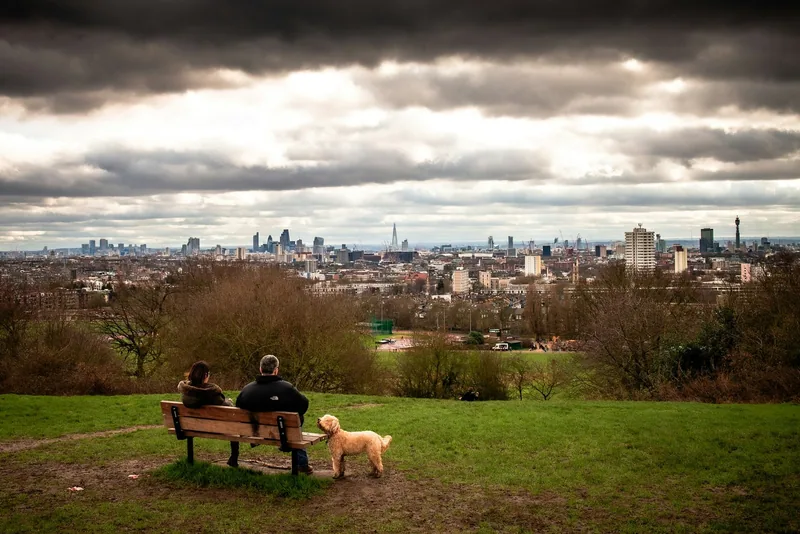
- Camden, Hampstead and the north. Hampstead Heath is the most dog-centred large open space in London and the reason many owners base themselves up there.
- Shoreditch, Hackney and the east. Victoria Park is flat, large and ringed by paths, with the two children's playgrounds closed to dogs.
- South-east London. Oxleas Wood is an ancient wood with miles of walking, and dogs on leads are allowed in the tea room courtyard beside the tower, which is unusual. Our page on Severndroog Castle and Oxleas Wood has the practical details.
- Richmond and the south-west. Richmond Park has the strictest rules in London because of its deer: leads everywhere from 1 May to 31 July, leads near deer, water and skylark areas at other times, and no dogs in Pembroke Lodge Gardens. The azalea garden inside it has its own rules, set out in our guide to the Isabella Plantation.
Two places in London where owners are regularly turned away are worth knowing before you travel out to them. The wetland reserve at Barnes admits no dogs except trained assistance dogs, and it will not let you leave one in a car in its car park either; our page on the WWT London Wetland Centre explains why. The reservoirs at Walthamstow take the same line, because they supply drinking water.
Carry bags, and use them. Failing to clear up after a dog is an offence, and in Westminster it carries an on-the-spot £100 fixed penalty notice, or prosecution and a fine of up to £1,000. The council's own wording is blunt: once you walk away from it, the offence has been committed. Other boroughs set their own amounts, so read the signs.
Eating and drinking with a dog
Pubs are the happy surprise of a London trip with a dog, and many keep a water bowl by the door. Restaurants are usually a no, food halls and markets almost always, and a hotel's own bar very often, even where the bedroom is a yes. Outdoor tables solve most of it in warm weather, and our guide to London beer gardens is the place to start.
What four nights with one dog actually costs
Work from a band rather than a rate. Our own estimate for a mid-range double in central London in September 2026 is £130 to £190 a night, and it moves with the school holidays, an arena concert or a big fixture, and any week when a trade fair fills the exhibition centres. Take the middle of that band, £160, and four nights is £640. Add a pet charge of £15 a night and it becomes £700. Add a second dog and it is £760. A refundable damage deposit, often £50 to £100, may also sit on your card until after check-out.
Against that, our estimate for a central aparthotel in the same month is £160 to £220 a night. At £190 with a £20 nightly pet charge, four nights comes to £840, but it includes a kitchen, which takes two restaurant meals a day out of the budget. For a longer stay the apartment usually wins outright. Run both totals, because the nightly rate on its own will mislead you.
Eight questions to ask before you pay
- Is the charge per animal, per night, or per stay?
- Is there a weight or breed limit, and a maximum number of animals?
- Is there a deposit, and is it refundable or a cleaning fee?
- Which rooms take dogs, and are they on the ground floor or beside the lift?
- May the dog be in the bar, the lounge or the breakfast room?
- What is the rule if we need to leave the room for an hour?
- Is there anywhere on site for the dog to relieve itself, and where is the nearest green space?
- If our animal is an assistance dog, what do you need from us in advance?
Frequently asked questions
Do London hotels charge extra for dogs?
Usually, yes. In September 2026 Motel One published £15 per pet per night in the UK and Roomzzz £20, and Travelodge sells a pet extra without publishing the price. Some hotels add a refundable damage deposit on top. A few independents take dogs free, but assume a fee and confirm the amount in writing.
Which British hotel chains accept dogs?
It varies sharply. Travelodge accepts pets in every room if you buy the pet extra; Premier Inn bans them except for assistance dogs; Motel One charges £15 per pet per night and Roomzzz £20. Aparthotels are the most consistently pet-friendly category. Check the current terms for the specific hotel rather than the brand.
Can I leave my dog alone in the hotel room?
Almost never. The standard term forbids leaving an animal unattended in a bedroom or a public area at any time, so housekeeping can work and so a barking dog does not disturb other guests. Plan a trip in which the dog comes with you, because very few paid attractions admit dogs.
Can a hotel refuse my assistance dog?
A hotel is a service provider under the Equality Act 2010, and section 29 makes it unlawful to discriminate against a disabled person in providing a service. All four chains named on this page admit assistance dogs free of charge, including Premier Inn, which admits no other animals. Tell the hotel in advance so the room and the staff are prepared.
Are emotional support animals treated as assistance dogs in Britain?
No. British practice distinguishes a trained assistance dog from an emotional support animal, and Travelodge's terms say so explicitly and charge for the latter as a pet. A chain that admits no pets can therefore refuse one. Settle the point in writing with the hotel before you travel rather than at the desk.
Where can I walk a dog in central London?
Hyde Park and Kensington Gardens together are the largest option, with several miles of paths. Green Park and St James's Park are closer to Westminster but small and crowded. Further out, Hampstead Heath in the north and Victoria Park in the east are both large and dog-friendly, and Richmond Park allows dogs under strict rules because of its deer.
Sources
- Equality Act 2010, section 29 - provision of services (checked September 2026)
- Travelodge - Booking terms and conditions, clause H, pets and other animals (checked September 2026)
- Premier Inn - Booking terms and conditions (Internet Archive copy, 26 September 2026) (checked September 2026)
- Motel One - Frequently asked questions, pet charges (checked September 2026)
- Roomzzz Aparthotels - Pet charges and house rules (checked September 2026)
- The Royal Parks - Richmond Park visitor questions, dogs and deer (checked September 2026)
- GOV.UK - Equality Act 2010 guidance (checked September 2026)
- Westminster City Council - Dog fouling and fixed penalties (checked September 2026)