
Clerkenwell is the small district between Holborn and the City, and the reason to sleep here is Farringdon station: five separate services, including the Elizabeth line and Thameslink, which between them reach Heathrow, Gatwick and Luton without a change. It is a design and restaurant district on a working weekday and almost residential at the weekend, which is exactly when the rooms are cheapest.
Very few visitors think of it as an area to stay, which is why it is worth a page. It is Zone 1, it has the best rail connections of any inner-London hotel district, and it has more good places to eat within five minutes of a bed than anywhere else in the City fringe.
Our guide to Clerkenwell as a neighbourhood covers what is here: St John's Gate, the Charterhouse, the Italian church and the design showrooms. What follows is how it works as a base.
Clerkenwell and Farringdon as a base
- Fare zone
- Zone 1 throughout. Adult daily cap £8.90 (2026)
- Lines at Farringdon
- Elizabeth line, Thameslink, Circle, Hammersmith & City and Metropolitan
- Single to Oxford Circus
- £3.10 peak, £3.00 off-peak. About 11 minutes with one change, or 3 minutes to Tottenham Court Road on the Elizabeth line
- Airports without changing
- Heathrow on the Elizabeth line; Gatwick and Luton on Thameslink
- Step-free
- Yes. Farringdon has eight lifts in TfL's station data and is step-free from street to platform
- Night Tube
- None. No line through Farringdon runs a Friday and Saturday night service
- Best for
- Early flights, weekend breaks, eating well, and anyone who hates changing trains with luggage
The station is the reason, and here are the numbers
Farringdon is the only station in London where the Elizabeth line and Thameslink meet, and that combination is what makes the area worth considering.
Heathrow. The Elizabeth line runs straight through from Farringdon to every Heathrow terminal, six trains an hour, all calling at Terminals 2 and 3, four continuing to Terminal 4 and two to Terminal 5. No change with a suitcase, and every Heathrow station is step-free from train to street. TfL gives Paddington to Terminals 2 and 3 as 28 minutes, and Farringdon is three stops east of Paddington on the same line.
Gatwick. Thameslink runs from the same station. TfL's journey planner gives about 46 minutes from Farringdon to the airport, of which 40 is the train. From the central Thameslink stations the pay as you go fare is £19.20 at peak times and £10.70 off-peak, which makes the off-peak train one of the cheapest airport journeys in London. Our guide to Gatwick to central London compares it with the express.
Luton. The same line northbound, and it runs through the night, which no Underground line here does. That is worth real money for a 06:00 departure.
Three airports, no changes, from one Zone 1 station. No other hotel district in London can say that. If your trip involves an early flight at one end and a late arrival at the other, the saving in taxis and stress is larger than the difference in room rates.
For the lines themselves, see our guides to the Elizabeth line and to Thameslink.
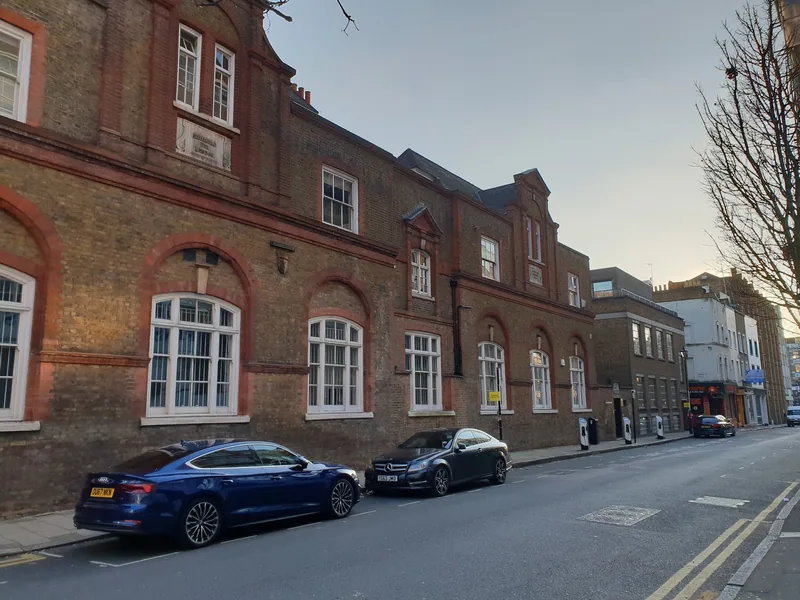
Photo: Chris Wood · CC BY-SA 4.0 · Wikimedia Commons · resized
The weekend, which is the cheap half of the week
Clerkenwell's hotels were built or converted for the architecture, media, legal and financial trade that works here Monday to Thursday. From Friday afternoon the district empties of workers, and what is left is a small resident population, the restaurants and the pubs. Rates follow.
The bands below are our own estimate from the market in September 2026 rather than a published tariff. What moves them, in order: the day of the week, whether a large trade event is on in the City, and the season.
| Band (our estimate, September 2026) | What it usually buys here |
|---|---|
| Under £120 | A weekend night in a budget or compact-room hotel, often in a converted office block |
| £120 to £200 | A weekend night in a design-led or warehouse-conversion hotel, or a studio in an aparthotel |
| £200 to £320 | The same room midweek, or a one-bedroom serviced apartment at the weekend |
| Over £320 | Midweek in the design or conference season, when the whole district is full |
One week in May is the exception to everything: Clerkenwell Design Week fills every room in the area, as our neighbourhood guide explains. If your dates are flexible, avoid it. If they are not, book it early.
Where within the area to sleep
Around Farringdon station and Cowcross Street. The most convenient and the noisiest. Good for an early train, less good for a lie-in.
Clerkenwell Green and St John Street. The prettiest streets, the most converted warehouses, and the best walk to dinner. This is where we would look first.
Rosebery Avenue and the Exmouth Market end. More residential, a short walk further out, and next to the best cluster of small restaurants in the district: see Exmouth Market.
The Barbican and Smithfield side. Quiet at night in a way that surprises people, because it is almost entirely offices and flats. The London Museum opens in the old General Market building on 28 November 2026, which will change the feel of these streets considerably.
Two specific noise problems
Both are avoidable if you know about them, and neither appears in a hotel description.
Smithfield trades at night. The wholesale meat market runs from midnight to 7am, Monday to Friday, with lorries and loading bays on Charterhouse Street and West Smithfield. A room facing those streets on a weekday night will hear it. At weekends the market is closed and the problem disappears entirely. The traders have agreed to move to the Royal Docks and will stay until at least 2028, so this is a live consideration for now.
The main roads cut the district in three. Farringdon Road, Clerkenwell Road and Rosebery Avenue all carry heavy traffic through the night. Behind them the side streets are genuinely quiet, so a courtyard or rear-facing room is worth asking for by name.
Getting home late, which is the real weakness
Farringdon has no Night Tube. None of the five services through the station runs on a Friday or Saturday night, which means that after the last trains your options are a night bus or a taxi. Five night bus routes stop within about 300 metres of the station, the N8, N25, N55, N63 and N242, and they cover the Strand, Oxford Street, the City and the East End between them. Our guide to London night buses explains how they work, and getting home late in London covers the rest.
If late nights are central to your trip, Holborn ten minutes' walk west has Night Tube on two lines, and Islington has night buses along Upper Street all night.
Eating, which is the other reason to stay
This is the strongest argument for Clerkenwell after the station. Within ten minutes of most of the hotels you have Exmouth Market, St John Street, Leather Lane and Whitecross Street, and the food is a long way above what the same walk buys you in Covent Garden. Our guides to Leather Lane and shopping in Clerkenwell and to the pubs of Clerkenwell have the detail.
The weekday pattern is worth knowing: the street-food stalls on Leather Lane and Whitecross Street run at lunchtime on working days and not at weekends, while the restaurants do the opposite, being quietest on a Monday. A Sunday here is calm rather than dead, because enough people live in the area to keep the pubs and a few cafés open.
What to ask before booking
- Is the room at the front, and is the front on Charterhouse Street? The market's working hours make this the single most useful question in the district.
- Is it a warehouse conversion, and where is the lift? Some converted buildings have a lift that stops one floor short, and old industrial windows are single-glazed.
- Is it an aparthotel or a hotel? Clerkenwell has an unusual number of serviced apartments, which suit longer stays: see aparthotels and serviced apartments.
- Is breakfast served at the weekend? In a district built around office trade, some hotel restaurants keep shorter weekend hours.
- Do you need step-free access? Farringdon itself is step-free, which is unusual in central London, but many of the buildings around it are not: see step-free transport in London.
Who it suits
Stay here if
- You have an early or late flight from Heathrow, Gatwick or Luton
- Your trip is Friday to Monday, when the rates fall
- You want to eat well without booking a table across town
- You need a step-free station in Zone 1
Look elsewhere if
- You will be coming home after the last train on a Friday or Saturday
- You want the river, a park or a view
- Your week is built entirely around the West End theatres
- You are here for Clerkenwell Design Week without having booked months ahead
To weigh it against the alternatives, see our comparison of the best areas to stay in London.
Frequently asked questions
Is Farringdon a good place to stay in London?
For anyone flying in or out, it is one of the best. Five services meet at the station, including the Elizabeth line to every Heathrow terminal and Thameslink to Gatwick and Luton, all without changing. It is Zone 1, the restaurants are good, and the main drawback is that there is no Night Tube.
How long does it take from Farringdon to Heathrow?
The Elizabeth line runs direct, six trains an hour, all calling at Terminals 2 and 3. TfL gives Paddington to Terminals 2 and 3 as 28 minutes, and Farringdon is three stops east of Paddington on the same line, so allow around 40 minutes plus the walk to the station. Peak fares apply to Heathrow at all times of day.
Is Clerkenwell quiet at night?
Mostly, with two exceptions. Farringdon Road, Clerkenwell Road and Rosebery Avenue carry traffic all night, and Smithfield meat market works from midnight to 7am from Monday to Friday, with lorries on Charterhouse Street. Ask for a rear-facing room and both problems largely go away.
Is Clerkenwell cheaper than the West End?
Usually at weekends, when the business demand that fills these hotels has gone home, and often not midweek. The exception is Clerkenwell Design Week in May, when the district is the most expensive place in London relative to its usual rates. Always price your own dates rather than trusting a rule.
Can I walk from Clerkenwell to St Paul's and the City?
Yes. TfL gives about ten minutes on foot from Farringdon station to St Paul's, and the Barbican and the Museum of the Order of St John are both closer than that. Walking east or south from here is quicker than taking a train for almost anything in the City.
Sources
- Transport for London - Daily and weekly fare caps (checked September 2026)
- Transport for London - Single Fare Finder, Farringdon fares (checked September 2026)
- Transport for London - Journey Planner (sample journeys, Tuesday 29 September 2026, 11:00) (checked September 2026)
- Transport for London - The Elizabeth line to and from Heathrow (checked September 2026)
- Transport for London - detailed station data: lifts, ramps and step-free routes (checked September 2026)
- Transport for London - Night Tube lines and stations (checked September 2026)
- London Museum - opening at West Smithfield, 28 November 2026 (checked September 2026)