
The Freud Museum is the Hampstead house in which Sigmund Freud lived out his final year, and where his consulting room (couch, rug, desk and antiquities) was reassembled exactly as it had stood in Vienna. It opens Wednesday to Sunday, costs £16.90 for an adult with the donation, and an unhurried visit takes about ninety minutes.
Freud was 82 when the Nazi annexation of Austria in March 1938 forced the family out. Unusually among refugees, they were allowed to bring their possessions, which is why the study at 20 Maresfield Gardens is not a reconstruction with borrowed props. The furniture, the books and roughly two thousand antiquities are the originals, arranged as they were at Berggasse 19.
Our survey of small museums across the city gives it a short entry. This page goes further: how much time each part of the house needs, what the donation price actually means, the stairs problem, and why 2026 is an unusual year to come.
The Freud Museum at a glance
- Address
- 20 Maresfield Gardens, Hampstead, London NW3 5SX
- Open
- Wednesday to Sunday, 10:30 to 17:00. Closed Monday and Tuesday
- Adult ticket
- £16.90 with the voluntary donation, £14.90 without (September 2026)
- Concessions
- £14.90 / £12.90; young person 12–16 £11.00 / £9.00; under-12s free
- Booking
- Online in advance, but drop-in visitors and same-day bookings are accepted
- Suggested time
- At least an hour; two hours to see every room and the film
- Nearest station
- Finchley Road (Jubilee and Metropolitan lines), 5 minutes' walk
The two prices, and which one to pay
Every ticket is listed twice. The higher figure includes a voluntary donation; the lower one does not. In September 2026 an adult paid £16.90 with the donation or £14.90 without, a concession £14.90 or £12.90, and a young person aged 12 to 16 £11.00 or £9.00. Children under 12 go in free, as do members and patrons.
Nobody will press you. The museum is a registered charity that receives no direct public funding and pays its way almost entirely from tickets and shop sales, which is worth knowing when you choose. The concession rate covers students with valid ID, people over 65, UK unemployed visitors and disabled visitors, and proof is asked for at the desk.
Two discounts are easy to miss. A National Art Pass gives 50% off the standard adult rate. Museums Association and ICOM members select their own ticket type when booking online and show the card on arrival. Visitors who need a carer or companion can add a free Disabled Companion ticket at the point of booking.
The audio guide costs nothing extra, but bring your own headphones. It streams to your phone and is included in admission. The rooms are small and quiet, so the museum asks you not to play it aloud, and there are no headphones to borrow at the desk.
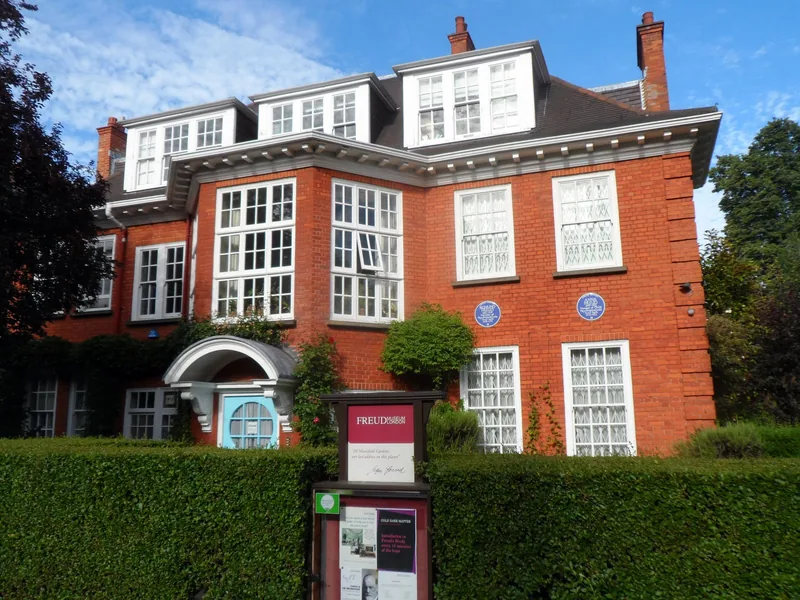
Photo: Spudgun67 · CC BY-SA 4.0 · Wikimedia Commons · resized
Thirty minutes, ninety minutes or two hours
The museum itself publishes a tiered plan, and it is a sensible way to think about the visit.
If you have half an hour, go straight to the study on the ground floor. The couch is there, covered by its Iranian rug and piled with cushions, and so is the desk with Freud's favourite antiquities lined up facing his chair. The chair itself is the oddest object in the room: a high-backed, almost human-shaped piece designed for him by the architect Felix Augenfeld so that he could sit with his legs hooked over one arm, which is how he liked to read.
If you have an hour, start in the dining room instead. It holds Edmund Engelman's photographs of the Vienna apartment, taken secretly just before the family left in 1938, so you see the rooms that the London study was copied from. There is also a Lucian Freud drawing, Palm Tree, that Anna Freud bought from her nephew's first solo show in London in 1944, hung among painted 18th-century furniture brought from the family's Austrian country cottage.
If you have ninety minutes, add the first floor: the family tree and photographs on the landing, then Anna Freud's room with her own couch and the collections from her pioneering work in child analysis. In the next room a 20-minute film uses her voice, a rare recording of her father speaking, and footage from Vienna and London. On the landing, look for the Wolf Man's painting of his dream of wolves in a tree, made by one of Freud's most famous patients, and a portrait of Freud by Salvador Dalí, who met him in London in 1938.
If you have two hours, you can add the temporary exhibition room, the half-landing reading spot, the shop and the garden.
2026: forty years, and forty objects out of the study
The house stayed a family home until Anna Freud died in 1982; she left it to become a museum, and it opened to the public in 1986. That makes 2026 its fortieth year, and the museum is marking it with an exhibition called 40 Objects, 40 Years, which brings some of Freud's most precious antiquities out of the study to be examined at close range, alongside domestic objects and items that have never left storage.
There is a catch worth knowing before you buy a ticket: the anniversary exhibition is displayed on the first floor, and the museum states plainly that there is no step-free access to it. A separate temporary exhibition programme also runs through the year (Freud and Latin America was showing in September 2026), and all exhibitions are included in the admission price.
The stairs, and what the museum does about them
This is a substantial Victorian family house, and the first floor is reached by stairs with no lift. The ground floor, which includes the study, the dining room and the shop, is the part most visitors come for, and that is the part that can be reached most easily.
For anyone who cannot manage the upper floor, the museum provides exhibition handouts covering what is up there. Visitors with access requirements are asked to call ahead on 020 7435 2002 so that staff can prepare, and disabled visitors may park in the museum's own driveway rather than hunting for a space in the street. Our guide to accessible London sets out the wider position on historic houses, which is rarely good.
The first floor is where Anna Freud's story is told. If stairs are impossible, you will see the couch and the antiquities but miss the room that explains why the house matters twice over. Ask at the desk for the handouts before you go in, not after.
Booking, changing your mind and turning up on spec
Tickets are sold online through the museum's own site, and that is the safest way to guarantee entry on a Saturday or during a run of good weather. But the museum is clear that drop-in visitors and last-minute bookings are welcome, so if you find yourself in Hampstead with a free afternoon, walk up and ask.
Admission tickets are non-refundable. They can, however, be moved: email the museum and they will change the date and time of your visit. American Express is accepted for admission, which is not universal among small London museums.
Groups can book the entire house for a timed session and have it to themselves, with the option of a subject specialist to lead the visit — an expensive but genuinely different way to see the study, and popular with university and clinical groups.
Coffee, the shop and the garden
There is no café. Hot drinks and bottled water are sold inside, and the gift shop takes both cash and card. It is better than most museum shops of this size, heavy on psychoanalytic texts and the sort of postcard people actually keep. You can order online in advance and choose collection in store, then pick the parcel up as you leave.
The garden is Freud's own, and on a warm day you are welcome to sit in it. Free wi-fi covers the building. For lunch, the cafés of Hampstead village are ten minutes uphill, and Hampstead Heath is a twenty-minute walk east.
Getting to Maresfield Gardens
Finchley Road station, served by the Metropolitan line and the Jubilee, is nearest at roughly five minutes on foot. Hampstead on the Northern line and Finchley Road & Frognal on the Overground are both around ten minutes. Buses 13, 113, 187, 268 and C11 all stop on Finchley Road. Our Underground guide explains which of those lines is fastest from central London.
Driving is awkward. Maresfield Gardens is residents-only from Monday to Friday between 09:00 and 18:30, with pay-and-display at the southern end of the street and on Nutley Terrace. There is a bike rack in the driveway to the right of the house.
What to combine it with
The museum takes an hour and a half, which leaves most of a day. The natural pairing is Keats House, twenty minutes away on the far side of the village — two houses, two writers, two very different kinds of grief, and both with restricted opening days that need checking together.
If it is the history of medicine and the mind that brings you here, three other places go deeper. Wellcome Collection on Euston Road is free and covers the body and the clinic; the Old Operating Theatre Museum near London Bridge preserves a surgical theatre from before anaesthetics; and the Hunterian Museum at the Royal College of Surgeons holds an 18th-century anatomical collection, free but not for every visitor.
For another house museum with one overwhelming interior, try Sir John Soane's Museum in Holborn or Leighton House in Holland Park. Dennis Severs' House in Spitalfields is the strangest of the lot. Hampstead itself is covered in our neighbourhood guide, and for a wet afternoon there are more ideas in our rainy-day guide. Evening events here are ticketed separately; our round-up of museum lates has the alternatives.
Frequently asked questions
Is Freud's actual couch in the museum?
Yes. The psychoanalytic couch on which his patients lay in Vienna was shipped to London with the rest of the family's belongings in 1938 and stands in the study on the ground floor, with its Iranian rug and cushions. It is not roped off behind glass, but you cannot sit on it.
How much does the Freud Museum cost?
In September 2026 an adult ticket cost £16.90 including the voluntary donation, or £14.90 without it. Concessions were £14.90 or £12.90, young people aged 12 to 16 paid £11.00 or £9.00, and children under 12 were free. A National Art Pass gives 50% off the standard adult price.
Which days is the Freud Museum open?
Wednesday to Sunday, 10:30 to 17:00. It is closed every Monday and Tuesday, and it publishes separate holiday hours for Easter and Christmas each year, so check the visit page if you are coming around a bank holiday.
How long should I allow for a visit?
The museum recommends at least an hour. Half an hour is enough for the study alone, ninety minutes covers the dining room, the study, Anna Freud's room and the family film, and two hours lets you add the temporary exhibition, the shop and the garden.
Is the Freud Museum suitable for children?
Under-12s go in free, and the house is calm and quiet rather than hands-on. There is nothing to touch and nothing designed for young children, so it suits teenagers with an interest in the subject far better than primary-age visitors. The Heath, ten minutes away, is the obvious counterbalance.
Sources
- Freud Museum London - Visit (checked September 2026)
- Freud Museum London - What to see when you visit (checked September 2026)
- Freud Museum London - About us (checked September 2026)
- Freud Museum London - 40 Objects, 40 Years (checked September 2026)