
Benjamin Franklin House at 36 Craven Street, a minute from Trafalgar Square, is the only home Franklin lived in that still stands anywhere in the world. He rented rooms here for sixteen years before the American Revolution. Entry is £10 for a self-guided visit on Wednesday, Thursday, Saturday and Sunday, or £14 for the Friday architectural tour.
Franklin arrived in London in 1757 as an agent for the colony of Pennsylvania and stayed, on and off, until 1775, which is a good deal longer than most visitors expect. He lodged with a widow named Margaret Stevenson and became part of her household. He was in this building when the argument between Britain and its American colonies moved from a tax dispute to a war.
The house is a narrow Grade I listed Georgian townhouse over five floors, deliberately left with bare boards and unrestored surfaces rather than dressed up with furniture. That is either the most atmospheric thing about it or the most disappointing, depending on what you came for.
Benjamin Franklin House at a glance
- Address
- 36 Craven Street, London WC2N 5NF, off the Strand behind Charing Cross station
- Self-guided visit
- Wednesday, Thursday, Saturday and Sunday. Adults £10, concessions £8, 11 and under free (September 2026)
- Architectural Tour
- Fridays at 11am, 12pm, 1pm, 2pm, 3pm and 4pm. Adults £14, concessions £10, under-12s free
- Closed
- Mondays and Tuesdays, apart from private tours arranged in advance
- Access
- No wheelchair access: five floors, stairs between each, uneven and sloping surfaces
- Nearest stations
- Charing Cross and Embankment, both a few minutes away
What kind of visit is on offer in 2026
This matters more here than at any other house museum in London, because the house has changed what it sells. For years its signature offer was a live "Historical Experience", in which an actress playing Polly Hewson led you through the rooms while projections and sound filled them. Guides and articles still describe the visit that way.
The schedule the house publishes now lists two things: a self-guided visit on Wednesday, Thursday, Saturday and Sunday, and a guided Architectural Tour on Fridays at set times. The Historical Experience appears in the house's descriptive pages but not on the days-and-times list or the ticket page. If a live performance is the reason you want to come, email or phone before you book, rather than turning up and hoping.
Check what is actually running before you buy a ticket for Craven Street. The house's own pages disagree with each other: one gives self-guided hours as 11am to 4pm, another as 11am to 5pm with last entry at 4:30pm, and one page describes the house as open on Mondays while another says Monday is closed. The booking page is the version to trust.
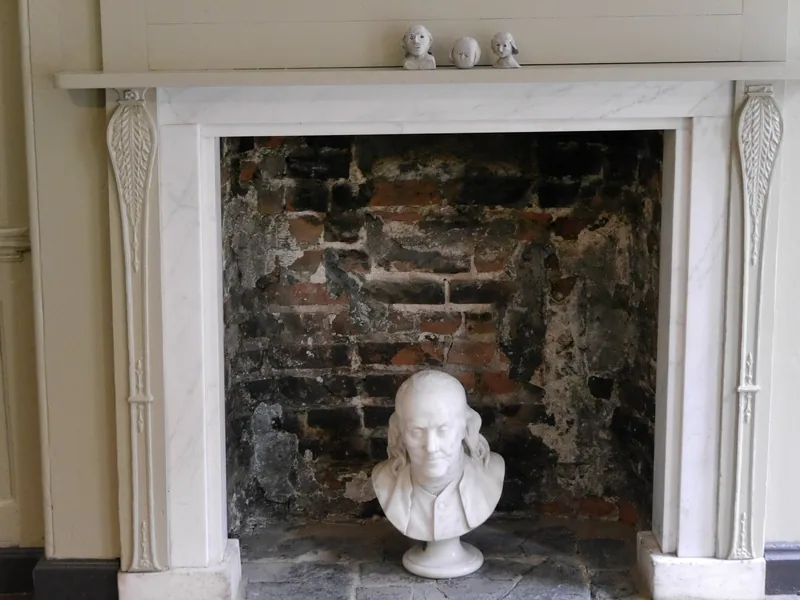
Photo: Edwardx · CC BY-SA 4.0 · Wikimedia Commons · resized
The self-guided visit, and the Cravenstreet Gazette
On Wednesday, Thursday, Saturday and Sunday you drop in and go round at your own pace. There is no timed slot. Instead of labels, you are handed a printed guide called the Cravenstreet Gazette, laid out like a period newspaper, which walks you room by room through Franklin's London, the family he lodged with and what happened in each space.
A free audio guide is also available through the Bloomberg Connects app, which you can download before you arrive; it is the same app several London museums now use, so it may already be on your phone. Adults pay £10 and concessions £8, with children of 11 and under free. A typical visit runs to about an hour.
Seating is provided in every historic room, which sounds like a small thing and is not: the staircases are steep and the floors slope, and being able to sit in each room changes how long people can stay.
The Friday Architectural Tour: what the extra £4 buys
On Fridays the house switches to guided tours on the hour from 11am to 4pm. The Architectural Tour costs £14 for adults, £10 concessions, and looks at the fabric of the building itself: the Georgian features that survive, Franklin's long tenancy from 1757 to 1775, the anatomy school that operated here alongside him, and the conservation project that began in 1998 and saved the house from dereliction.
It is the better visit if you care about buildings, and the only one with a guide answering questions. The trade-off is that Friday is the one day you cannot simply wander in when it suits you: tours start at fixed times, and a 12:20 arrival means waiting forty minutes.
The bones under the floor
In 1998, conservation work stopped when human and animal bones turned up beneath what is now the Seminar Room, ground that had been the garden in Franklin's day. A coroner established that the remains were more than a century old, so no inquest was needed, and archaeologists from University College London were invited to examine them.
Over 1,200 pieces of bone came out of a pit a metre wide and a metre deep. They belonged to at least fifteen people, and they carry the marks of dissection: a femur cut cleanly through, probably to demonstrate amputation, and skull fragments with circles removed by a trepanning device, used to relieve pressure on the brain. One sample is displayed in the Seminar Room.
They are not a mystery. William Hewson, who married Polly Stevenson (the daughter of Franklin's landlady) in 1770, ran a private anatomy school from the house. Hewson was a serious scientist who identified fibrinogen, the protein at the centre of blood clotting; Franklin supported his election to the Royal Society. A piece of turtle spine and traces of mercury found in the pit tie the remains directly to an experiment Hewson performed in 1770 to demonstrate the lymphatic system.
The darker context is straightforward. Dissection did not become fully legal in England until 1832, and private schools like Hewson's obtained bodies where they could, including from the men who robbed graves along the Thames. Hewson himself contracted septicaemia during a dissection and died in 1774, aged 34. The house tells this history plainly, without theatre, and that is the right way to hear it.
If this part of the story is what interests you, the Hunterian Museum at the Royal College of Surgeons and the Old Operating Theatre Museum near London Bridge both go much further into Georgian surgery.
Access: the honest position
The house states it clearly, so there is no point softening it. This is a five-storey townhouse with a staircase between every floor. The floors and the stairs are uneven and sloping. There are handrails on all the staircases, but there is no wheelchair access anywhere in the building, and the only toilets are in the basement, with no accessible facility.
Carers are admitted free, and disabled visitors qualify for the concessionary rate. Guide dogs and hearing dogs are welcome throughout. Pushchairs cannot be taken round and are left at reception, as are large bags; there are no baby-changing facilities. Anyone who cannot manage the stairs can use the house's virtual tour instead, which covers the Georgian interiors room by room. Our guide to accessible London has alternatives nearby that do work for wheelchair users.
Leave the suitcase at the station, not at reception. Craven Street is two minutes from Charing Cross, so it tempts people arriving or departing by train. Large bags go behind the desk at the house's discretion and there is no cloakroom as such; the station's own left-luggage office is the safer choice.
Exhibitions, the chess club and the walking tours
Small changing exhibitions run in the house. Recent titles include Ink & Independence, Lives Revealed: The Hidden Figures of Franklin's London Home and Georgian Gems. There is also a programme of talks, many of which are streamed online for anyone who cannot get to Craven Street. A chess club meets at the house, a nod to Franklin's own enthusiasm for the game, and the team runs American History in London walking tours that start outside.
The 250th anniversary of American independence falls in 2026, and the house has built a programme around it. If you are visiting in that year, look at the events page before you fix a date; some of the talks sell out.
Getting to Craven Street, and what is within five minutes
Craven Street runs between the Strand and the Embankment, on the western flank of Charing Cross station. Charing Cross Underground (Northern and Bakerloo lines) and Embankment (Northern, Bakerloo, District and Circle) are both a short walk, and buses 6, 9, 11, 13, 15, 23, 77a, 91 and 176 stop on the Strand. Parking is close to impossible; come by public transport. Our guide to London's main railway stations covers Charing Cross itself.
Almost everything worth seeing in central London is within ten minutes. Trafalgar Square is at the top of the street, with the National Gallery and the National Portrait Gallery beyond it, both free. St Martin-in-the-Fields runs lunchtime concerts in its crypt. Somerset House is fifteen minutes east along the Strand, and Banqueting House a similar distance south down Whitehall.
For another Georgian celebrity's address, Handel Hendrix House in Mayfair is twenty-five minutes on foot or ten by Tube. The area around Craven Street is covered in our guides to Westminster and Covent Garden, and there are more one-room collections in our piece on the city's overlooked small museums.
Frequently asked questions
Is Benjamin Franklin House really the only Franklin house left?
Yes. The house at 36 Craven Street is the only surviving residence of Benjamin Franklin anywhere in the world, including in the United States. That is the museum's central claim about itself, and it is the reason a fairly plain Georgian terrace off the Strand is worth an hour of your time.
How much does Benjamin Franklin House cost?
In September 2026 the self-guided visit cost £10 for an adult and £8 concession, with children aged 11 and under free. The Friday Architectural Tour cost £14 for an adult and £10 concession, with under-12s free. Carers accompanying a disabled visitor go in free.
Which days is the house open?
Wednesday, Thursday, Saturday and Sunday for self-guided visits, and Friday for the Architectural Tour at set times. Mondays and Tuesdays are closed to the public, although private tours can be arranged by email or telephone in advance.
Is there a live performance or actors in the house?
Not on the current published schedule. The house was long known for a live Historical Experience with an actress in character, and that description still appears on parts of its website, but the days and times it publishes now list only the self-guided visit and the Friday tour. Contact the house directly if the performance is what you want.
Can wheelchair users visit Benjamin Franklin House?
No. The building has five floors linked by stairs, with uneven and sloping floors and no lift, and the house states that there is no wheelchair access. The toilets are in the basement and none is accessible. A virtual tour of the interiors is available online instead.
Sources
- Benjamin Franklin House - Visit (checked September 2026)
- Benjamin Franklin House - Buy Tickets (checked September 2026)
- Benjamin Franklin House - Craven Street Bones (checked September 2026)
- Benjamin Franklin House - Getting Here (checked September 2026)