
Keats House is a white Regency villa on a quiet Hampstead lane where John Keats lived for two years, fell in love with the girl next door and wrote 'Ode to a Nightingale'. The garden is free to walk into. The house costs £10.30 for an adult, opens on Wednesdays, Thursdays, Fridays and Sundays only, and shuts for an hour over lunch.
Keats moved in at the end of 1818, when he was twenty-three, and left for Italy in 1820. He died in Rome the following February, aged twenty-five. Almost everything he is remembered for was written in or around this building, and the garden outside is where the nightingale ode took shape in the spring of 1819.
The house belongs to the City of London Corporation, which also looks after Hampstead Heath at the end of the street. Our guide to Hampstead places it among the village's other attractions; this page is about the visit itself: the door you use, what the free tour covers, and why so many people find the place empty.
Keats House in brief
- Where
- 10 Keats Grove, Hampstead, London NW3 2RR. Telephone 020 7332 3868
- Open
- Wednesday, Thursday, Friday and Sunday, 11:00–13:00 and 14:00–17:00. Closed Monday, Tuesday and Saturday, and closed to visitors between 13:00 and 14:00
- Admission
- Full price £10.30; concessions £5.30; 18 and under free; National Trust members £6.20; National Art Pass free; local ticket £2.80 (September 2026)
- Tickets
- Bought at the welcome desk on arrival. No advance booking. Card payment only, no cash
- Garden
- Free. Dogs welcome on a lead
- Free tours
- Volunteer-led, on most Thursdays, Fridays and Sundays, starting at roughly 2.15pm and lasting about half an hour at no extra charge
- Nearest station
- Hampstead Heath, 250 metres, on the Mildmay line of the Overground
Two houses pretending to be one
What looks like a single villa was built in the 1810s as a pair of semi-detached houses called Wentworth Place. Keats lodged in one half with his friend Charles Brown. The Brawne family took the other half, which is how the poet came to be living a wall away from Fanny Brawne, the woman he was engaged to and never married. The two halves were later joined into the building you walk through today, so the internal geography is odd: rooms that were once separate households now open into one another.
That detail is worth holding on to as you go round, because it explains the emotional weather of the place. The rooms are small, the walls are thin, and the story attached to them is one of illness, money trouble and a love affair conducted at extremely close quarters.
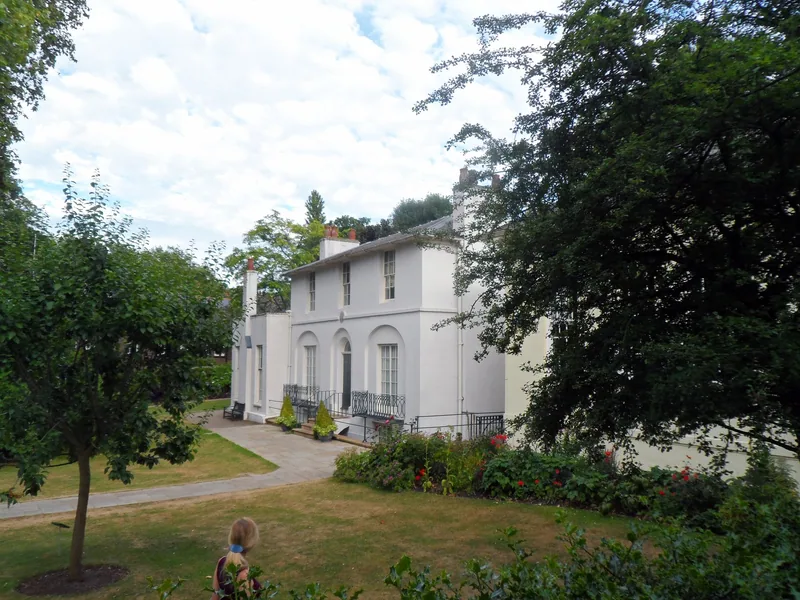
Photo: Spudgun67 · CC BY-SA 4.0 · Wikimedia Commons · resized
The garden, and why you can visit it without paying
The garden is open to anyone, free of charge, and you do not need a ticket or a conversation with anybody to walk in. Use the gate beside the double gates, or the double gates themselves when they are open. There is an intercom at the front gate if you need help.
This is not a token strip of lawn. It is the space in which the nightingale ode was composed, and on a warm afternoon it is one of the calmer corners of north London: a lawn, mature trees and benches, with the Heath a few minutes downhill. Dogs are allowed on a lead. The museum asks you to take your litter away with you, because there are no bins.
Plenty of people in Hampstead treat the garden as a free public space and never go inside. That is a perfectly reasonable way to use it, and it earns a place among the no-cost things to do around the city. But the house is cheap, and the rooms are the point.
The garden costs nothing and the shop needs no ticket. Tell the staff at the welcome desk that you only want the shop and they will wave you through. Between the two, you can spend a pleasant twenty minutes at Keats House without buying admission at all.
Four days a week, and an hour off in the middle
Keats House opens on Wednesdays, Thursdays, Fridays and Sundays. It is closed all day on Mondays, Tuesdays and, unusually for a museum, Saturdays, which is the day most visitors assume a small house museum will be at its busiest.
On the four days it does open, the hours are 11:00 to 13:00 and then 14:00 to 17:00. The house closes to visitors for the hour in between. That single detail ruins more visits here than anything else: arrive at 13:15, having walked up from the station, and you are waiting on the pavement for forty-five minutes.
Two practical rules follow. Come in the late morning if you want the house at its quietest, and treat 16:00 as your real deadline in the afternoon, because an hour is the least this house deserves. If you are travelling around a bank holiday or in late December, telephone 020 7332 3868 first, since a small municipal museum will sometimes close for an event or a school session.
What a ticket costs, and the ways to pay less
The full adult price was £10.30 in September 2026. Concessions were £5.30, and anyone aged 18 or under went free, a more generous cut-off than most London museums, which stop at 16 or at 12.
Three other rates are worth knowing. National Trust members pay £6.20, which is unusual, because the house belongs to the City of London Corporation rather than the Trust; the discount is a courtesy rather than a membership right, so carry the card. National Art Pass holders go in free. There is also a £2.80 local ticket. The City's price list carries a reduced adult rate of £8.80 as well, attached to the Great British Summer Savings promotion rather than offered all year, so check which figure the desk is charging on the day.
There is no online booking system and no timed entry. You turn up, pay at the welcome desk inside the rear entrance, and go in. Payment is by card: the house does not take cash, and neither does the shop.
Admission covers the historic rooms, the current exhibition and any special displays, with no separate exhibition ticket, and it covers the volunteer tour if one is running while you are there. Groups are asked to give notice in advance, and groups of more than twenty may be split into two.
The doors shut between 13:00 and 14:00. Keats House closes to visitors for an hour in the middle of the day, on top of being shut every Monday, Tuesday and Saturday. Aim to be inside by 12:15, or leave it until after 14:00, and never make this your lunchtime stop.
The free volunteer tour is the best thing on offer
A volunteer leads a tour of the ground floor on most Thursdays, Fridays and Sundays, beginning at around 2.15pm. It lasts roughly half an hour, costs nothing on top of your ticket, and is the difference between looking at furniture and understanding what happened in these rooms.
Numbers are capped because the rooms are small, so if the tour matters to you, be at the welcome desk a few minutes before the hour and say you would like to join. Volunteers here tend to know the poems as well as the house, which is not true of every guided tour in London.
The digital guide, and the headphone rule
Keats House has a free digital guide made with Bloomberg Connects, which you can use through the app or in your phone's browser. It carries an audio description for every room as well as background on the key objects, so it works both as an ordinary guide and as a real access tool for blind and partially sighted visitors. It is also the best substitute if you arrive on a day when the volunteer tour is not running.
Use headphones inside the house. The rooms are quiet and close together, and one phone playing aloud carries through the whole floor. The museum also publishes a short film and a recording of the nightingale ode, both worth ten minutes before you go rather than while you are standing in the room.
Photography for personal use is allowed, without flash. Food and drink may not be brought into the house, and there are cafés and pubs a few minutes away in the village. See our round-up of London's historic pubs for the Hampstead options.
Access: what works and what does not
The approach is better than most historic houses. Paths from the gate to the house are step-free, laid in bonded gravel and York stone, and you enter by the rear door under the veranda, where there is a small slope rather than a step. An induction loop is available at the welcome desk and in the events rooms; switch your hearing aid to the T position.
Inside, there is wheelchair access to most of the ground-floor rooms, and one further room can be reached by a ramp placed from outside on request. Ground-floor corridors are wide enough for one wheelchair. The stairs to the basement and the upper floor are the barrier: they cannot be avoided, so those levels are out of reach for wheelchair users and anyone with reduced mobility. A low-level interactive touchscreen on the ground floor shows the rooms you cannot reach.
There are places to sit in every public room, large-print guides for the permanent displays and the temporary exhibitions, and assistance dogs are welcome throughout. One accessible toilet with a baby-changing table sits in the garden next to the house. There is a single disabled person's parking space, which has to be arranged in advance because it may be in use. For the wider picture, see our guide to accessible London.
Getting to Keats Grove
Hampstead Heath, an Overground station on the Mildmay line, is the closest at about 250 metres: cross the road, turn into Keats Grove and the house is a couple of minutes along on the left. Hampstead station on the Northern line is roughly 900 metres and Belsize Park about a kilometre, both pleasant walks downhill or a slog back up, depending on your direction. Many visitors still think of the Mildmay as the North London Line; our explainer on the renamed Overground routes sets out which is which.
Buses 1, 24, 46 and C11 all stop within 350 to 400 metres. If you are driving, the nearest car park is on East Heath Road, about 420 metres away, with Blue Badge bays; street parking in the surrounding roads is free on Sundays. Coaches can drop passengers at the end of Keats Grove, but the nearest coach parking is over by Regent's Park.
What to do with the rest of the afternoon
Keats House takes under an hour, so it works best as one part of a Hampstead day. The Heath begins at the end of the road, and the climb to Parliament Hill gives you the standard postcard view of the City. Half an hour north-west, the Hampstead Pergola and Hill Garden is the strangest free thing in the area.
For another house with a single powerful room in it, the Freud Museum is twenty minutes away near Finchley Road, and it too closes on Mondays and Tuesdays, so the overlap with Keats House is Wednesday, Thursday, Friday or Sunday. Across the hill, Highgate Cemetery makes a heavier but memorable second stop.
If you are collecting writers' houses, the Charles Dickens Museum in Bloomsbury is the fullest of them and Carlyle's House in Chelsea the most untouched, though the Chelsea house opens one day a week. Hampstead is also thick with commemorative plaques; our guide to London's blue plaques explains how to read them. On a Sunday, when parking is free and the Heath is busy, see our Sunday in London itinerary. And for a wet day, the house is small enough to be a genuine shelter, and there are more ideas in our rainy-day guide. A wider list of one-room collections appears in our piece on small museums across the capital.
Who this house suits
Worth the journey if
- You care about the poems, or want to see where one of them was written
- You like small, calm, uncrowded historic houses with volunteers who know their subject
- You are already walking on the Heath and want forty-five minutes indoors
- You want a free garden in a part of London with very few public ones
Think again if
- Your free day is a Monday, Tuesday or Saturday, when the house does not open at all
- Stairs are impossible and you want to see the whole house
- You are travelling with children who need something to do rather than look at
- You expect a large museum; this is four or five modest rooms
Frequently asked questions
How much does Keats House cost?
The full adult price was £10.30 in September 2026, with concessions at £5.30 and free entry for anyone aged 18 or under. National Trust members paid £6.20, National Art Pass holders went free, and a local ticket cost £2.80. The garden is free to everyone, and the shop can be used without buying admission.
Which days is Keats House open?
Wednesday, Thursday, Friday and Sunday, from 11:00 to 13:00 and again from 14:00 to 17:00. It closes on Mondays, Tuesdays and Saturdays, and it also shuts to visitors for the hour between one and two o'clock, which catches out a great many people arriving after lunch.
Do you need to book Keats House in advance?
No. There is no online booking and no timed entry, so you arrive during opening hours and buy a ticket at the welcome desk. Payment is by card only. Groups are asked to let the house know in advance, and a group larger than twenty may be asked to split into two because the rooms are small.
Where was 'Ode to a Nightingale' written?
In the garden at Keats House, in the spring of 1819. The museum makes a recording of the poem available online, and it is worth listening to before you visit so that the garden means something when you walk into it.
Which station is nearest to Keats House?
The Overground stop at Hampstead Heath, on the Mildmay line, is roughly 250 metres away and much closer than anything on the Northern line. Hampstead station is roughly 900 metres and Belsize Park about a kilometre. Buses 1, 24, 46 and C11 stop within a five-minute walk.
Can you take a dog to Keats House?
Dogs on a lead are welcome in the garden, which is useful if you are coming off the Heath. Only assistance dogs may go inside the house. There are no bins in the garden, so take any litter away with you.
Sources
- City of London Corporation - Visit Keats House (opening times and admission prices) (checked September 2026)
- City of London Corporation - Keats House (checked September 2026)
- Bloomberg Connects - Keats House digital guide (checked September 2026)
- City of London Corporation - Hampstead Heath (checked September 2026)