
The Carlyles' House at 24 Cheyne Row in Chelsea opens one day a week, by pre-booked timed ticket, and keeps the fixtures the Victorian writers Thomas and Jane Carlyle lived with for more than forty years. It is the hardest of London's tiny museums to get into, and the best introduction to a category of place most visitors never find.
London has perhaps a dozen museums that consist of a single house, a single collection or a single machine. They are run by small charities, borough councils or volunteers, they open on days that suit their staffing rather than their visitors, and between them they hold some of the most memorable hours you can spend in the city. Our survey of the capital's small museums covers the better-known dozen; this page is about the smaller tier below that, starting with the one that is genuinely difficult to visit.
The Carlyles' House at a glance
- Address
- 24 Cheyne Row, Chelsea, London SW3 5HL
- Open
- Wednesdays only, by pre-booked timed entry. No walk-ups
- Tickets
- Two weeks of slots are live at any time, with new dates released every Thursday
- Prices
- Adult £12.00, child 5–17 £6.00, under-5s free, family (2 adults + up to 3 children) £30.00, one adult and two children £18.00 (National Trust, 2026 season)
- Members
- National Trust members go free but still need to book a slot
- Access
- Many stairs and no lift; the Trust describes the house as unsuitable for wheelchair users
One day a week, and a booking window that opens on Thursdays
This is the detail that defeats most people. The house opens on Wednesdays, every visit is a pre-booked timed slot, and the National Trust keeps only two weeks of dates live at any moment. New tickets go on sale every Thursday for the week after next.
The practical consequence is that you cannot plan this one three months ahead, and you cannot decide on the morning to go. If a Wednesday in your trip is the only possible day, set a reminder for the Thursday two weeks before and book then. The house is small, the slots are limited and they do go.
It also closes for the winter. The Trust's booking calendar simply stops showing open days, so if you are looking at a January visit, check before you build the afternoon around it.
Wednesday is not a suggestion at Cheyne Row. There is no ticket desk to talk your way past and no capacity for walk-ups. Turning up on a Saturday, which many visitors do after a walk along the Embankment, means looking at the plaque and going home.
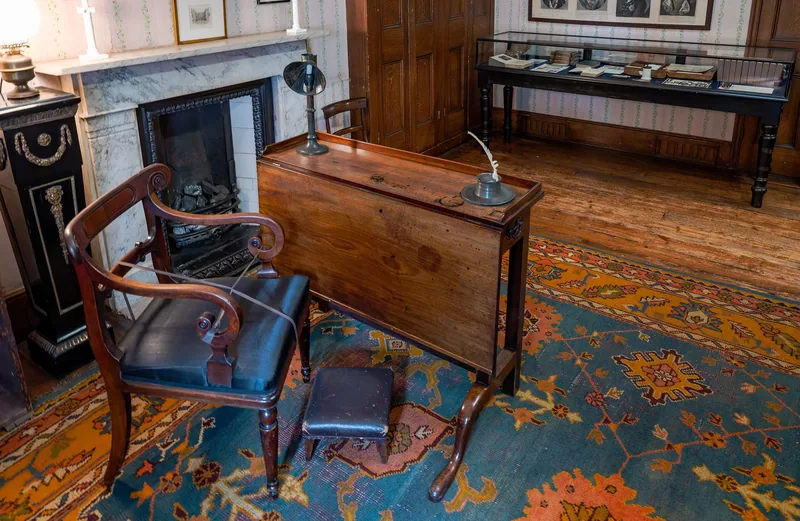
Photo: Tilman2007 · CC BY-SA 4.0 · Wikimedia Commons · resized
What survives inside 24 Cheyne Row
Thomas Carlyle was, in the middle of the 19th century, one of the most famous writers in Britain. His wife Jane was a letter-writer of extraordinary sharpness whose correspondence is now read more widely than his histories. They lived in this narrow Chelsea terrace for over forty years, and the house kept its original Victorian fixtures and fittings rather than being refurnished by later owners.
That is what makes it unusual among literary houses: it is not a reconstruction. Jane's writing table stands in the drawing room. The kitchen, the bedrooms and the service spaces are all there. Behind the house is a small walled garden, which is about as quiet as Chelsea gets.
Thackeray, who knew them, described a household with "a snuffy Scotch maid to open the door" and the best company in England ringing at it. Both halves of that are on display here: the frugality and the visitors. The house has also appeared in the BBC Two series Hidden Treasures of the National Trust, which followed conservation work on objects including a letter from Thackeray inviting the Carlyles to tea with Charlotte Brontë, and a camel-hair coat from Persia.
Prices, membership and what a family pays
For the 2026 season the Trust listed adult admission at £12.00, a child aged 5 to 17 at £6.00, under-5s free, a family ticket at £30.00 for two adults and up to three children, and £18.00 for one adult with two children. National Trust members pay nothing but still have to book a timed slot like everyone else.
National Trust prices are published in two versions, with and without the Gift Aid donation, and the difference is usually around ten per cent. Check the figure on the booking page as you go through, so that you know which one you are agreeing to.
Access at Cheyne Row: the position is blunt
The Trust does not dress this up. The house has many stairs and is described as unsuitable for wheelchair access. The toilet is outside and has limited access. Parking is restricted to metered bays in the surrounding streets. Only guide dogs and assistance dogs are admitted.
If stairs are a problem, the honest advice is to enjoy the exterior and the blue plaque and spend the afternoon at the National Army Museum ten minutes east instead, which is free, step-free and open six days a week.
Getting to Cheyne Row
Sloane Square on the District and Circle lines is about fifteen minutes away down the King's Road; South Kensington is a similar walk through the back streets. Buses 11, 19, 22, 49 and 319 stop at Carlyle Square, from where you go down Bramerton Street, right into Glebe Place and follow the road into Cheyne Row. The 170 stops at Albert Bridge, and Cheyne Row runs back from the statue of Carlyle on the Embankment.
Cyclists have National Cycle Route 4 along the river, bike parking on the Embankment, and docking stations at Chelsea Embankment, Phene Street and on the King's Road. Our guides to Chelsea and the King's Road cover what else is in walking distance, and the Chelsea Physic Garden is five minutes along the river.
The other very small museums, and when they open
Four more are worth knowing about. None takes more than two hours, all of them are cheap or free, and every one has an opening pattern that will catch you out if you do not check it.
Dr Johnson's House, 17 Gough Square
The house where Samuel Johnson compiled his Dictionary of the English Language, tucked in a courtyard off Fleet Street. It opens from 10am until 5pm Tuesday to Saturday, with the last tickets sold at 4.30pm, and from noon until 4pm on Sundays. Adults paid £10 in September 2026, students £9, children aged 5 to 16 £5, and under-5s and carers went free. On Friday afternoons between 2pm and 5pm adults pay £5, the single best value in this article.
The house is a five-storey townhouse with seven steps up to the front door and a staircase between every floor, so there is no step-free access, but there are handrails throughout and seating in every room. Ye Olde Cheshire Cheese is round the corner, and St Paul's Cathedral is ten minutes away. American Express is not accepted.
Hogarth's House, Chiswick
The painter William Hogarth's country retreat, now marooned beside a very loud road. It is run by Hounslow Council, entry is free, and it opens from 12 noon until 5pm from Tuesday through to Sunday, and on bank holiday Mondays too, closing only on Christmas Eve, Christmas Day, Boxing Day and New Year's Day. That makes it one of the easier small houses to fit into a day, and it pairs naturally with Chiswick House a few minutes' walk away. Our Chiswick and Kew guide covers the area.
The Fan Museum, Greenwich
Two Georgian houses containing the only museum in Britain devoted to fans. The garden behind is not open to visitors. It opens Tuesday to Saturday, 11am to 5pm. Adults paid £5.00 in September 2026, children aged 7 to 16 and concessions £3.00, and a family ticket £10.00; under-7s, disabled visitors and their carers, Art Fund members and London Pass holders go free. Senior citizens get in free on Wednesdays. Groups of eight or more must arrange a time in advance, at a flat £5.00 a head. It closes for several weeks between exhibitions (it was shut from 5 April to 8 May 2026), so check before travelling. It is five minutes from the Cutty Sark and the Royal Observatory, covered in our Greenwich guide.
Kirkaldy Testing Museum, Southwark
Not a house at all, but a Victorian works on Southwark Street built around one enormous machine for testing the strength of materials. It opens only for tours. A premium tour, including a run of the Kirkaldy testing machine itself, takes place on the first Sunday and fourth Saturday of each month at 1:30pm, lasts about two and a half hours, is capped at 24 people and costs £23 plus a booking fee. A standard tour runs on the third Saturday of the month at 2pm, lasts about an hour and a half, is capped at 15 and costs £15 plus the fee. Book through the museum's listed links; bookings close twelve hours before the start. Some standard-tour places are usually available on the door if you arrive five minutes early, at the same price without the booking fee, and the volunteers prefer cash.
September is the month the Kirkaldy pattern breaks. The usual third-Saturday standard tour is replaced by the museum's Open House weekend opening. Our guide to the Open House Festival explains how that weekend works across the city.
The small museums compared
| Museum | Open | Adult price | Booking |
|---|---|---|---|
| The Carlyles' House, Chelsea | Wednesdays only, in season | £12.00 | Essential, timed slots released on Thursdays |
| Dr Johnson's House, Fleet Street | Tue–Sat 10am–5pm; Sun 12–4pm | £10.00 (£5 on Friday afternoons) | Optional |
| Hogarth's House, Chiswick | Tue–Sun and bank holiday Mondays, 12–5pm | Free | None |
| The Fan Museum, Greenwich | Tue–Sat 11am–5pm | £5.00 | Online or on the door |
| Kirkaldy Testing Museum, Southwark | Three tour dates a month | £15.00 or £23.00 plus booking fee | In advance; some door places on standard tours |
Prices and days were checked on each museum's own website in September 2026. Every one of these organisations is small enough that a single staffing change can alter the pattern, so treat the table as a starting point and confirm on the day.
How to build a day out of them
Do not try to chain them geographically; they are scattered. Instead, pick the day first and see which ones open on it.
A Wednesday can take Cheyne Row in the morning and the National Army Museum or the Physic Garden in the afternoon. A Friday belongs to Fleet Street: Dr Johnson's House at the £5 afternoon rate, then the free Soane Museum and, facing it across Lincoln's Inn Fields, the equally free Hunterian, both ten minutes away. A third Saturday suits Southwark and the Kirkaldy tour. Sundays are thin: Dr Johnson's House opens for four hours and Hogarth's House for five, and almost nothing else on this list does.
None of these places has a café worth planning around, so eat before or after. Our list of London's historic pubs covers the Fleet Street options, and free things to do in London has the no-cost alternatives for a day when everything you wanted turns out to be shut. For the two most theatrical small houses in the city, see Dennis Severs' House and the Charles Dickens Museum.
Frequently asked questions
When is Carlyle's House open?
The National Trust, which now calls it The Carlyles' House, opens it on Wednesdays only during the season, and every visit must be booked as a timed slot in advance. Two weeks of dates are on sale at any one time, with new tickets released each Thursday. There are no walk-up tickets.
How much does The Carlyles' House cost?
For the 2026 season the Trust listed £12.00 for an adult, £6.00 for a child aged 5 to 17, £30.00 for a family of two adults and up to three children, and £18.00 for one adult with two children. Under-5s and National Trust members go free, though members still need to book a slot.
Which is London's smallest museum?
There is no official answer, but the Fan Museum in Greenwich, Dr Johnson's House off Fleet Street and the Kirkaldy Testing Museum in Southwark are all single-building collections that can be seen in an hour or two. The Kirkaldy is the most unusual of them, built around one Victorian testing machine that is still run for visitors.
Are any of these small museums free?
Hogarth's House in Chiswick is free and open six days a week plus bank holiday Mondays. The two collections facing each other across Lincoln's Inn Fields, the Soane and the Hunterian, are also free. The rest charge between £5 and £23.
Can wheelchair users visit these houses?
Mostly not. The Carlyles' House and Dr Johnson's House are both multi-storey townhouses with stairs between every floor and no lift, and both state that there is no wheelchair access. Ask each museum directly before travelling, because the ground-floor position varies.
Sources
- National Trust - The Carlyles' House, prices and opening times (checked September 2026)
- Dr Johnson's House - Visit Us (checked September 2026)
- London Borough of Hounslow - Hogarth's House (checked September 2026)
- The Fan Museum - Visit (checked September 2026)
- Kirkaldy Testing Museum - tour dates and prices (checked September 2026)