
Sutton House is a Tudor brick house of about 1530 on Homerton High Street, the oldest house in Hackney, and it opens on Fridays and Sundays only, from 11:00 to 16:00. You buy a ticket at the welcome desk; no booking is needed for a self-led visit. There is no cafe and no shop, and the courtyard garden next door is free.
It survived the East End by never staying the same thing twice. Built for a senior servant of Thomas Cromwell, it has been two houses, a Victorian school, a church institute in the First World War, a trade union office in the 1960s and 1970s and a punk squat in the 1980s. All of that is visible inside, which makes it a better visit than a restored period interior.
Our guide to Hackney and London Fields covers the neighbourhood and free museums in London the alternatives. This is a paid house; what follows is what you get and when you can get in.
Sutton House and Breaker's Yard: the essentials
- Address
- 2 and 4 Homerton High Street, Hackney, London E9 6JQ
- House open
- Fridays and Sundays, 11:00–16:00
- December 2026
- Sundays only: 6, 13 and 20 December
- Tickets
- Bought at the welcome desk. No booking for a self-led visit; book ahead for a guided tour
- Breaker's Yard
- Free, no entry fee
- Nearest station
- Hackney Central (Mildmay line), five minutes' walk
- Listing
- Grade II*, list entry 1226810, first listed 24 April 1951
- Food and drink
- None on site
Two days a week, and the garden that does not always match
The National Trust's own visiting page says the house is open on Fridays and Sundays from 11am to 4pm, with the Breaker's Yard open at the same hours and free. Its day-by-day opening calendar, read the same day, says something slightly different: on Fridays the house opens 11:00 to 16:00 while the community garden is shown as closed, and on Sundays both open, the garden from 10am until dusk. We have printed both rather than choose.
Two dates matter if you are here this autumn or winter. Sunday opening ran from 4 October 2026; before that, September Sundays were closed. And December drops the Fridays entirely.
| Month (2026) | House | Community garden |
|---|---|---|
| September | Fridays 11:00–16:00 | Closed |
| October and November | Fridays and Sundays 11:00–16:00 | Sundays only, 10:00 to dusk |
| December | Sundays 6, 13 and 20 only, 11:00–16:00 | Closed |
A closure notice on the Trust's site does not match the calendar. When we read it on 28 September 2026 the page carried a notice that the house and Breaker's Yard would be closed on "the 27th of October (Sunday)". In 2026, 27 October is a Tuesday, when the house is shut anyway. Check the specific date before travelling in late October rather than assuming either reading is right.
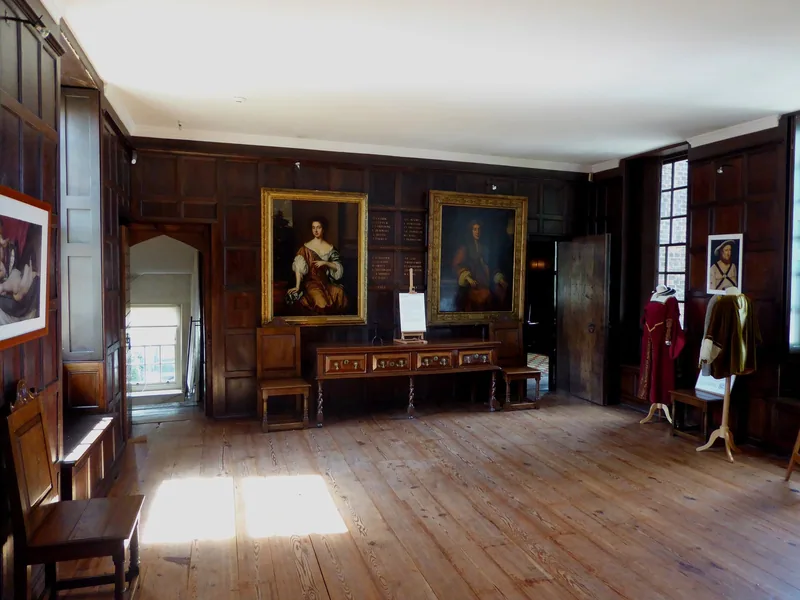
Photo: Ethan Doyle White · CC BY-SA 4.0 · Wikimedia Commons · resized
What it costs, and the figure the Trust does not publish
The National Trust publishes no admission price for Sutton House in its own visitor data, which is unusual: most of its properties list adult, child and family rates. Its instruction is to buy a ticket at the welcome desk on arrival, and members go free. We have not printed a figure we could not read on the Trust's own pages; ask at the desk or telephone the house first.
Two things are published. The Breaker's Yard next door has no entry fee. And guided tours, separate from ordinary opening, should be booked ahead: the house keeps a small number of tickets for the door, first come, first served, and no booking is needed during free-flow hours.
1530 or 1535, and a house called the bryk place
Sutton House was listed at grade II* on 24 April 1951, as list entry 1226810, under the address "Nos 2 and 4 (Sutton House)" and with the note that it was formerly listed as St John's Institute. The entry received a minor amendment in December 2016.
Its date is given two ways by two reliable sources. Historic England dates the house to about 1530 and names the builder as Sir Ralph Sadler, statesman; the National Trust says it was built in 1535 by Sir Ralph Sadleir, an aide to Thomas Cromwell who was Secretary of State to Henry VIII by 1540. Both are worth knowing, and the difference does not change the point: this is an early-Tudor brick house that predates almost everything around it.
The alterations are easier to date. Historic England records early 17th-century changes for Captain John Milward, internal work about 1700 when the recessed centre of the front was refaced in brick, subdivision into two dwellings about 1752 to 1754, and a rear range known as the Wenlock Barn with wing additions about 1904, when the original H-plan became the present courtyard plan. The brick is 16th-century English bond with diaper patterning, and an indenture of about 1550 calls it "the bryk place".
It had been St John's Institute since about 1890. The Trust bought it in 1938 through the W A Robertson Memorial Fund, as one of nine war memorial purchases, and a plaque records that.
The linenfold panelling, and where else it survives
The carved oak linenfold panels are the reason architectural historians come. Linenfold is relief carving that imitates folded cloth, slow and skilled to make, and the National Trust's own claim for Sutton House is a strong one: these are among only a few examples of their kind left in London, the others being at Hampton Court Palace and Westminster Abbey. For a terraced house on a Hackney main road, that is remarkable company.
One caution from the statutory description: at the time of Historic England's survey, the linenfold panelling from the ground-floor front room of the west wing was in store rather than on the wall. The Trust now shows a Linenfold Parlour, so the panelling is back on display, but ask at the desk if it is the reason for your visit.
The painted staircase, the Armada window and the Tudor kitchen
Three things in the house reward a slow look. The early 17th-century dog-leg staircase in the west wing has strapwork wall paintings on the landing, with gryphons and cherubs flanking the door surrounds; the Trust describes the scheme as trompe l'oeil, painted to look like three-dimensional carving, and suggests looking for a goat, a dog, a griffin and a ram in it.
In the courtyard, the only surviving original window looks across from the west side. It is called the Armada window, and the Trust's explanation for its survival is delightful: it probably escaped the Georgian re-sashing because it faced a shed and nobody thought it mattered. From the courtyard you can also see the Tudor gabled roof of the centre block, the original chimney stack and much original brickwork, all of which the remodelled front hides.
The Tudor kitchen still stands on the east side, in the old service wing. Bread and ale were produced here for the Sadleir household and the surplus sold to local people, probably out of a cellar, and the space right of the fireplace is thought to have held a bread oven. The original fireplace probably ran the whole length of the wall, which the Trust notes would have made the room unbearably hot to work in.
The squatters, the Blue House and the Squatter's Eye
The 1980s are the part of the story most visitors remember. The house was occupied by squatters and ran as a music, arts and community venue known as the Blue House, and the Trust has kept the artwork they left rather than scrubbing it off. The best-known piece is a wall painting called Squatter's Eye, in the Exhibition Room.
The Trust is careful in its wording: it says it may be possible to see the squatters' wall paintings on your visit, which is not a promise. If that is what you have come for, ask at the desk on arrival rather than at the end.
Keeping a squat in a Tudor house's official history is unusual, and it signals how this property is run: with the local community rather than for a coach party. A free photography exhibition made with Future Hackney has been showing alongside the historic rooms. If period interiors staged as narrative appeal, Dennis Severs' House in Spitalfields is the other London house that does it, by very different means.
The Breaker's Yard, and the two-storey caravan
Next to the house, on land the Trust reclaimed, is the Breaker's Yard: a small garden built on the site of a former car scrapyard and designed to celebrate rather than hide that history. It has won awards, it costs nothing to enter, and its centrepiece is a two-storey caravan, which is exactly as odd as it sounds and is the thing children head for.
Alongside it the flagged courtyard of the house itself is the calmest spot on the site, planted in spring and summer and strung with lights at Christmas.
What is on now
From 2 October to 20 December 2026 the house is showing Lost at Play: 500 Years of Fun and Games, built around objects found under the floorboards and behind door frames during conservation work: the things people who lived here actually dropped. It runs during ordinary opening hours, 11:00 to 16:00.
From 6 to 20 December 2026 there is also a Father Christmas visit in short timed slots, at £10 for a ticket covering one child and up to two adults, with additional children charged separately, up to two more per family. That is the only price the Trust publishes for anything at Sutton House.
The displays change in smaller ways too. A new oilcloth went into the Little Chamber in March 2020, reproducing the bright geometric floor covering the room probably had, made from old ships' sails; a conservation project in summer 2022 uncovered several layers of wallpaper in the gallery, each one a different set of residents.
There is no cafe and no shop
This is worth planning around. The National Trust's own facilities list for Sutton House records no cafe, no coffee shop, no restaurant, no kiosk and no shop, and marks food and drink as unavailable. There are toilets, including an adapted one near the entrance, and that is the extent of the amenities.
Hackney solves the problem easily. The pedestrianised Narrow Way has cafes along it, and Broadway Market is twenty minutes south-west at a weekend. Do not arrive hungry on a Friday expecting the house to feed you; Victoria Park, a mile south, has the nearest cafe with outdoor tables.
Getting there, and the sign to ignore
Hackney Central, on the Mildmay line of the Overground, is a quarter of a mile away and a five-minute walk; Hackney Downs is half a mile. The Trust's own directions are unusually detailed and worth following: leave Hackney Central, cross at the traffic lights, turn right and then almost immediately left down the pedestrianised Narrow Way towards the tall stone clock tower, cross again at the tower into St John's Churchyard Gardens, follow the Walled Garden Walk straight through, then continue down Sutton Place and turn right at the end. Sutton House is the first house on the right, at the very beginning of Homerton High Street.
The Trust adds one instruction twice, which suggests people keep getting it wrong: there is a black sign at the junction of Sutton Place and Homerton High Street that points left towards Sutton House, and it is wrong. Ignore it and turn right.
Several bus routes stop within walking distance; the Trust suggests entering the postcode E9 6JQ into TfL's journey planner rather than naming them. There is no car park.
Access
The house is a Tudor building on several levels and the Trust does not overstate it: there is wheelchair access on the ground floor only, and the other floors are reached by staircase. There is an adapted toilet near the entrance, a vehicular drop-off point, ramped access and slopes, an induction loop, large-print guides and wheelchairs available to borrow. The Trust marks level access and terrain as unavailable, which is honest for a floor of 16th-century flagstones.
A full AccessAble guide is published separately and is the document to read if steps are the deciding factor. Assistance dogs are welcome; other dogs are not. Our lists of London's best small museums and the borough museums nobody visits find more places on this scale, several of them easier to get into.
Frequently asked questions
When is Sutton House open?
Fridays and Sundays from 11:00 to 16:00, with Sunday opening from 4 October 2026. In December 2026 it opens on Sundays only: 6, 13 and 20 December. No booking is needed for a self-led visit; tickets are sold at the welcome desk.
How much does Sutton House cost?
The National Trust does not publish an admission price for Sutton House in its own visitor information, so ask at the welcome desk or telephone the house. National Trust members go free, and the Breaker's Yard garden next door has no entry fee at all.
Is there a cafe at Sutton House?
No. The Trust's facilities list records no cafe, coffee shop, restaurant, kiosk or shop, and marks food and drink as unavailable. The Narrow Way, on the five-minute walk from Hackney Central station, has several places to eat.
Can I see the squatters' wall paintings?
Possibly. The 1980s squat, known as the Blue House, left artwork that the Trust has kept, including a painting called Squatter's Eye in the Exhibition Room. The Trust says only that it may be possible to see the squatters' wall paintings on a given visit, so ask when you arrive.
How old is Sutton House?
Historic England dates it to about 1530 and the National Trust to 1535; either way it is the oldest house in Hackney and one of the few surviving early-Tudor brick houses in London. It was listed at grade II* in April 1951 and an indenture of about 1550 already calls it "the bryk place".
Sources
- National Trust - Sutton House and Breaker's Yard: opening calendar, facilities and directions (checked September 2026)
- National Trust - Things to see and do at Sutton House (checked September 2026)
- Historic England - Nos 2 and 4 (Sutton House), grade II*, list entry 1226810 (statutory description read on an Internet Archive copy dated 15 May 2025, because the live site blocks our requests; checked September 2026)
- AccessAble - Sutton House and Breaker's Yard access guide (checked September 2026)
- National Trust Collections - objects and works of art at Sutton House (checked September 2026)