
The Mildmay line is the Overground route right across the top of inner London: Stratford in the east to Richmond or Clapham Junction in the west, 28 stations, a train every seven or eight minutes across the shared middle section, and not one metre of it inside Zone 1. End to end takes about 65 minutes. It is the line to know if your journey is across London rather than into the middle of it.
The name arrived in November 2024 with the other five; it honours the Mildmay Hospital in Shoreditch, and our page on the six Overground names tells that story properly. What follows is the railway itself: the two western ends and how to tell them apart, what the trains are like, the four interchanges that cost you more time than you expect, the weekend picture, step-free access station by station, and the one cross-town ride the line owns.
Fares, caps and touching in work exactly as on the Tube. Our guide to the DLR and the Overground covers the network-wide mechanics.
The Mildmay line in numbers (September 2026)
- Route
- Stratford to Richmond and Stratford to Clapham Junction, 28 stations in total, 23 on each branch
- End to end
- 64 to 65 minutes to Richmond, 65 minutes to Clapham Junction
- Frequency
- Four an hour to each western terminus, so eight an hour between Stratford and Willesden Junction
- Fare, Stratford to Richmond
- £2.40 off-peak, £3.20 peak, pay as you go
- Zone 1
- None of it. The line never enters the central zone
- Night service
- None, weekends included
- Step-free
- 21 of the 28 stations, the best of the six lines
One line, two western ends, and where they split
From Stratford westwards, every Mildmay train takes the same 18 stations: Hackney Wick, Homerton, Hackney Central, Dalston Kingsland, Canonbury, Highbury & Islington, Caledonian Road & Barnsbury, Camden Road, Kentish Town West, Gospel Oak, Hampstead Heath, Finchley Road & Frognal, West Hampstead, Brondesbury, Brondesbury Park, Kensal Rise and Willesden Junction.
At Willesden Junction the line divides. One branch continues west through Acton Central, South Acton, Gunnersbury and Kew Gardens to Richmond. The other turns south through Shepherd's Bush, Kensington (Olympia), West Brompton and Imperial Wharf to Clapham Junction. Both get four trains an hour, so read the front of the train at any station east of Willesden Junction, where trains for both destinations use the same platform.
The practical division is simple. Richmond branch: Kew Gardens for the Royal Botanic Gardens and Richmond itself. Clapham Junction branch: Shepherd's Bush for the Westfield centre, and a set of west London stations that otherwise need two changes to reach. Neither branch is faster than the other; they are simply different halves of west London.
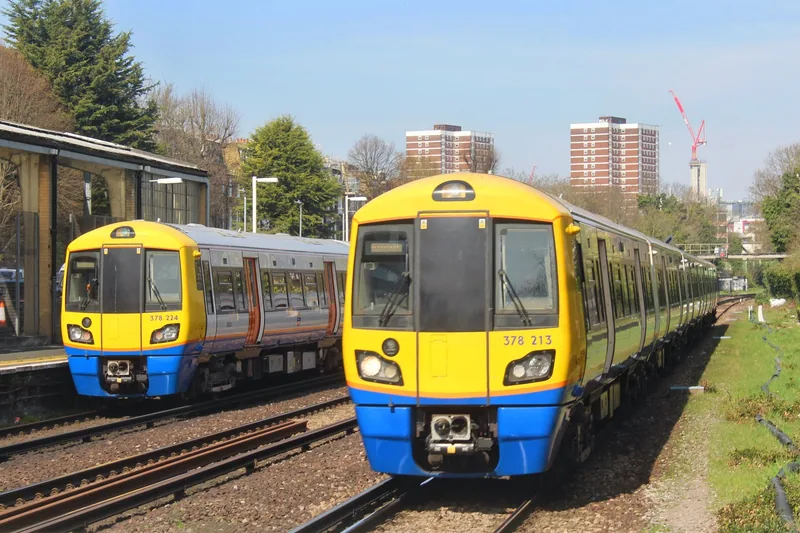
Photo: CallumClass450 · CC BY 4.0 · Wikimedia Commons · resized
What the trains are like
The trains are the standard Overground units, set out in detail on our page about the six lines. What matters here is the length of the ride. Sixty-five minutes on seats that run along the sides, with nothing to lean a head against, is a long time; and there is no toilet on the train or at most of the smaller stations, which is the single most useful thing to know before committing to the full Stratford-to-Richmond run. Break it at Hampstead Heath or Highbury & Islington if you can.
The line runs above ground almost throughout, in cuttings for much of the north London stretch, so the view alternates between brick retaining walls and sudden gaps with a view over Hackney or Kensal Green. The short tunnel sections are just that: short.
Trains get crowded at times that will surprise a visitor. The eastbound morning peak into Stratford is heavy, and so is the Saturday afternoon run to Shepherd's Bush for the shopping centre and, on match days, for the football. The usual advice about avoiding the London rush hour applies less neatly here than on the Tube, because the flows are local rather than into and out of the centre.
Five places where changing trains costs more than the map suggests
South Acton has the longest step-free walk between two platforms anywhere on the network, and it is on this line. TfL's own dataset records 1,300 metres from the westbound platform at South Acton to the eastbound one. Nowhere else in the whole dataset comes close: the next longest entries are 600 metres. If you are wheeling anything and you get on the wrong side at South Acton, you have most of a mile of pavement ahead of you.
Kensington (Olympia) is the second worst. The same dataset puts the step-free route from the District line platform to the southbound Overground platform at 600 metres, and the route between the two Overground platforms at the same 600 metres: eight to ten minutes inside one station. It is also a station where the District line service is thin on weekdays and better at weekends, so do not plan a weekday change onto the District there.
Willesden Junction is two stations stacked. The Mildmay uses the high-level platforms and the Lioness and Bakerloo lines use the low-level ones, with a subway, stairs and a lift between them. Allow five to eight minutes. The Lioness line to Watford Junction is the connection you would make there.
Highbury & Islington puts the Victoria line a long way down. The Overground platforms are at the top, the Victoria line is deep below, and the interchange runs through a busy ticket hall with escalators. It is a good change, not a quick one; allow four or five minutes, more at peak. Highbury & Islington is also the walk for the Emirates Stadium, covered in our guide to getting to the Emirates.
Camden Road is not Camden Town. There is no interchange between them at all: they are separate stations about six minutes' walk apart, and the Northern line does not stop at Camden Road. If your target is the market, get off at Camden Road and walk, or take the Northern line to Camden Town; see Camden Town for which is nearer to what.
Gospel Oak is the honourable exception: it is a genuine cross-platform-ish change onto the Suffragette line to Barking Riverside, with lifts, and the two railways touch nowhere else.
Weekends: the same service, and the reason it is often shut
The Mildmay runs four trains an hour to each western terminus on a Sunday as well as a weekday, and the journey is if anything marginally quicker: TfL's Journey Planner gives 62 to 64 minutes Stratford to Richmond at 13:00 on a Sunday against 64 to 65 on a Wednesday. There is no reduced Sunday timetable in the way the Tube has one.
What there often is instead is engineering work. The Mildmay shares tracks and junctions with freight and with Network Rail services along much of its length, and weekend closures of one section at a time are common, with replacement buses that take far longer than the train. This is the line on which it is most worth checking the status page on a Saturday morning before setting out, rather than discovering it at the gateline.
Nothing runs overnight here. Last departures are around midnight, and the weekend overnight trains are the Windrush line's alone, so a late evening in Hackney ends with the night bus network or a taxi; see getting home late in London.
Step-free access: 21 of 28, and the seven that are not
The Mildmay is the best of the six Overground lines for step-free travel. Check the published station records — the ones that log an actual lift, ramp or level path, not a general claim of accessibility — and 21 of the 28 stations can be got into and out of without a stair. Ten of them work at street level with no lift at all: Homerton, Hackney Central, Kensal Rise, Acton Central, South Acton, Kew Gardens, Richmond and Kensington (Olympia) among them.
The seven that are not step-free are Dalston Kingsland, Caledonian Road & Barnsbury, Kentish Town West, Finchley Road & Frognal, Brondesbury, Brondesbury Park and Gunnersbury. Five of those hold no boarding ramp at the platform either, so there is no assisted option at Brondesbury, Brondesbury Park, Dalston Kingsland, Finchley Road & Frognal or Kentish Town West.
Dalston Kingsland is the one that catches visitors, because it is the station for Ridley Road market and the Dalston restaurants and it has neither lift nor ramp. Dalston Junction, three minutes' walk away on the Windrush line, does have lifts. Our guides to Dalston and Stoke Newington and step-free transport in London cover the walk and the assistance.
The ride this line owns: Kew Gardens to Hampstead Heath in 28 minutes
Here is the journey nothing else in London does. Kew Gardens station to Hampstead Heath station is 28 minutes on one Mildmay train, no changes, £2.40 off-peak. At one end you are two minutes from the Victoria Gate at Kew; at the other you are two minutes from the southern edge of the Heath and the Parliament Hill path. Two of London's four great green spaces, one seat, four trains an hour.
Add Hampstead Heath to Hackney Central, another 20 to 21 minutes on the same line, and you have crossed from the botanic gardens to Hackney in under an hour for a single capped fare. Our pages on Hampstead Heath and Hackney and London Fields cover both ends.
The Mildmay is the cheap cross-town route, not the fast one. Stratford to Richmond takes 64 to 65 minutes on the Mildmay and 45 to 47 minutes by Jubilee line to Waterloo and South Western Railway, because the fast route goes through the middle and the Mildmay goes round. Take the Mildmay when you want one seat, daylight and the lower fare; take the Tube when you are late.
TfL's single fare finder lists two fares for Stratford to Richmond: £2.40 off-peak and £3.20 peak by the direct Overground route, and £5.90 off-peak and £7.30 peak by a route through Zone 1. Where you change trains outside the central zone, touch the pink card readers on the platform so the system knows you avoided Zone 1. Our explainer on how fare caps work has the detail.
Both ends are worth the journey in their own right
Stratford is the eastern terminus and the busiest interchange on the line: the Mildmay meets the Central and Jubilee lines, the DLR and the Elizabeth line there, with the Olympic Park on one side and a very large shopping centre on the other. Our guides to Stratford and the two Westfield centres explain what is there, and one stop west, Hackney Wick puts you at the canalside end of the Olympic Park.
Richmond at the other end is a full interchange with the District line and South Western Railway, and the river is a seven-minute walk downhill from the station. Because both the Mildmay and the District line serve Richmond and Kew Gardens, you can go out one way and come back the other on the same capped fare, which is the neatest thing about this end of the line.
What goes wrong
Shared infrastructure is the recurring problem. A signal failure on the North London line affects freight, Network Rail services and the Mildmay together, and because the line has no parallel Tube for most of its length there is often no quick alternative: from Gospel Oak to Camden Road, the replacement is a bus through traffic.
The second problem is branch confusion at Willesden Junction and east of it, where the Richmond and Clapham Junction trains share a platform and nothing tells you which is which except the destination blind and the screen on the platform. Getting it wrong costs you a return trip to Willesden Junction and about 25 minutes.
The compensation threshold is worth knowing on a railway this frequent: one cancelled train and the fifteen-minute gap behind it will usually take you past the half-hour mark that the Overground scheme starts at. The rules, the deadline and what you get back are on our page about complaining in Britain.
Frequently asked questions
Where does the Mildmay line go?
Across the top of inner London from Stratford in the east to either Richmond or Clapham Junction in the west, through Hackney, Highbury & Islington, Camden Road, Hampstead Heath and Willesden Junction. There are 28 stations in total and none of them is in Zone 1. The full journey takes about 65 minutes.
How often do Mildmay line trains run?
Four an hour to Richmond and four an hour to Clapham Junction, which means eight an hour on the shared section between Stratford and Willesden Junction. The pattern is the same on Sundays as on weekdays. There is no all-night service on this line.
Is the Mildmay line quicker than the Tube across London?
Not usually. Stratford to Richmond takes 64 to 65 minutes on the Mildmay against 45 to 47 minutes via the Jubilee line and South Western Railway. The Mildmay wins on fare, on not having to change, and on being above ground, not on speed.
Can I use the Mildmay line with a wheelchair?
At 21 of its 28 stations, yes. The exceptions are Dalston Kingsland, Caledonian Road & Barnsbury, Kentish Town West, Finchley Road & Frognal, Brondesbury, Brondesbury Park and Gunnersbury. Note also that the step-free interchange at Kensington (Olympia) is 600 metres long, which is a real walk rather than a technicality.
Which station is best for Kew Gardens on the Mildmay line?
Kew Gardens station, which is on the Richmond branch and is also a District line station. It is a few minutes' walk from the Victoria Gate entrance to the Royal Botanic Gardens. From Kew Gardens the line runs to Hampstead Heath in 28 minutes without changing, which is the most useful single ride it offers a visitor.
Sources
- Transport for London Unified API - Mildmay line stop sequences and the two western branches (checked September 2026)
- Transport for London Unified API - single fares, Stratford to Richmond, direct and via Zone 1 (checked September 2026)
- Transport for London - detailed station data: lifts, ramps, same-level paths and step-free interchange distances (checked September 2026)
- Transport for London - daily and weekly capping, and pink card readers (checked September 2026)
- Transport for London - London Overground (checked September 2026)
- Transport for London - live line status and planned weekend closures (checked September 2026)