
You cannot get into Ranger's House at the moment. English Heritage, which runs the villa on the western edge of Greenwich Park and the Wernher Collection inside it, says it will be "open on select dates in 2027" and had not released those dates when we checked on 28 September 2026. There were no ordinary opening days in 2026 at all.
That single fact is the reason this page exists. Ranger's House holds one of the strangest and richest private art collections in Britain, put together by a man who made his money out of South African diamonds, and it sits five minutes from the busiest part of Greenwich. Yet guidebooks, listings sites and map apps still print opening hours for it. People travel across London and find a locked gate.
If you are travelling in 2026, the house is out: see the outside from Chesterfield Walk and spend the day on the Greenwich museums that are open. If you are planning for 2027, this page tells you what you will be walking into.
Ranger's House: the position in September 2026
- Open?
- No. English Heritage's own page says "Open on select dates in 2027. Dates released soon"
- Price
- Not published. Tickets are sold through a booking calendar with no dates in it
- Address
- Chesterfield Walk, Blackheath, London SE10 8QX
- Telephone
- 020 8853 0035 (English Heritage also gives Eltham Palace, 020 8294 2548, for access queries)
- Listed
- Grade I, list entry 1218679, first listed 19 October 1951
- Collection
- About 700 works from the Wernher Collection, on two floors
- Nearest stations
- Blackheath, about 15 minutes on foot; Cutty Sark DLR, about 20 minutes uphill through the park
What the Wernher Collection is, and why it is peculiar
Julius Wernher dealt in gold and diamonds at Kimberley in South Africa from the 1870s and became one of the richest men in Britain. He bought medieval and Renaissance art at a period when almost nobody else wanted it, and he bought at the top of the market when he did want something. English Heritage calls the result one of the greatest private art collections ever assembled in Europe.
The collection is not a gallery of big pictures. It is overwhelmingly small: ivory carvings, Limoges enamels, silver, bronzes, jewels, maiolica, porcelain, and furniture with hidden mechanisms. Hundreds of objects the size of a hand, each made to be picked up and turned over by somebody who could afford to. It is closer to a Renaissance prince's cabinet of curiosities than to a national museum, which is what Wernher was imitating.
English Heritage is inconsistent about the number on display: its visitor page says "nearly 700 varied works of art" and its collection pages say "more than 700". Treat it as about 700.
Five things to look for
- The mechanical travelling cabinet, made in Paris about 1755 by Jean-François Leleu and his master Jean-François Oeben, cabinetmaker to the French royal family. Closed, it looks like a chest of five drawers. Turn a crank and a bookcase and porcelain shelves rise out of the top. Wernher was given it as a Christmas present in 1874, while he was living in the diamond fields at Kimberley, and English Heritage says it was what set him collecting in the first place.
- The nautilus cup, Augsburg, about 1660: a shell from south-east Asia engraved with Neptune and his seahorse, mounted in silver gilt on a stem carved as an African warrior holding the whole thing up.
- Three of the Emperor of China tapestries, woven at the Beauvais manufactory about 1690 to 1708 for Louis-Alexandre de Bourbon, Comte de Toulouse, for his château at Rambouillet. Six were made; three are here, which is unusual, because sets like this normally get broken up and sold separately.
- A Madonna of the Pomegranate long dismissed as a later copy after Botticelli. Conservation work has shown it to be a rare piece from Botticelli's own workshop.
- A tripod occasional table by Martin Carlin, inlaid with Sèvres porcelain plaques on kingwood, one of the hardest and most expensive woods an eighteenth-century cabinetmaker could choose to work.
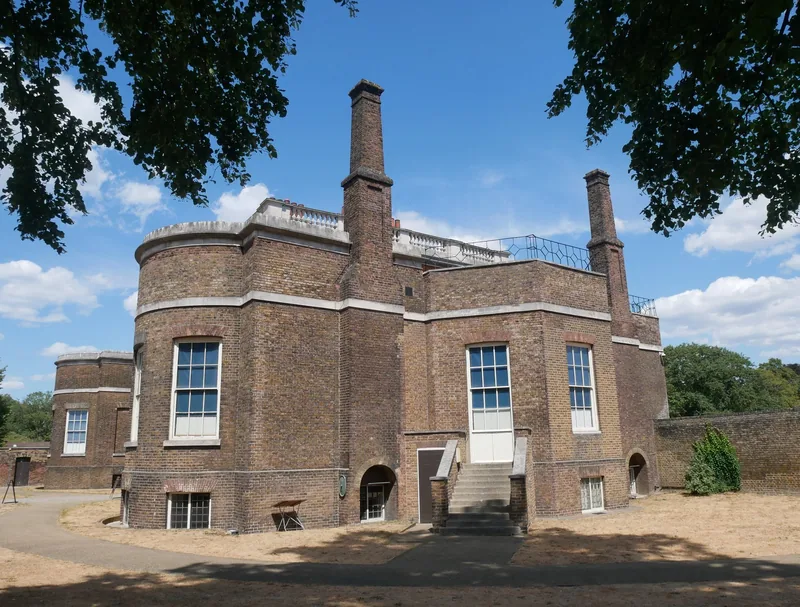
Photo: Doyle of London · CC BY-SA 4.0 · Wikimedia Commons · resized
The house, and the date nobody agrees on
The building is a red brick villa of seven bays with a Portland stone centrepiece, a pedimented Ionic doorcase and a single-storey wing at each end. It is listed at Grade I, which puts it in the top few per cent of protected buildings in England.
Two official sources give different dates for it. The statutory list entry, written from older records, says the house was "built circa 1690 by Andrew Snape". English Heritage's own research says something more precise and later: Andrew Snape, Serjeant Farrier to Charles II, occupied a strip of waste ground between the park and the heath in the 1670s without permission and had put up three houses by about 1688, one of them on this site; Captain Francis Hosier then demolished Snape's house and built the present villa in about 1722 to 1723, possibly to a design by John James, a clerk of works at the Royal Hospital for Seamen down the hill. Both statements are published by the same organisation. The sensible summary is that there was a house here from the 1680s and the one you can see was built in the early 1720s.
Hosier had four years in it. In 1727 he was sent to blockade Spanish treasure ships at Porto Bello, in what is now Panama, and died of yellow fever along with about 4,000 other seamen. The lease went eventually to Philip Dormer Stanhope, 4th Earl of Chesterfield, in 1748. Chesterfield added the gallery on the south side, nearly doubling the size of the house and pushing illegally through the park wall to do it, and wrote a great many of his famous letters here. Richard Hulse balanced it with a north wing after 1783. From 1807 it was home to Augusta, Dowager Duchess of Brunswick, sister of George III, and was known as Brunswick House; her daughter Caroline, Princess of Wales, lived next door at the now-demolished Montagu House and was Ranger of Greenwich Park from 1806. The house took its present name from that post.
The list entry is worth reading for what survives inside: a panelled hall with round arches, an early eighteenth-century staircase with a cut string and three turned balusters to each tread, the middle one fluted, carved step ends, fluted newel posts, and several original marble fireplace surrounds. There is an old London County Council plaque outside for Chesterfield and for Lord Wolseley, a later resident.
The Bridgerton question
Ranger's House is the exterior of the Bridgerton family's London house in the Netflix series, and English Heritage leads with that on its own page. If that is why you want to come, the good news is that the part you have seen on screen is the front, and the front is visible from a public footpath whether the house is open or not.
Chesterfield Walk runs along the park wall, and standing on it you are looking at the elevation used in the series. No ticket, no queue, no gate. Our guide to London's film and television locations covers the other addresses people go looking for.
Getting to Chesterfield Walk
The house is at the top of the hill, on the Blackheath side of Greenwich Park, which catches out anybody who assumes it is near the river. From Greenwich Park's river gates it is a climb of about 20 minutes. From Blackheath station it is flat: cross the heath towards the park wall and turn along Chesterfield Walk, about 15 minutes in all. Our guide to Blackheath covers the village at that end.
Blackheath is in fare Zone 3 and is served by trains from London Bridge, Cannon Street and Charing Cross. Cutty Sark on the DLR is the usual way into Greenwich, but it leaves you at sea level with the whole hill to walk. If the climb is a problem, the 53 and 54 bus routes run across the heath and along Shooters Hill Road, which puts you on the level much closer.
What to do on the day instead
Everything else on this hill is open, and most of it costs nothing. The National Maritime Museum and the Queen's House are both free, ten minutes downhill. The Fan Museum on Croom's Hill is the closest thing in the area to Ranger's House in spirit: a small collection of small things in a Georgian house, and it is open.
Be careful with one of them. The Royal Observatory closes on 2 November 2026 for rebuilding and is not due to reopen until the summer of 2027, so a day built around both the Observatory and Ranger's House will not work in any month of the next year.
If what you actually want is a great collection in a domestic house, the two obvious substitutes are both open and both free: the Wallace Collection in Manchester Square, which is the same idea on a much larger scale, and Kenwood on the edge of Hampstead Heath, which English Heritage also runs. Our list of free museums in London has the rest.
For the other English Heritage property in south-east London, Eltham Palace is about half an hour away by train and is the site English Heritage itself points visitors to when Ranger's House cannot help them.
Access, and two statements that do not match
English Heritage publishes two different explanations of the same problem. Its main Ranger's House page says visitors with limited mobility "will only have access to the ground floor of the house, as our interior chairlift is out of service". Its prices and opening times page says there "is no interior lift, and our exterior wheelchair platform is out of service". Both were on the site on 28 September 2026.
What is consistent is the outcome: the upper floor is not reachable without using stairs, and the arrangement is not working. English Heritage asks visitors with reduced mobility to telephone the site, or Eltham Palace, before travelling. Do that rather than relying on either sentence.
Do not build a Greenwich day around Ranger's House in 2026. English Heritage has published no opening dates for 2026 and none yet for 2027, and third-party listings that still show Wednesday-to-Sunday hours are repeating information from before the current arrangement. Telephone 020 8853 0035 or look at the English Heritage page on the day you book anything else.
If the 2027 dates appear
Three things to expect, based on how English Heritage was running the house when it last opened to general visitors.
- Booking will matter more than usual. A property that opens on a handful of dates sells those dates. English Heritage advertises 15% off for advance tickets across its sites, and the Ranger's House page carries that offer even now.
- Membership changes the sums. English Heritage membership starts at £44 a year and admits up to six children free with an adult member. If Ranger's House is one of three or four English Heritage sites on your list, that is usually cheaper than separate tickets. Prices read on english-heritage.org.uk, September 2026.
- Allow an hour and a half. This is a two-floor house with hundreds of very small objects in it. An hour is not enough to look properly and three hours is more than the building holds.
Frequently asked questions
Is Ranger's House open to the public?
Not in 2026. English Heritage's page for the property says it will be open on select dates in 2027 and that the dates will be released soon. No ordinary weekly opening hours were published for 2026, and no admission price is currently shown.
Can I see the Bridgerton house in Greenwich without a ticket?
Yes. The front of Ranger's House, which is the elevation used as the Bridgerton family home, faces Chesterfield Walk, a public path along the western wall of Greenwich Park. You can walk up to it and photograph it for nothing at any time, whether or not the house itself is open.
What is the Wernher Collection?
About 700 works of art collected around 1900 by Sir Julius Wernher, who made his fortune from South African diamonds and gold. It is unusually strong in medieval and Renaissance jewellery, ivories, enamels, bronzes and eighteenth-century French furniture, and it was given a permanent home at Ranger's House rather than being broken up.
How do I get to Ranger's House from central London?
The flattest route is a train to Blackheath, then about 15 minutes on foot across the heath to Chesterfield Walk. From the river side, take the DLR to Cutty Sark and walk up through Greenwich Park, which takes about 20 minutes and is steep. Buses 53 and 54 cross Blackheath close to the house.
Is Ranger's House the same as the Queen's House?
No. They are separate buildings at opposite ends of Greenwich Park. The Queen's House is the white Inigo Jones building beside the National Maritime Museum, it is free, and it is open. Ranger's House is a red brick villa on the Blackheath side of the park and is currently shut.
Sources
- English Heritage - Ranger's House and the Wernher Collection (checked September 2026)
- English Heritage - Ranger's House: prices and opening times, and the access statement (checked September 2026)
- English Heritage - History of Ranger's House: Andrew Snape, Francis Hosier and Lord Chesterfield (checked September 2026)
- English Heritage - Highlights of the Wernher Collection (checked September 2026)
- Historic England - The Ranger's House, list entry 1218679, Grade I (Internet Archive copy, 13 January 2026) (checked September 2026)
- Royal Museums Greenwich - Royal Observatory transformation and closure dates (checked September 2026)