
Fenton House and 2 Willow Road stand ten minutes' walk apart in Hampstead, and they are never open on the same day. Fenton House opens on Fridays, Sundays and bank holiday Mondays; 2 Willow Road opens on Thursdays and Saturdays. Both close for the winter: in 2026 the last days were Saturday 31 October and Sunday 1 November, and Fenton House says it is closed until spring 2027.
That is the first thing to know and almost nothing else says it. Two National Trust houses, both small, both worth an hour, in the same village, with opening patterns that interlock so precisely you cannot see both without staying two nights.
They are also two very different buildings. One is a merchant's house from the 1690s with a walled garden, an orchard and keyboard instruments that are still tuned and played. The other is a reinforced-concrete terrace of 1938 in which the architect lived until he died, left almost as he arranged it. Our Hampstead guide places both in the village.
Two houses, two timetables
- Fenton House and Garden
- Hampstead Grove, NW3 6SP. Fridays, Sundays and bank holiday Mondays, 11:00–16:00. Closed November to February
- Fenton House admission
- House and garden £14.00 adult, £7.00 child (5–17), £35.00 family; garden only £8.50 adult
- Fenton House booking
- None needed since 2026. Buy at reception on arrival
- 2 Willow Road
- NW3 1TH. Thursdays and Saturdays, 11:00–16:30, last entry 16:00
- 2 Willow Road admission
- £13.00 adult, £6.50 child (5–17), £32.50 family
- 2 Willow Road booking
- Compulsory. Tickets released on a Thursday two weeks ahead
- Under-5s and members
- Free at both
- Walk between them
- About 800 metres, downhill from Fenton House
The week, laid out
The figures below come from the National Trust's own day-by-day opening data for the 2026 season, read in September 2026.
| Day | Fenton House | 2 Willow Road |
|---|---|---|
| Monday | Closed (open bank holidays) | Closed |
| Tuesday | Closed | Closed |
| Wednesday | Closed | Closed |
| Thursday | Closed | 11:00–16:30 |
| Friday | 11:00–16:00 | Closed |
| Saturday | Closed | 11:00–16:30 |
| Sunday | 11:00–16:00 | Closed |
Between them they cover four days a week and overlap on none. In the whole published calendar for 2026 there was not a single date on which both were open, and no shared bank holiday Monday either.
Do not plan to see both in a day. A Friday or Sunday gets you Fenton House; a Thursday or Saturday gets you 2 Willow Road. If you want both, it has to be a Thursday and a Friday, or a Saturday and a Sunday, and 2 Willow Road has to be booked a fortnight ahead. What to book before you go to London covers the others like it.
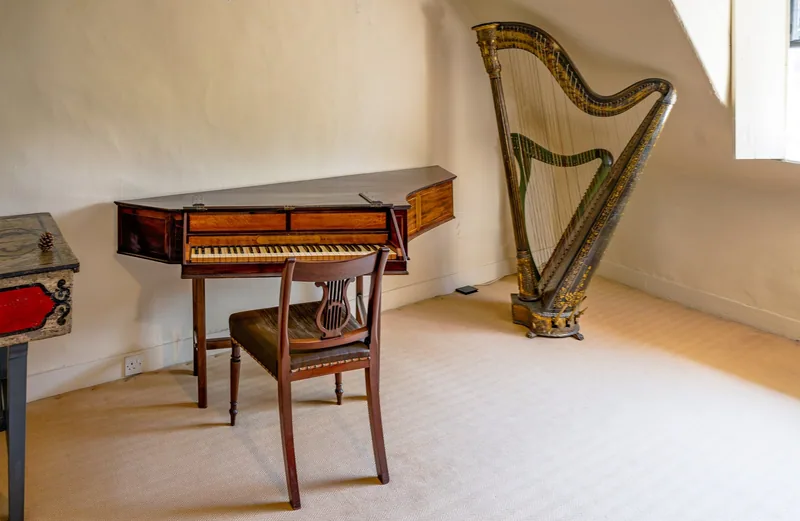
Photo: Tilman2007 · CC BY-SA 4.0 · Wikimedia Commons · resized
Fenton House: what it costs, and when it shuts for the winter
An adult ticket for the house and garden is £14.00, a child aged 5 to 17 is £7.00, a family of two adults and up to three children is £35.00, and one adult with up to three children is £21.00. If you only want the garden, that is £8.50 for an adult, £4.25 for a child, £21.25 for a family and £12.75 for one adult with up to three children. Under-5s and National Trust members are free.
The National Trust dropped pre-booking at Fenton House from 2026, so you now buy a ticket at reception on arrival. That makes the house a viable spur-of-the-moment stop on a Hampstead walk, provided the day is a Friday or a Sunday.
The winter close is long: house and garden shut from November to February. In 2026 the last open day was Sunday 1 November, and the National Trust now says the house is closed until spring 2027 (checked November 2026), so anyone in London in December, January or February should not plan on it.
The house itself, and the date on the chimney
Fenton House is listed at grade I, one of relatively few houses in London to hold the highest grade, and was first listed on 11 August 1950 as list entry 1378648, with the statutory address No 3, Hampstead Grove.
Its date is given differently in different places. Historic England's statutory description dates the house to about 1693 and notes that the date is scratched on the chimney-stack; many guides give 1686; the National Trust says only that it is 17th century. The scratched chimney date is the harder evidence, so treat the 1690s as the answer and 1686 as a tradition.
The rest of the list entry is the best free guide to the building: a detached house of brown brick with red brick dressings under a hipped tiled roof, two storeys with an attic and basement, with a central early 19th-century Roman Doric portico. Look for the blind window with a circular panel that once held a clock and is now inscribed "Fenton House 1963" – the house was Clock House in the later 18th century, and Ostend House before that.
The name comes from P I Fenton, a merchant trading with Riga, who bought the house in 1793 and probably carried out the early 19th-century remodelling. The last private owner, Lady Binning, made substantial changes around 1936, including the west extension, and left the house to the National Trust in 1952 with her porcelain collection. Even the garage is separately listed at grade II, as are the garden walls, gates and railings and four garden statues with a cistern.
The instruments, and the volunteer who plays them
The reason to choose Fenton House over the other historic houses of Hampstead is the keyboard collection. It holds harpsichords, spinets and other early instruments, the oldest dating from 1540, and they are not sealed behind glass: they are kept in playing condition, tuned weekly, and played on open days by volunteer musicians.
The house also runs volunteer-led tours in which a musician guides you through the collection and plays as you go. These are not sold as tickets: the Trust asks for a donation of £5 towards the cost of the tour or £10 to help keep the instruments in tune, and you sign up on the day at reception. Spaces are limited, so ask as soon as you arrive.
Hearing a 1540 instrument played in a panelled room is a very different experience from reading a label about one, and it is the best argument for the £14. If nobody is playing, the house is a pleasant hour rather than a memorable one.
The garden and the orchard
The walled garden is the other half of the ticket and the reason for the garden-only price. It runs on several levels behind the house, with a formal terrace, a kitchen garden and an orchard of old apple varieties, and it is one of the few substantial private gardens in inner London that visitors can walk around. The orchard is at its best in late September and October, which is also the end of the open season. Our guide to Hampstead Heath covers the larger green space five minutes further on, and London's free museums is the page to read if neither ticket appeals.
2 Willow Road: booking is the hard part
An adult ticket is £13.00, a child 5 to 17 is £6.50, a family of two adults and up to three children is £32.50, and one adult with up to three children is £19.50. Members go free but must still book.
Every visitor has to pre-book, and the release pattern is unusual: tickets go on sale on a Thursday, two weeks in advance. The Trust's own worked example is that tickets for Thursday 22 or Saturday 24 October are released on Thursday 8 October. Groups of more than ten must email, and there is no group discount.
Within the day the structure is fixed. Guided tours run at 11:00, 12:00, 13:00 and 14:00; from 15:00 to 16:30 you can go round unguided, with last entry at 16:00. The tour is better for a first visit, because the interior is full of things that need explaining, but the self-guided slot suits anyone who dislikes being shepherded.
There is a 25-minute film on the ground floor, and it is wheelchair accessible. If the stairs are a problem, or if the tour is full, the film is a genuine alternative rather than a consolation: it covers the house and the Goldfingers, and it is shown on the only level you can reach without steps.
1938 or 1939, and what Goldfinger built
Here the two sources disagree again. Historic England's list entry dates the terrace to 1938; the National Trust describes the house as a Modernist home "from 1939" and says Ernö Goldfinger designed it in 1939. Both are authoritative and we have not picked one.
What it is, though, is not in doubt. Numbers 1, 2 and 3 Willow Road are a terrace of three houses designed to read as one building, listed grade II* on 14 May 1974 as list entry 1379196. The structure is reinforced concrete faced in red brick, with floors carried on concrete columns and on a cylindrical drum from which the spiral staircase at the centre of each house is cantilevered. It replaced an 18th-century row of cottages, in what Goldfinger called an adaptation of 18th-century style, and the brick was a deliberate argument that modern buildings need not be white.
Goldfinger kept No 2, the largest of the three, and lived in it with his wife Ursula, an artist, until his death in 1987. Historic England calls its interior the principal surviving artistic interior from the 1930s in England, which is a strong claim for a terraced house in Hampstead.
What is actually inside 2 Willow Road
Almost everything, which is the point. The list entry describes a narrow entrance hall with a rubber floor and the top-lit spiral stair rising through the house on a slim steel balustrade. At its base stands a sculpture by Victor Pasmore, from their collaboration on the 1956 exhibition This is Tomorrow.
On the first floor the living room looks over the rear garden, with fitted bookcases and a curved frame around a stretch of wall above the fireplace for hanging paintings, and a study behind. In the centre of the floor is Goldfinger's own fitted work bench, set over a change in level, with pairs of sliding screens that turn the space into a studio. The dining room runs across the front with a broad window shelf and a table Goldfinger designed; the small kitchen beside it was added by him in the mid to late 1960s. The bedroom floor keeps much of its fitted furniture and a top-lit bathroom, and the lowest floor was divided off as a flat for the children.
The art on the walls is the other surprise: the Goldfingers bought work by their contemporaries, so a small Hampstead house holds pictures that would be respectable in a public gallery. Anyone who takes to it should go on to Brutalist London, since Goldfinger designed two of the towers in it.
Stairs, and what each house asks of you
Neither house is easy. At Fenton House the visitor lavatories are on the first floor, reached by stairs only, and there is no accessible toilet at all; there are also steps from the small parking area up to the house. Blue Badge parking is very limited and must be reserved by email. Cars and taxis can drop visitors at the gate on Hampstead Grove, and there is public cycle parking opposite it.
At 2 Willow Road the spiral stair is the only route between four levels, and the ground-floor film is the alternative. Parking on the small forecourt can be arranged for disabled visitors by email, though the Trust says the nearby public car park may be easier, and there is space to drop off on the street outside. Both houses offer a Braille guide, a photograph album of the rooms and seating.
Getting to each, and doing both properly
Fenton House is 300 yards from Hampstead station on the Northern line, about 0.2 miles up the hill from the centre of the village, or three-quarters of a mile on foot from Hampstead Heath on the Overground. 2 Willow Road is a quarter of a mile from Hampstead Heath Overground station and half a mile from Hampstead Tube, and the walk from Fenton House is about 800 metres, downhill, through the older streets.
The honest plan for both is a weekend: 2 Willow Road on Saturday, booked a fortnight earlier, and Fenton House on Sunday morning. That leaves both afternoons for the rest of Hampstead, which is a lot: Kenwood House is free and open daily, and Keats House and the Freud Museum are within twenty minutes' walk.
The Hampstead Pergola costs nothing and takes half an hour, and our round-up of London's best small museums has more houses of this kind.
Frequently asked questions
Can I visit Fenton House and 2 Willow Road on the same day?
No. Fenton House opens on Fridays, Sundays and bank holiday Mondays; 2 Willow Road opens on Thursdays and Saturdays. Across the National Trust's whole published calendar for 2026 there was no date on which both were open, so seeing both means two separate days.
Do I need to book?
For 2 Willow Road, yes: every visitor must pre-book, and tickets are released on a Thursday two weeks in advance. For Fenton House, no: the National Trust stopped pre-booking there from 2026 and you buy a ticket at reception on arrival.
When do they close for the winter?
Fenton House closes from November to February; its last open day in 2026 was Sunday 1 November, and it is closed until spring 2027. 2 Willow Road's calendar showed no open dates after Saturday 31 October 2026. Check the National Trust's site for the spring reopening dates.
Which one should I choose if I can only do one?
Fenton House if you want a garden, an orchard and the chance to hear early keyboard instruments played, and if you are travelling with children. 2 Willow Road if you care about twentieth-century design: it is a single preserved interior rather than a house museum, and it is the stronger and stranger visit.
How much is it for a family?
Fenton House charges £35.00 for two adults and up to three children for the house and garden, or £21.25 for the garden alone. 2 Willow Road charges £32.50 for the same family. Under-5s are free at both, and National Trust members pay nothing, though they still have to book at Willow Road.
Sources
- National Trust - Fenton House and Garden: opening calendar and admission prices (checked November 2026)
- National Trust - 2 Willow Road: opening calendar, tour times and admission prices (checked September 2026)
- Historic England - Fenton House, grade I, list entry 1378648 (statutory description read on an Internet Archive copy dated 1 January 2026, because the live site blocks our requests; checked September 2026)
- Historic England - Nos 1, 2 and 3 Willow Road, grade II*, list entry 1379196 (statutory description read on an Internet Archive copy dated 4 December 2021; checked September 2026)
- AccessAble - Fenton House and Garden access guide (checked September 2026)
- AccessAble - 2 Willow Road access guide (checked September 2026)